Medical Record Review for Attorneys: A Step-by-Step Guide
The production arrives Friday afternoon. The demand deadline is next month, the PDF is enormous, and someone has helpfully named it Medical Records Final Final. Your paralegal needs to know whether to start reading, chase missing providers, or cancel everything else.
Medical record review for attorneys is a verification process, not just a reading assignment. The work is to establish what the records support, identify what's missing or contradictory, and preserve a route from every material conclusion back to the original page. A readable chronology helps. A readable chronology that silently drops the inconvenient diagnosis does not.
Table of Contents
- What a 4,000-Page File Actually Costs You
- How to Request Records Without Losing Months
- How to Build a Verified Medical Chronology
- Red Flags Hiding in the Records
- How to Verify a Summary Before You Rely on It
- What to Delegate and What Stays With Counsel
- Start With One Open File This Week
What a 4,000-Page File Actually Costs You
Say that Friday production contains 4,000 pages of treatment notes, duplicate pages, overlapping provider documentation, imaging reports, medication histories, and billing material. It isn't one coherent chart. It's several providers' filing habits sharing a PDF.
Each category answers a different question. Treatment notes establish the documented clinical course. Imaging reports describe findings, medication histories track changes, and bills identify charges that still need reconciliation with the care documented.
Budget the work before assigning it
Ontellus describes an industry planning benchmark of about 100 pages per hour for an experienced reviewer, making a 4,000-page file roughly 40 hours of manual review before the key facts are organized. Treat that as a planning estimate, not a measured standard or a production quota.
Review time by medical file size
The following calculations use that benchmark and an illustrative schedule of six productive review hours per day, rounded up to whole reviewer days.
| File size | Manual review hours | Reviewer days (6 productive hours) |
|---|---|---|
| 500 pages | 5 hours | 1 day |
| 1,000 pages | 10 hours | 2 days |
| 2,500 pages | 25 hours | 5 days |
| 4,000 pages | 40 hours | 7 days |
| 10,000 pages | 100 hours | 17 days |
Those are review allocations, not delivery promises. Retrieval follow-up, unreadable scans, chronology preparation, clinical consultation, and quality checks need their own space on the calendar. A staff member with an already full caseload doesn't acquire additional capacity because the assignment is marked urgent.
The economics extend beyond staff time: a 2006 New England Journal of Medicine study of 1,452 closed malpractice claims reported that approximately 54 cents went to administrative expenses for every dollar paid in compensation, including lawyers, expert witnesses, and courts.
Planning rule: Set the review questions, assign actual staff capacity, and work backward from the deadline before anyone opens the first page.
Decide whether the immediate deliverable is case screening, expert preparation, a damages reconciliation, or a demand-ready summary. Otherwise, a conscientious reviewer can spend the available time producing something thorough that doesn't answer the attorney's question.
How to Request Records Without Losing Months
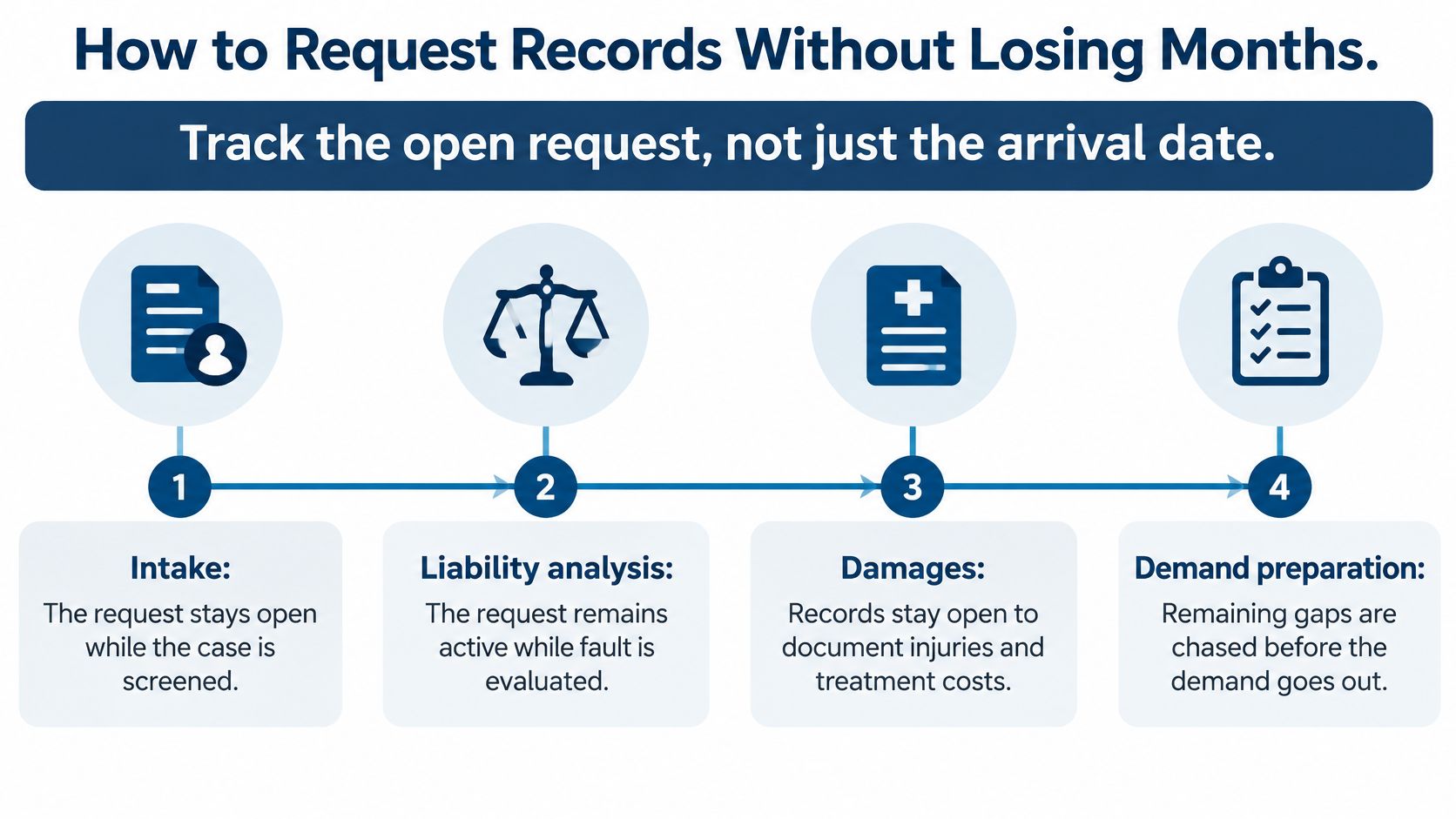
A records request can remain open through intake, liability analysis, damages evaluation, and demand preparation. Track it as active casework, not an email somebody sent and hopes the provider remembers.
Under HHS guidance on the HIPAA right of access, a covered entity generally must act on an individual's access request within 30 calendar days, with one additional 30-day extension permitted only when it provides a written explanation and expected completion date within the original period. That creates a practical maximum of up to 60 days for many patient-directed requests.
That clock isn't a universal deadline for every request bearing a law firm's letterhead. Requests made directly by counsel as a third party can involve different rules and fee treatment.
Choose the route before sending the request
Identify the record category, governing jurisdiction, and authority for disclosure before choosing between a patient access request, authorization, subpoena, or court order. Don't assume that a subpoena resolves every confidentiality restriction.
Retrieval route by record category
| Record category | Typical route | Timing to track |
|---|---|---|
| Treatment notes and test results | Signed HIPAA authorization or patient access request | Patient-access clock described above when applicable; confirm the rule governing an authorization request |
| Billing and itemized statements | Authorization or access request, plus provider billing request | Applicable access deadline and separate billing-department response |
| Imaging reports and image files | Separate requests for reports and image files | Track each production separately under its applicable request deadline |
| Psychotherapy notes | Separate authorization, subject to applicable exceptions | Confirm authorization requirements and governing disclosure deadline before sending |
| Substance use disorder records under 42 CFR Part 2 | Part 2-compliant consent or applicable court-order process | Confirm current Part 2 requirements, consent validity, and any court-controlled deadline |
The Attorney Assistant record-retrieval overview identifies February 16, 2026, as the enforceability date for amended Part 2 requirements and emphasizes the need to account for state confidentiality protections. State law can be stricter than HIPAA, so maintain a state-specific overlay rather than one supposedly universal request packet.
Use the firm's guide to acquiring medical records to turn the request process into an assigned workflow. Keep sensitive records in access-controlled systems and route disclosure questions to counsel.
Keep a tracker that produces decisions
At minimum, capture:
- Request date and authority: Record when the provider received the request and which disclosure route applies.
- Authorization status: Identify rejected, expired, incomplete, or category-specific forms.
- Provider response: Log acknowledgments, partial productions, and promised delivery dates.
- Deficiency notices: Assign a person to resolve each problem.
- Extension deadline: Preserve the notice and calculate the next escalation date.
Prepare a missing-records memo that distinguishes provider nonproduction from genuine absence. No records received is a retrieval status. No treatment occurred is a factual conclusion. They aren't interchangeable.
How to Build a Verified Medical Chronology
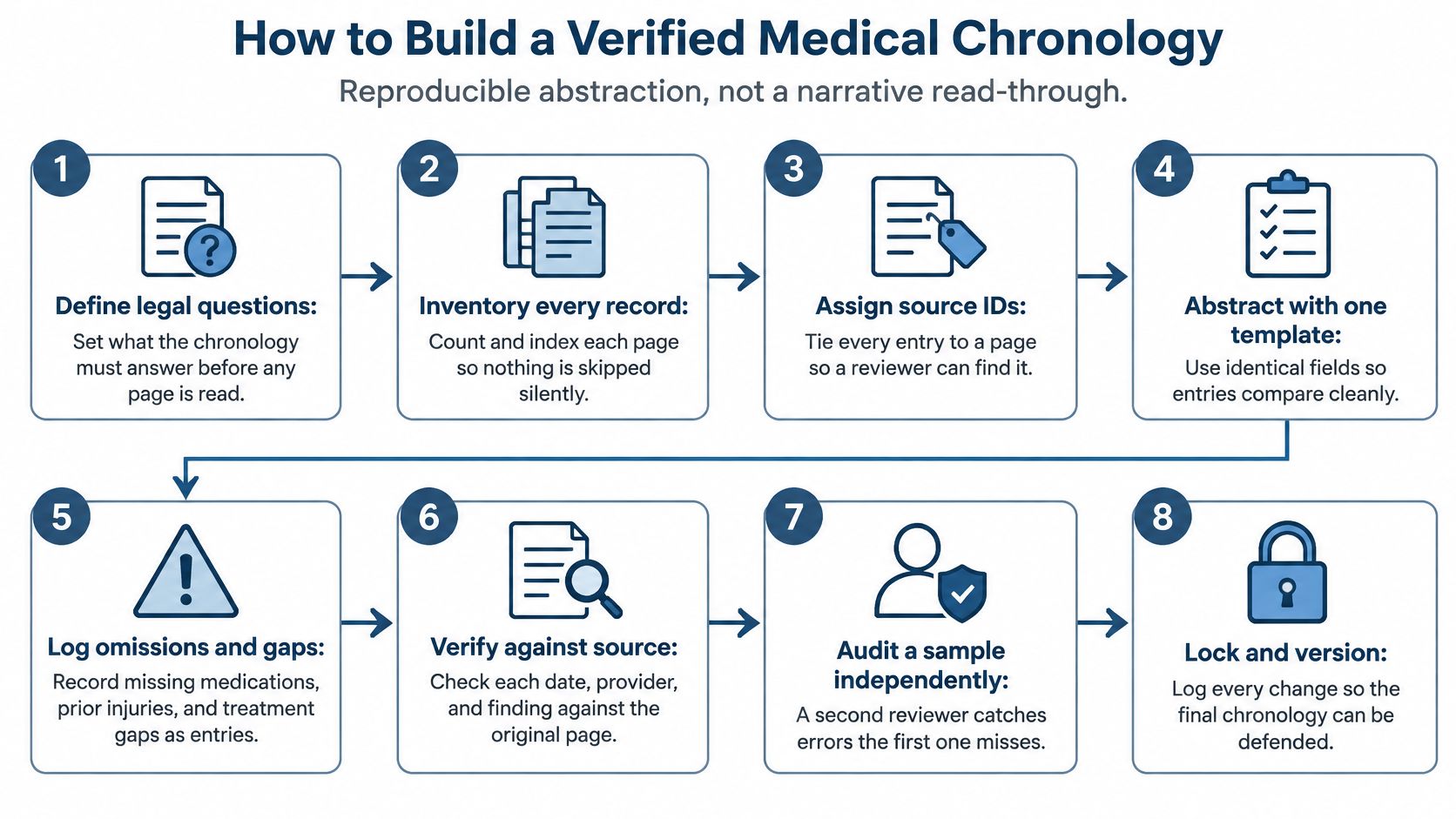
Build a chronology through reproducible abstraction, meaning reviewers extract the same kinds of information under written rules. A narrative read-through leaves too much dependent on what the reader happens to consider memorable.
American Bar Association guidance on medical records as legal documents emphasizes completeness checks, precise requests, indexing, authentication requirements, and an unbroken chain of custody. Those controls belong in the workflow, not in a cleanup exercise before a deposition.
Use a repeatable review sequence
- Define the legal questions and inclusion criteria. Establish the relevant injuries, time periods, and issues so the reviewer knows what the chronology must answer.
- Obtain the complete production. Inventory records, billing, imaging, and available metadata because missing inputs become missing conclusions.
- Preserve source files and provenance. Retain the original production and document who supplied it, when it arrived, and how it was received.
- Paginate, index, and organize chronologically. Give reviewers stable source references while distinguishing service dates from entry and signature dates.
- Extract events into structured fields. Capture dates, providers, symptoms, findings, diagnoses, treatment, documented causation indicators, and gaps.
- Maintain a separate issue log. Flag contradictions, late entries, missing results, medication changes, and unexplained delays without burying them in narrative.
- Assign an independent sample audit. Have another reviewer check a defined selection without relying on the first reviewer's reasoning.
- Reconcile disagreements before release. Resolve discrepancies, document changes, and version the attorney-facing summary.
Keep the source column visible
A spreadsheet can handle a straightforward file; case-timeline software can help when events need issue tags, linked evidence, and multiple users. For a practical comparison of those approaches, consult Lighthouse Legal's case timeline comparison. Choose based on traceability and review needs, not the attractiveness of the exported timeline.
Use fields like these. The entries below are hypothetical examples, not medical findings.
| Chronology field | Example entry |
|---|---|
| Date of service | February 12, with entry date recorded separately |
| Provider as printed | Provider name exactly as shown in the signature block |
| Source page or Bates reference | Stable Bates identifier plus original PDF page |
| Presenting complaint | Patient's description of pain, copied exactly when quoting |
| Findings and tests | MRI report describes an L4 to L5 disc protrusion |
| Diagnosis and treatment | Provider's diagnosis; physical therapy twice weekly |
| Documented causation indicator | Intake note reports a fall on 02/02; preserve the exact wording |
| Gaps and flags | No follow-up documented in the available production for nine weeks |
Keep the source column visible during review, not hidden several screens to the right. Support staff can draft first-pass entries, with attorneys approving material entries individually and qualified clinical reviewers addressing interpretation.
A reported fall is not an established cause. An imaging finding is not, by itself, proof of negligence. Preserve the distinction between documented fact, clinical interpretation, and legal theory.
Red Flags Hiding in the Records
A complete-looking chart can still mislead. The important facts may sit in different categories, and nobody discovers the mismatch unless someone deliberately compares them.
The Government Accountability Office's description of medical records includes diagnoses, billing information, medications, and test results. For litigation review, those categories serve different purposes: diagnoses and tests inform injury analysis, medications help reconstruct treatment, and billing supports reconciliation of claimed expenses.
Compare categories without collapsing them
Keep the clinical narrative and billing evidence separate. A charge can identify a service worth investigating, but it doesn't substitute for the provider's account of what happened. Likewise, a treatment note doesn't establish the amount paid, the outstanding balance, or the recoverable damages.
Red flags, why they matter, and the next step
| Red flag | Why it matters | Next step |
|---|---|---|
| Prior injury to the same body region missing from intake history | Pre-existing conditions may affect causation and damages | Request prior records for that body region and note the date range requested |
| Treatment gap longer than the plan suggests | Insurers and opposing counsel may question the explanation | Ask the client for the reason and document the answer with its source |
| Late entries or amended notes | The timing and content of an entry may require explanation | Request available audit trails or addenda through the appropriate process |
| Medication change absent from later notes | The treatment account or adverse-effect analysis may be incomplete | Reconcile against pharmacy records and relevant prescribing notes |
| Missing imaging report or unavailable films | Important diagnostic evidence remains unverified | Request the report and images separately |
| Billing with no matching clinical note | The production may be incomplete or the charge may require correction | Cross-check dates and service codes against notes |
| Duplicate pages with differing content | Reviewers could rely on the wrong version | Keep both versions and log the differences |
Use medical billing itemization to separate charges, adjustments, payments, and balances before preparing a damages figure. Adding every number on every statement is arithmetic, but it isn't reconciliation.
Don't turn a flag into an accusation. A late entry may have an ordinary explanation; a missing note may reflect an incomplete production rather than missing care. The reviewer's job is to identify the unresolved question and assign the next action, not fill the silence with a theory.
Every flag gets a page citation, a named owner, and a disposition. Otherwise, it's just a concern somebody plans to remember.
Preserve the explanation when the issue closes. If the client attributes a gap to an insurance delay, label that as the client's account until supporting documents establish more.
How to Verify a Summary Before You Rely on It
A clean chronology isn't necessarily a complete one. Invented statements attract attention because they can be checked; omissions are quieter. A missing medication, prior injury, treatment gap, or alternative diagnosis may never reach the attorney unless someone works from the source record toward the summary.
Clinical-summarization results described in coverage associated with a review of AI in malpractice disputes reported a 3.45% omission rate versus a 1.47% hallucination rate in one framework. Treat those as reported results from a particular evaluation, not a performance estimate for your firm's software.

Test the reviewer as well as the tool
Human review also needs calibration. A medical-record methodology study published in the American Journal of Epidemiology found that reviewers initially agreed on an average of only 3.4 of six judgment-dependent answers, with reliability improving to very good or excellent after six months.
Objective demographic fields performed better than judgment-heavy fields. That's a useful warning against assuming that accurate dates mean accurate interpretation.
Build a release protocol
- Pilot the abstraction form: Give reviewers the same blinded subset and compare their independent entries before assigning the full production.
- Measure agreement: Use Cohen's kappa for categorical fields and an appropriate intraclass correlation for continuous fields, with methodological help where needed.
- Retrain on disputed fields: Clarify definitions and add examples to a written data dictionary instead of telling reviewers to be more careful.
- Audit in both directions: Check material summary statements against their cited pages, then inspect source encounters for relevant facts the summary omitted.
- Control document versions: Log duplicate handling, preserve substantive differences, and record which production each entry uses.
- Require sign-off: Have an attorney or qualified reviewer approve the output and document unresolved limitations.
Sampling helps identify systematic problems, but it doesn't establish that every unreviewed entry is correct. Review material causation statements, disputed dates, significant diagnoses, and damages inputs directly rather than leaving them to random selection.
Use approved AI-enabled systems for organization and extraction only within the firm's confidentiality controls. Keep medical interpretation with qualified clinicians and legal conclusions with counsel; an automatically generated paragraph doesn't acquire authority because it reads smoothly.
A polished chronology isn't complete until the team can show what was searched, what was unavailable, and which conclusions remain uncertain.
What to Delegate and What Stays With Counsel
Repeatable work can move to support staff. Professional judgment stays with counsel or a qualified expert. That split creates capacity without pretending that organizing a chart and interpreting it are the same assignment.
Many firms already use outside support: the 2024 U.S. Legal Support litigation-support survey of more than 1,000 legal professionals found that 47.40% of surveyed law firms relied on external vendors for medical-record retrieval. Retrieval, however, is only one part of the workflow.
Assign ownership, not just tasks
Delegation split for medical record review
| Task | Delegate to support staff? | Attorney or qualified reviewer decides |
|---|---|---|
| Records requests and deadline tracking | Yes | Attorney reviews deficiency notices and escalations |
| Pagination, indexing, and Bates labeling | Yes | Attorney spot-checks the index |
| First-pass chronology from the template | Yes, with a second check | Attorney approves each material entry |
| Billing tabulation and lien totals | Yes | Attorney approves damages figures |
| Draft summary of the clinical course | Draft only | Attorney or qualified reviewer signs off |
| Causation and standard-of-care opinions | No | Attorney with a qualified expert |
| Expert selection and litigation strategy | No | Attorney |
A medical records coordinator can own request follow-up, production inventories, and escalation queues. That ownership matters more than the job title. If everyone is responsible for checking the provider portal, nobody is reliably responsible for checking the provider portal.
Attorney Assistant's Staffline is one option for dedicated support alongside an internal coordinator or specialized retrieval vendor. Its full-time legal support professionals work inside the firm's systems on tasks such as records and bill retrieval, file opening, and lien reduction; the firm teaches its specific procedures, while performance is co-managed. Attorneys retain approval over work that feeds a demand or filing.
Write the handoff before work starts
Document the protocol, template, permitted actions, escalation triggers, and sign-off rules before assigning the file. Specify whether staff may correct an index, resend an authorization, contact a client about missing provider information, or must first obtain approval.
An external team doesn't remove the need for supervision. Nor does an internal employee automatically know the partner's preferred treatment of conflicting dates. Written instructions make both arrangements more reliable.
Judge the arrangement by completed, usable work: unresolved requests with owners, traceable chronology entries, reconciled billing, and timely escalations. Hours logged are useful for planning. They aren't proof that the file is ready.
Start With One Open File This Week
Start with a contained pilot, not a firm-wide overhaul announced in an email everyone will save for later. Choose a file where the result will affect an actual decision.
- Select an open matter with a near-term demand or filing date and name the attorney responsible for the deliverable.
- Estimate the review allocation using the planning method above, then compare it with staff availability after existing commitments.
- Open the working documents: the request tracker, chronology template, and red-flag log.
- Assign an independent audit of a defined sample and record every disagreement, including how it was resolved.
- Write the delegation rules before transferring tasks, including who approves material entries and damages inputs.
- Review the bottleneck afterward: distinguish provider delays, extraction problems, clinical questions, and simple lack of staff capacity.
If the same backlog returns, the conversation is about capacity and workflow ownership, not another reading marathon. Dedicated Staffline professionals can carry records and bill retrieval, file opening, and lien-reduction support under the firm's procedures, while attorneys retain the decisions that require their judgment.
Medical record review for attorneys works when someone owns the process from outstanding request to approved work product. Look at where records time is being lost this month before adding another urgent assignment to the same overloaded person.
Attorney Assistant offers dedicated legal support staff for records retrieval, case administration, and other operational work inside your firm's workflows. Visit Attorney Assistant to discuss where a Staffline professional could take ownership of your records backlog, with clear procedures and attorney sign-off.
Related Articles

Medical Records Coordinator: What the Role Actually Does
A medical records coordinator manages records retrieval, summaries, billing, and liens for law firms. Learn duties, KPIs, and when to outsource vs hire.

Medical Records Request: A Practical Guide for Law Firms
Run a clean medical records request with HIPAA-compliant steps, sample language, timelines, fees, and follow-up tactics built for law firm operations.

Case Management App for Law Firms in 2026: How to Choose
Compare case management app options for law firms on intake, documents, calendaring, security and pricing, with a checklist to pick the right fit.