9 Signs of Ineffective Client Intake at Your Law Firm

TL;DR:
- Effective client intake relies on quick responses, structured follow-up, and building trust through human interaction. Tracking KPIs like response time, win rate, and lead loss rate helps identify and address process failures. Firms that prioritize accountability and balance automation with personal contact experience higher conversion rates and revenue growth.
Ineffective client intake is defined as any breakdown in the process that prevents a qualified lead from becoming a signed client. For law firms, these breakdowns are not abstract. They show up as unanswered calls, leads that never receive a second contact, and intake forms that collect data but build no trust. Firms responding to leads within 5 minutes convert 400% more cases than slower competitors. That single statistic reframes the problem: most firms do not have a lead generation problem. They have an intake execution problem.

1. Signs of ineffective client intake start with slow response time
Delayed response is the most measurable and most damaging sign of a broken intake process. Prospects evaluate multiple firms simultaneously, and lead decisions happen within minutes. A firm that calls back three hours later is not competing. It is conceding.
Speed-to-lead is the single largest factor impacting case growth and marketing ROI. When a firm spends money on advertising and then fails to respond quickly, it is paying to send clients to competitors. The math is straightforward and painful.
Measuring your current response time is the first step. Pull call logs and CRM timestamps for the last 30 days. Calculate the average time between first contact and first human response. If that number exceeds 15 minutes during business hours, you have a confirmed intake failure.
- Track response time as a standing KPI, not a one-time audit
- Set coverage protocols for lunch hours, evenings, and weekends
- Use automated acknowledgments to confirm receipt while a human prepares to call
Pro Tip: An automated text confirming receipt of a contact form buys goodwill and time. It does not replace the call. Send the text within 90 seconds and make the call within 5 minutes.
2. Leads falling through the cracks signal tracking and follow-up gaps
A single call attempt followed by silence is not follow-up. It is abandonment. One voicemail without further contact loses qualified prospects who simply did not answer on the first try. This pattern is one of the clearest red flags in client intake.
Inconsistent CRM usage makes this problem invisible. When intake staff skip logging calls, notes, or outcomes, managers cannot see the pipeline accurately. A lead that looks “contacted” in the system may have received one voicemail three weeks ago and nothing since.
Structured multi-step follow-up is the fix. A documented sequence of at least three to five contacts across phone, email, and text, spread over seven to ten days, captures prospects who were genuinely interested but unavailable. Without that structure, your team stays busy without converting.
- Log every contact attempt in your CRM with a timestamp and outcome
- Set a minimum follow-up sequence of three attempts before marking a lead inactive
- Review “no contact” leads weekly to catch prospects who slipped through
- Track consultation booking rates and referral statuses as outcome metrics
- Use CRM reports to coach staff on follow-up consistency, not just call volume
Pro Tip: Reviewing lost leads monthly is more valuable than reviewing active ones. Lost leads show you exactly where the process broke down and which staff members need coaching.
3. Treating intake as form-filling removes the human connection clients need
Intake is not a form. It is the first substantive interaction a potential client has with your firm, and it sets the tone for everything that follows. When firms reduce intake to data collection, they lose the opportunity to build trust at the moment it matters most.
Clients who receive only an automated confirmation after submitting a contact form often choose competitors who called them directly. The form collected the data. The competitor won the case. This is poor client onboarding in its most common form.
The first human touchpoint must be timely, personal, and purposeful. The intake caller should acknowledge the client’s situation, confirm the firm can help, and set clear next steps. That conversation does more for conversion than any automated workflow.
- Train intake staff on active listening and empathy, not just data entry
- Write and test a call script that covers qualification, emotional acknowledgment, and next steps
- Measure call quality through recorded reviews, not just call duration
- Avoid over-relying on intake automation tools as a substitute for human judgment
Automated scheduling and reminders support the process. They do not replace the conversation that converts a prospect into a client.
4. Unstructured intake submissions create downstream chaos
Informal emails and loosely defined forms prolong intake-to-signature cycle times and create duplicated effort across departments. When intake data arrives inconsistently, every downstream step requires someone to chase missing information.
The client experience suffers visibly. A prospect who submits a contact form and then receives three follow-up requests for the same information perceives the firm as disorganized. That perception damages trust before the engagement even begins.
| Intake method | Typical outcome |
|---|---|
| Informal email thread | Missing fields, inconsistent data, manual re-entry required |
| Structured intake form | Complete data capture, direct CRM import, faster case setup |
| Progressive disclosure form | Higher completion rates, reduced friction, better lead quality |
| Verbal intake only | No documentation trail, high error rate, compliance risk |
Structured intake forms with defined required fields eliminate most of this friction. Progressive disclosure increases completion rates by presenting questions in logical stages rather than overwhelming prospects with a single long form. Centralizing all intake data in one CRM record removes the need for cross-department data requests.
Incomplete intake submissions cause stalled approvals and client dissatisfaction. The fix is governance: assign ownership of each intake step, define what “complete” looks like, and audit submissions weekly.
5. No defined qualification criteria means wasted time on wrong-fit leads
An intake process without qualification criteria is not a process. It is a conversation. Staff who lack clear guidelines on case type, jurisdiction, damages threshold, or conflict checks spend time on leads the firm will never sign. That time comes directly out of capacity for qualified prospects.
The intake-to-onboarding handoff is a frequent failure point where collected data is not transferred accurately or on time. When qualification criteria are undefined, the handoff becomes even more unreliable. Cases that should have been declined early consume attorney time during consultation.
Build a written qualification checklist that intake staff complete before scheduling any consultation. Include case type, geographic eligibility, statute of limitations status, and conflict check confirmation. This protects attorney time and improves the quality of your consultation pipeline.
6. Measuring the wrong KPIs hides intake performance problems
Tracking call volume and form submissions tells you how busy your intake team is. It does not tell you how effective they are. Firms that confuse activity metrics with performance metrics consistently underestimate their intake failure rate.
Tracking three KPIs drives measurable improvement: win rate (leads converted to signed clients), response speed (time from first contact to first human reply), and lead loss rate (qualified leads that did not sign). These three numbers expose exactly where the process is breaking down.
Ignoring these metrics creates data overload without direction. A firm tracking 20 intake metrics but not these three is flying blind on the questions that matter most. Simplify your dashboard and focus on the numbers that connect directly to revenue.
7. Inconsistent intake scripts produce inconsistent conversion rates
When each intake staff member handles calls differently, conversion rates vary by person rather than by lead quality. That variance is a sign of bad client management at the process level. It means your results depend on who answers the phone, not on how good your intake system is.
Documented call scripts solve this. A script is not a rigid reading exercise. It is a framework that covers qualification questions, empathy language, objection responses, and next-step commitments. Staff who follow a tested script convert at higher rates than those improvising, regardless of individual skill level.
Review call recordings monthly and compare conversion rates by staff member. Large gaps between top and bottom performers almost always trace back to script adherence, not talent. Use those gaps to refine the script and target coaching.
8. No coverage outside business hours creates a predictable revenue leak
Most personal injury, family law, and criminal defense inquiries arrive outside the 9-to-5 window. A firm with no after-hours coverage is declining every lead that calls at 7 p.m. on a Tuesday. Those leads do not wait until morning. They call the next firm on the list.
The highest-ROI improvement for most firms is investing in intake speed and quality rather than more marketing spend. After-hours coverage is the clearest application of that principle. The leads are already there. The firm is simply not answering.
Coverage options include trained answering services, on-call intake staff, and structured callback protocols with automated acknowledgment. The right solution depends on call volume and practice area. The wrong solution is doing nothing.
9. No post-intake review process means repeating the same mistakes
Firms that do not review intake outcomes cannot improve them. If no one is analyzing which lead sources convert, which staff members close at higher rates, or which case types stall before signing, the same inefficiencies repeat indefinitely.
A monthly intake review meeting with defined agenda items takes less than an hour and produces more operational clarity than any software purchase. Review win rate by lead source, response time averages, and the top three reasons leads did not convert. Assign ownership of each improvement action before the meeting ends.
Lean KPI measurement focused on win rate, response time, and lead loss drives coaching that actually changes behavior. Without that review loop, intake remains a cost center rather than a growth driver.
Key takeaways
Ineffective client intake is a measurable operational failure, and fixing it requires tracking win rate, response speed, and lead loss rate as the three non-negotiable KPIs.
| Point | Details |
|---|---|
| Response speed is the top priority | Firms responding within 5 minutes convert 400% more leads than slower competitors. |
| Follow-up must be structured | A minimum of three to five contact attempts per lead prevents qualified prospects from being abandoned. |
| Human contact drives conversion | Automated tools support intake but cannot replace the first personal call that builds client trust. |
| Structured forms reduce rework | Defined intake fields and CRM integration eliminate downstream data gaps and client friction. |
| Three KPIs reveal everything | Win rate, response speed, and lead loss rate expose exactly where intake is breaking down. |
What I’ve learned from watching firms diagnose their own intake
I have reviewed intake processes at firms that were convinced their problem was lead volume. In almost every case, the real problem was that existing leads were not being worked properly. One firm was generating 80 inquiries a month and signing 12 cases. When we mapped the follow-up sequence, we found that 60% of leads received exactly one contact attempt. The firm was not short on leads. It was short on process.
The firms that improve fastest share one trait: they measure before they change anything. They pull response time data, review CRM completion rates, and listen to call recordings before spending a dollar on new tools or staff. That discipline is rare, and it is the difference between fixing intake and just adding complexity to it.
The uncomfortable truth is that most intake failures are not technology problems. They are accountability problems. Scripts exist but are not followed. CRM fields exist but are not filled. Follow-up sequences are defined but not enforced. The solution is not a new platform. It is a manager who reviews the numbers weekly and holds the team to the standard.
I would also push back on the instinct to automate everything. Intake software should support human processes, not replace the first conversation that determines whether a prospect trusts your firm. The firms with the best conversion rates use technology to handle logistics and humans to handle relationships. That balance is not complicated. It is just consistently undervalued.
— Nicole
How Attorneyassistant helps firms stop losing leads they already have
Most firms that come to Attorneyassistant are not struggling to generate interest. They are struggling to convert it. Missed calls, single-attempt follow-up, and intake processes that rely on whoever happens to answer the phone are costing firms signed cases every week.
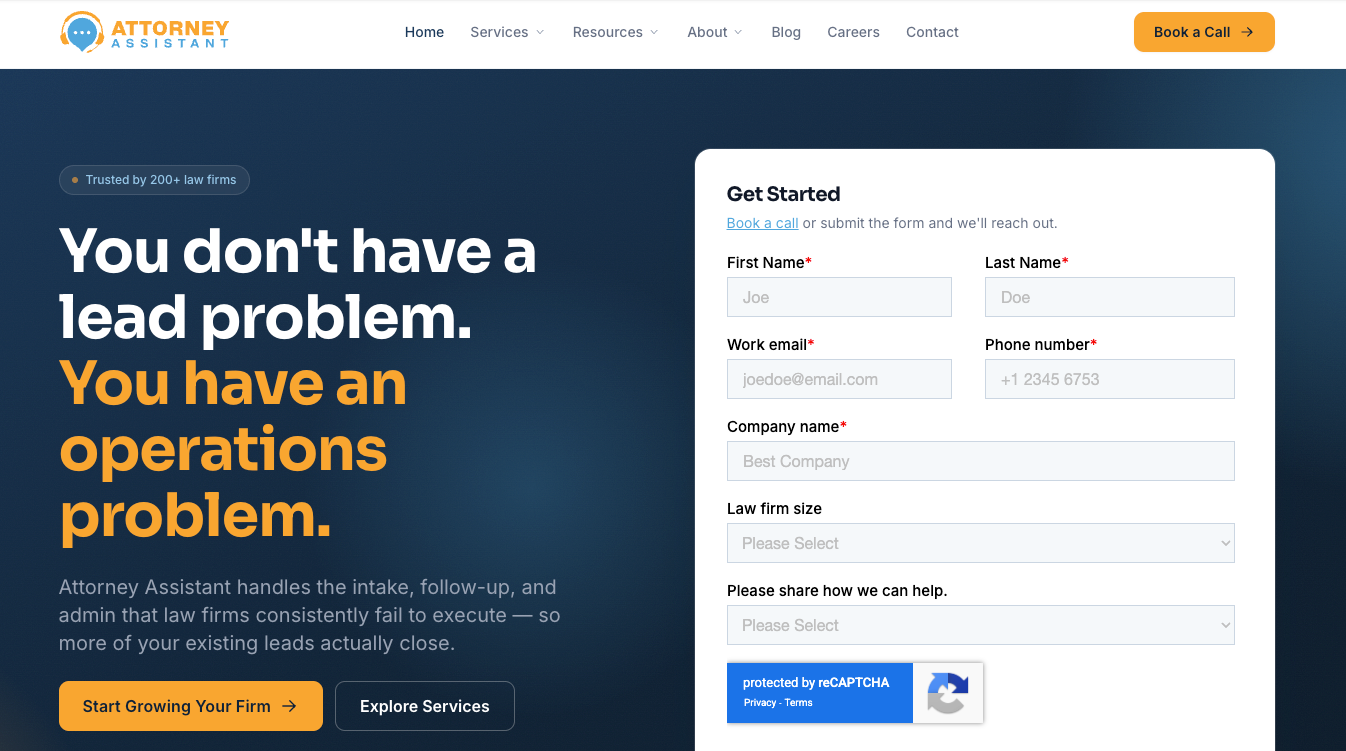
Attorneyassistant handles lead follow-up and intake workflows so firms respond faster, work every lead through a structured sequence, and reduce the internal chaos that comes from unmanaged intake. If you want to see exactly where your firm is leaking revenue, book a call and we will walk through your intake numbers together. No pitch. Just a clear diagnosis.
FAQ
What are the most common signs of ineffective client intake?
The most common signs are slow response times, single-attempt follow-up, inconsistent CRM usage, and no defined qualification criteria. Each of these directly reduces the number of qualified leads that convert to signed clients.
How quickly should a law firm respond to a new lead?
Firms should respond within 5 minutes of receiving a new inquiry. Research shows that responding within 5 minutes produces 400% higher conversion rates compared to firms that respond hours later.
What KPIs should law firms track to measure intake performance?
Track three KPIs: win rate, response speed, and lead loss rate. These three numbers identify exactly where the intake process is breaking down without creating data overload.
Why does over-automation hurt client intake?
Over-automation removes the human interaction that builds trust early in the client relationship. Clients who receive only automated responses often choose competitors who made direct personal contact first.
How does poor intake affect law firm revenue?
Poor intake creates a direct revenue leak by losing qualified leads that were already in the pipeline. Improving intake speed and quality delivers a higher return than increasing marketing spend on new leads.
Recommended
Related Articles

Master legal intake to boost PI case conversions by 40%
Learn how optimized legal intake processes increase personal injury case conversions by 40% through faster follow-up, multi-channel outreach, and smart screening.

Case Management Notes: A Law Firm's How-To Guide
Learn how to write case management notes that hold up, with a defensible structure, privilege safeguards, handoff tips, and a smarter way to staff the work.

Medical Records Coordinator: What the Role Actually Does
A medical records coordinator manages records retrieval, summaries, billing, and liens for law firms. Learn duties, KPIs, and when to outsource vs hire.