Your calendar is full. That's supposed to be good news, until you look closer. Half the consultations are with people who can't sign, don't fit the practice area, or booked through an open link because Tuesday at 2 p.m. looked convenient. Meanwhile, the prospect who fit called at 8 p.m., got voicemail, and never heard back.
That's the problem with appointment setting for B2B work. Booked meetings are an output, not the goal. If you measure reachability, qualification, and held meetings separately, you can see where good opportunities leak out before you fill another week with expensive small talk.
Table of Contents
- Where Appointment Setting Fits in the B2B Sales Process
- Speed to Lead and After-Hours Coverage
- How to Run an Appointment Setting Workflow Step by Step
- Qualification Criteria That Separate Real Meetings From Noise
- Outreach Cadences That Reach Busy Buyers
- The Role of Virtual Staff in Appointment Setting
- Metrics That Show Whether Appointments Are Working
- Confirm Your Scorecard Before You Scale Outreach
Where Appointment Setting Fits in the B2B Sales Process
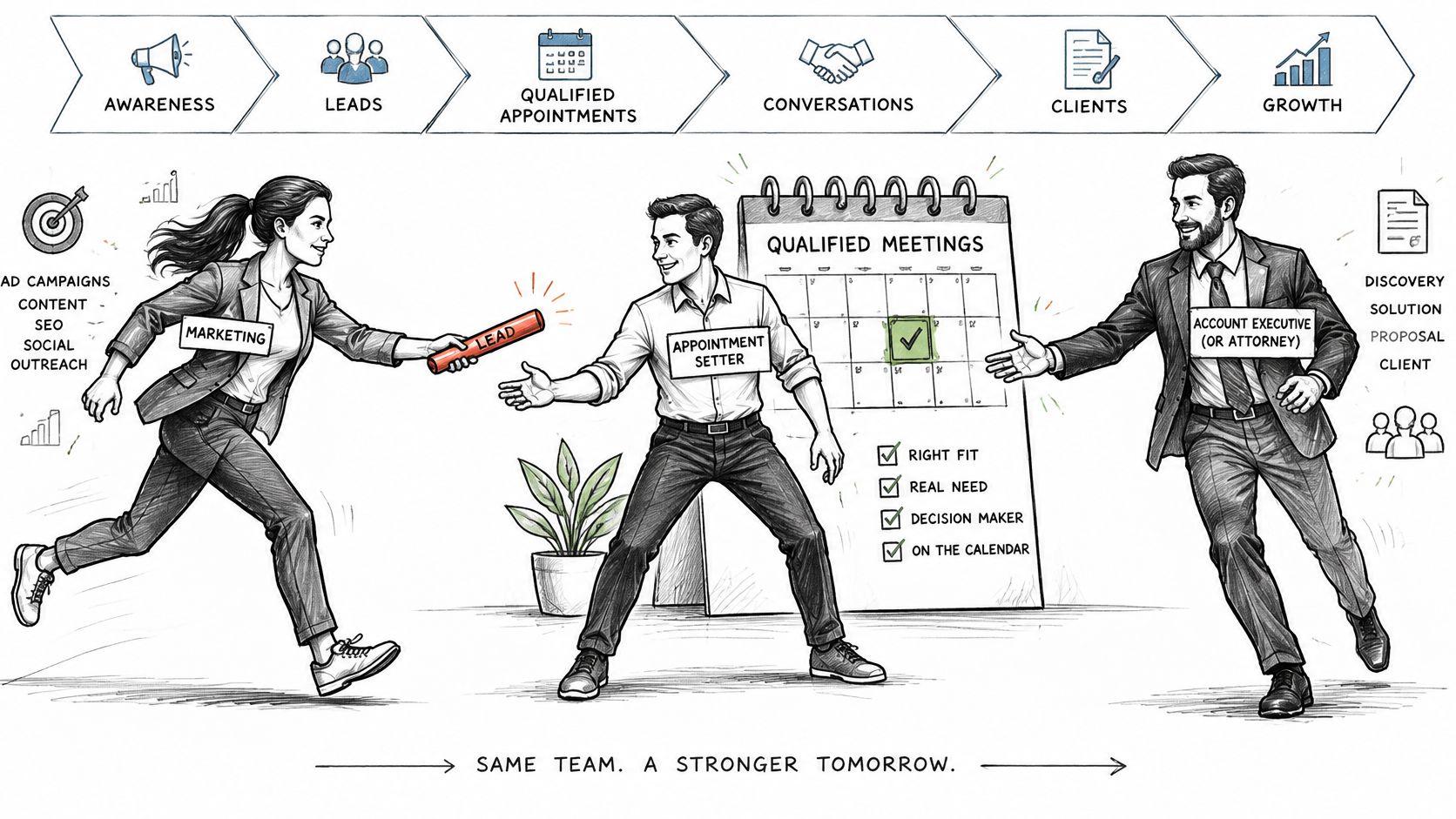
Think of it as a relay. Marketing runs the first leg by generating an inquiry. The appointment setter carries it to a qualified calendar slot. The account executive or attorney runs the rest. Drop the baton at any handoff and nobody finishes, however fast the first runner was.
Appointment setting is the work of turning interest into a scheduled conversation with someone who's agreed to attend and can act on it. A booked meeting with a prospect who has no budget, no authority, and no timeline isn't pipeline. It's an expensive coffee.
If you're sorting out early-stage roles, it's worth clarifying what prospecting means in sales before assigning who owns first contact.
Who Owns Each Stage of the Appointment Pipeline
| Role | Owns | Stops at | Hands off |
|---|---|---|---|
| Marketing | Generates and tags inquiries | Inquiry capture | Inquiry with source and timestamp |
| Appointment setter | First contact, qualification and booking | Confirmed slot with a brief | Calendar invite and qualification notes |
| SDR | Outbound prospecting and early nurture | Interest confirmed | Lead with context and history |
| Account executive or attorney | Discovery, proposal and decision | Proposal, retainer or decline | Closed opportunity or declined fit |
| Virtual assistant | Confirmations, reminders, file prep and CRM updates | Task completed and logged | Updated record for the setter or attorney |
A booking is only complete when the person running the meeting gets a short brief covering need, timing, decision-maker, and open questions. Say a law firm's intake specialist books the consultation. The attorney still decides fit, conflicts, and jurisdiction. The setter's job is to make sure the attorney isn't discovering a conflict three minutes into the call.
Speed to Lead and After-Hours Coverage
Speed to lead is the gap between an inquiry arriving and a human making the first attempt. An auto-reply does not count. A person does.
A 2025 study by Hennessey Digital of 1,333 U.S. law firms found a median first response of 13 minutes, with only 25% responding within five minutes and 26% not responding within seven days, as reported in the Hennessey 2025 lead form response time study. Vendor summaries of lead response benchmarks point the same direction: the longer a web inquiry sits, the worse the odds of ever qualifying it.
Be careful about what counts as a response, though. An automated acknowledgement may register in that data, but it doesn't qualify a matter, answer a question, or secure a slot. Count only human first attempts in your own measurement.
How to Measure It Without Lying to Yourself
Stamp five moments for every inquiry: receipt, first attempt, contact, qualification, and booking. Then calculate the median and 90th percentile response time. Averages hide the slow cases, and the slow cases cluster at night and on weekends.
Those five stamps also show you where leads leak. High contact rates with low qualification means the wrong people are getting through. Strong qualification with weak bookings means scheduling is the bottleneck. Track each stage separately and a booked meeting stops being the goal. It becomes the output of a workflow where reachability, qualification, and held meetings each hold up on their own.
Practical rule: If your 90th percentile is measured in days, you don't have a speed problem during office hours. You have a coverage problem outside them.
Set a written rollover rule. At close of business, new inquiries route to live coverage immediately, and you test that rule like you'd test a fire alarm. An inquiry at 9:40 p.m. on a Friday that waits until Monday has cooled for two days while competitors were awake.
Set your own response window and measure against it rather than copying someone else's number. Our breakdown of the advantages of fast lead response walks through how to pick a window your team can reliably hold.
How to Run an Appointment Setting Workflow Step by Step
Follow one inquiry through. Say a former employee emails a hypothetical employment law firm at 4 p.m. on a Tuesday about a termination. This is what should happen, and where it usually breaks.
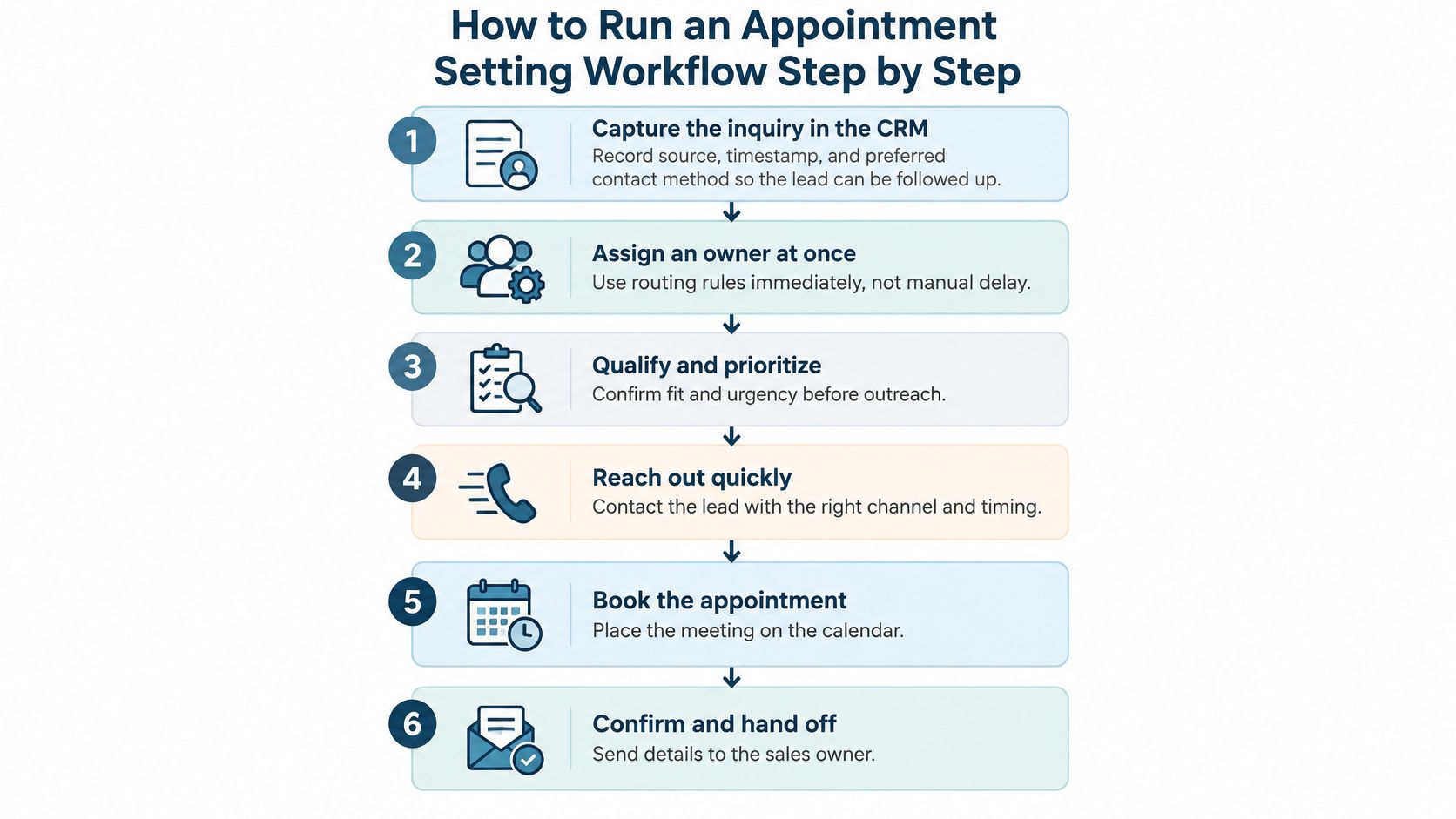
The sequence below shows the workflow at a glance before the step-by-step detail.
The Eight Steps
- Capture the inquiry in the CRM. Record source, timestamp, and preferred contact method. Your CRM cannot follow up with a lead if nobody puts the lead in the CRM. The common slip is leaving the inquiry in someone's inbox.
- Assign an owner at once. Use routing rules, not a shared inbox everyone assumes someone else is watching. In our example, a named intake specialist owns the record within minutes.
- Make the first attempt inside your response window. Log every attempt with its outcome. Technically, calling someone back four days later is follow-up. It is not particularly useful follow-up.
- Run the qualification questions. Tag the result as qualified, not ready, not a fit, or unreachable. Don't use "pending" as a parking lot.
- Offer two specific time slots. An open calendar link invites unqualified prospects to book prime attorney time. Two concrete options make booking a single reply, then confirm the chosen slot in writing.
- Send the handoff brief. Cover need, timing, decision-maker, and open questions so the consulting attorney walks in prepared, not curious.
- Send reminders and recover no-shows the same day. A missed consultation gets a recovery attempt that day, while the prospect still remembers booking it.
- Record the final disposition. Unreachable prospects return to a cadence with a reopen date instead of dying in a dead file.
This short walkthrough shows how the handoffs look in practice.
After-hours inquiries follow the same eight steps. The only difference is who makes the first attempt. The workflow shouldn't change just because the office lights are off.
Qualification Criteria That Separate Real Meetings From Noise
Qualification is a set of questions with pre-agreed answers. It isn't a feeling about whether the caller sounded serious.
BANT, covering Budget, Authority, Need, and Timing, is a reasonable starting point. Many groups require two additions: a fit criterion, and for legal intake, a conflict and jurisdiction check. Without those, you'll book polished meetings that were never winnable.
Before the call, use a short pre-qualification form that lets prospects answer the basic criteria in their own words. Keep the form to the same criteria as the table below. A question the form asks but the setter never follows up creates a second, inconsistent standard, and your setters will follow whichever one is easier.
Qualification Criteria With Qualified and Disqualifying Signals
| Criterion | Question to ask | Qualified signal | Disqualifying signal |
|---|---|---|---|
| Authority | Who else signs off on this decision? | Speaks for budget or can name the approver | Gathering information for someone with no access |
| Need | What problem would solve this now? | Names a specific, current pain | Vague interest with no stated problem |
| Timing | When does this need to be resolved? | Defined window within the next quarter | Undefined someday timeline |
| Budget or scope | What range of spend or matter size are you working with? | Within the service range | Outside the range with no path to adjust |
| Fit | Does this match what we deliver? | Matches a service line or practice area | Outside the service line or practice area |
| Conflicts and jurisdiction | Who are the other parties and where did this happen? | Screened and within jurisdiction | Conflict flagged or outside jurisdiction |
Watch for partial qualification. A prospect with a real need and real timing but no authority shouldn't be turned away. Route them to the person who holds authority, with the context attached.
Say a personal injury inquiry involves a matter outside the firm's jurisdiction. The right move is a referral note, not a consultation that wastes the prospect's afternoon and the attorney's hour. I would rather a setter protect the calendar and take a short-term booking dip than defend a full schedule of wrong meetings.
Agree the definition of qualified in writing with whoever runs the sales or consultation meetings. Then review ten recent calls each week to check the criteria are applied the same way by every setter. Our guide to lead qualification services covers how to document that definition so it survives staff turnover.
Outreach Cadences That Reach Busy Buyers
A first meeting usually takes several touches, not one call and one hopeful email. Research cited by WeLevel from RAIN Group, involving 489 sellers and 488 buyers, found that booking a first meeting with a new prospect required an average of eight touches, while top performers achieved the meeting in five, according to WeLevel's summary of RAIN Group research. The same source reports that Cognism analyzed more than 204,000 cold calls and found leads required three attempts on average to reach, with 98% of conversations occurring by the fifth call.
Those are averages across sellers, so treat them as context, not quotas. Measure your own touches per booked meeting and attempts required to establish contact.
A cadence beats a single attempt for ordinary reasons. Prospects screen calls. They travel. They want a second, clearer explanation before agreeing to talk. An unanswered first call tells you almost nothing except that the phone rang.
Illustrative 21-Day Outreach Cadence for a B2B Prospect
| Day | Channel | Touch | Purpose |
|---|---|---|---|
| Day 1 | Phone | First call with a short voicemail | Establish contact and state the reason for calling |
| Day 1 | Two-line note with one specific observation | Give a reason to reply without a call | |
| Day 2 | Phone | Call at a different time of day | Reach prospects on other schedules |
| Day 4 | Professional network | Connection request with a brief note | Add a second channel that is not email |
| Day 6 | Phone | Call and voicemail | Create a second recorded attempt |
| Day 9 | Reference the earlier voicemail and offer two time slots | Make booking a single reply | |
| Day 13 | Phone | Call with a different opening question | Test a new angle on the same need |
| Day 17 | Short written summary or useful resource | Deliver value even without a meeting | |
| Day 21 | Closing note with a reopen option | Mark the record and move it to nurture |
Vary call times. Calling at 10 a.m. every day only proves the prospect is busy at 10 a.m. every day.
Every touch must add something new, a specific observation, a useful resource, or a different format. Otherwise your cadence isn't persistence. It's nagging with a CRM license.
After the final touch, move the record to a nurture list with a reopen date. Don't leave it rotting in an active queue where it inflates your pipeline and misleads your forecast.
The Role of Virtual Staff in Appointment Setting
The dividing line is simple. Judgment stays with people who own the outcome. Repeatable operational work moves to dedicated virtual staff.
Tasks that suit virtual staff include:
- Lead entry and de-duplication: Clean records in, duplicates merged before two setters call the same prospect.
- Confirmations and reminders: Sent on schedule, logged every time.
- Rescheduling and document requests: Handled without pulling an attorney out of a deposition.
- CRM hygiene and call logging: Dispositions, timestamps, and next actions kept current.
- Calendar conflict checks: No double-booked consultations discovered five minutes before start time.
Tasks that stay put include qualification calls needing judgment, objections drifting into legal or commercial advice, final fit decisions, and conflict clearance.
The capacity argument is concrete. A 2026 survey of 400 legal professionals, including attorneys, paralegals, and legal-operations staff, reported that nearly 40% estimated losing four or more hours of billable work each week because of administrative tasks, as covered by the ABA Journal report on administrative workload. Those are self-reported estimates, but the direction is hard to argue with. Your attorneys went to law school to practice law. Ideally, they should occasionally get to do that.
Say a solo attorney's intake sits in email between court appearances. A dedicated assistant working inside the firm's systems can own capture, reminders, and follow-up logging, while the attorney keeps qualification judgment and the consultation itself. If you're comparing staffing models, resources on how to hire appointment setters can help you weigh setter-focused hiring against broader support roles.
Virtual staff only work with structure: a written playbook, permissions limited to the systems they need, shared review of recorded calls, clear escalation rules, and performance measured by contact rate and booking accuracy, not hours logged. Our overview of virtual staffing solutions explains how dedicated, full-time support differs from shared task pools.
One caution. A virtual assistant doesn't replace a named owner for each inquiry. If your intake process lives primarily inside someone's memory, you have built the world's least reliable CRM, and adding staff just gives more people access to the same ambiguity.
Metrics That Show Whether Appointments Are Working
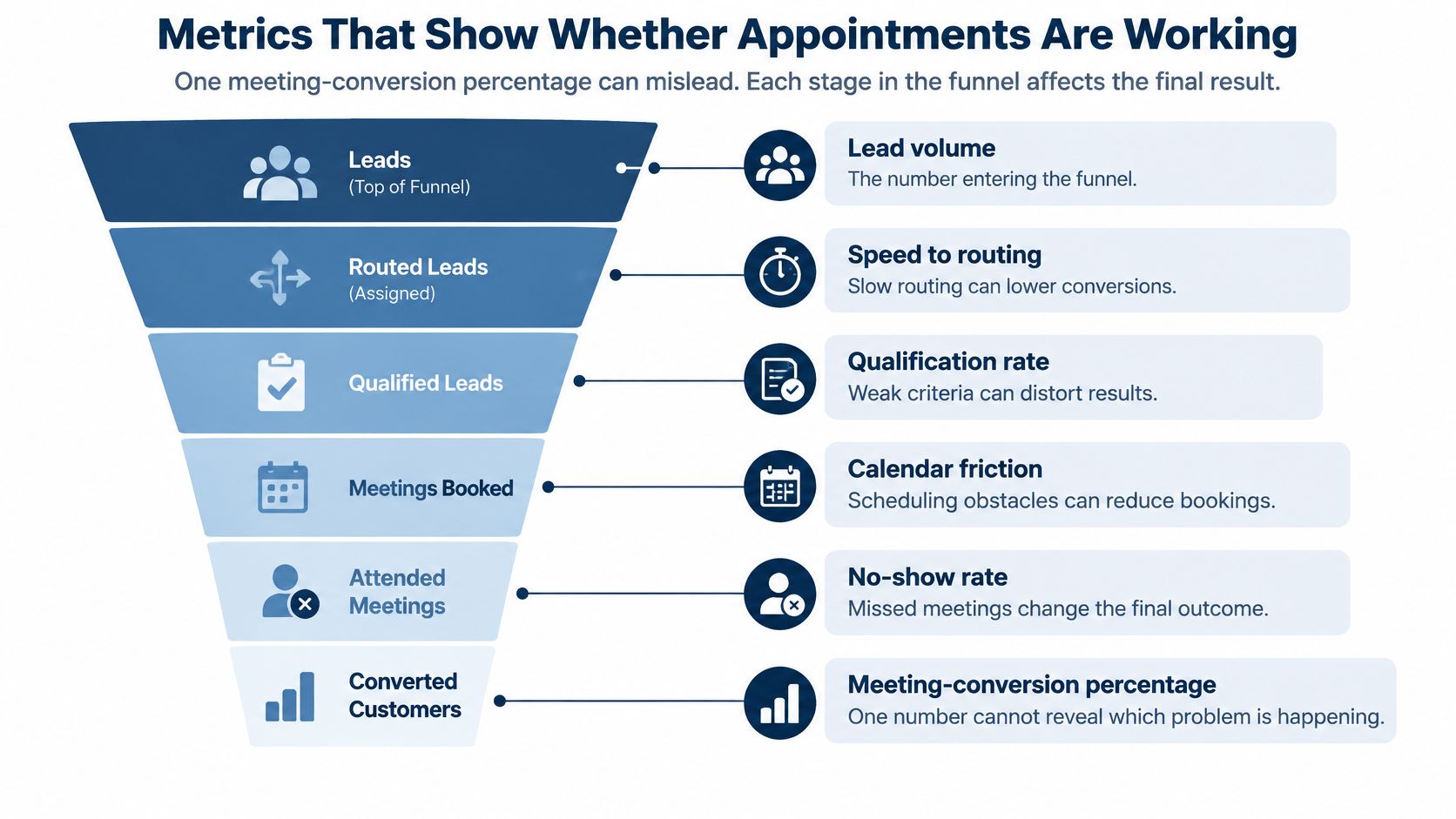
One meeting-conversion percentage misleads you. A low rate could mean slow routing, weak criteria, calendar friction, or no-shows, and a single number can't tell you which fire to put out.
Manage appointment setting as a funnel with separate denominators. Each stage answers a different question, and each weak stage points to a different fix.
The funnel below shows why the stages need to be read separately.
For benchmark context, in 2024, 17% of B2B cold-call conversations with the right decision-maker resulted in an appointment for average-performing teams, while top performers reached 33%, according to Belkins outbound appointment setting benchmarks. Those are cold-call figures from one vendor. Let them inform expectations, not set your targets.
Appointment Setting Metrics and What Weak Results Point To
| Metric | Calculation | What a weak result usually points to |
|---|---|---|
| Inquiry to first contact rate | Inquiries with a logged attempt in the target window divided by inquiries | Routing gaps, staffing gaps or after-hours rollover |
| Contact to qualified rate | Contacts that pass the criteria divided by contacts | Unclear criteria or weak lead sources |
| Qualified to booked rate | Qualified leads with a confirmed slot divided by qualified leads | Calendar friction or slow time offers |
| Booked to held rate | Meetings attended divided by meetings booked | Weak reminders or poor scheduling times |
| Held to retained rate | Matters or deals won divided by meetings held | Handoff quality or weak fit |
| Median and 90th percentile speed to lead | Time from inquiry to first attempt, ranked across all inquiries | Ownership gaps and after-hours delays |
Segment every stage by source, practice area, time of day, setter, and attempt number. That's where useful differences hide. A firm-wide contact rate can look acceptable while weekend inquiries convert at half the weekday rate.
A Diagnostic Rule You Can Use Monday Morning
- Low inquiry to contact: Routing or after-hours gaps.
- Low contact to qualified: Criteria problems or weak lead quality.
- Low booked to held: Reminders or scheduling times.
- Low held to retained: Handoff brief quality or fit decisions upstream.
Fix the stage the numbers indict. Increasing call volume against a qualification problem just produces wrong meetings faster.
Confirm Your Scorecard Before You Scale Outreach
Before you add setters, channels, or spend, audit the last 30 days of inquiries. Four steps, in order.
- Stamp each inquiry. Record the time of first attempt, contact, qualification, and booking. If the timestamps don't exist, that's your first finding.
- Find the largest drop rate. Not the largest absolute number. The stage losing the biggest share of what enters it.
- Name the leak. Decide whether it's reachability, qualification, booking, or attendance, using the diagnostic pattern from your funnel numbers.
- Fix one stage for two weeks. Change nothing else, so the result is readable. If email is part of that stage, check message quality against a cold email deliverability playbook before blaming the list.
If the leak sits in first contact or after-hours follow-up, dedicated support or 24/7 live intake can cover that stage. Qualification criteria and the handoff brief stay your firm's responsibility. Frontline signs the case. Staffline carries it. Neither fixes criteria nobody wrote down.
Every engagement with Attorney Assistant starts with diagnosing where the firm is losing revenue, then we map the intake process, follow-up gaps, and admin workflows. Consultations require no commitment. A Client Success Consultant learns the firm's needs and builds a custom pricing package, and you can start with the Book a Call button on the website.
If your scorecard shows inquiries leaking at first contact, after-hours coverage, or follow-up, Attorney Assistant can help with 24/7 live intake through Frontline and dedicated full-time legal support through Staffline, built specifically for law firms. Visit Attorney Assistant to book a working conversation about where your intake and appointment setting lose opportunities, and what to fix first.
Related Articles

Appointment Setting Lead Generation for Law Firms
Master appointment setting lead generation for law firms. Learn response-time tactics, follow-up cadences, scripting tips, and when to outsource intake.

Client Service Questionnaire Templates for Law Firms
Build a client service questionnaire for your firm: sample questions by stage, send timing, response metrics, and how to route results into intake.

Nice No Soliciting Sign: Wording, Design and Templates
Nice No Soliciting Sign ideas that work: ready-to-use wording, design rules, legal limits and printable templates for doors and apartments.