
A call answering service for law firms is worth paying for when it qualifies matters, captures structured intake data, and creates a documented next action, not when it records a message. Only 56% of law firms answered calls with a person, and 57% of voicemails went unreturned within 72 hours.
That's not just a telephone problem. It's an ownership problem: someone expressed interest in hiring a lawyer, and nobody owned what happened next.
The useful buying question isn't whether a provider can pick up. It's whether your firm can trace that conversation through qualification, consultation, and a signed engagement, without asking everyone to search their inbox.
Table of Contents
- Why a Call Answering Service Is Not the Same as Intake
- What a Legal Call Answering Service Actually Does
- The Real Benefits for Law Firms and Their Attorneys
- How Call Answering Service Pricing Models Compare
- How to Choose the Right Call Answering Service
- Measuring Intake Performance as a Closed Loop
- Questions Legal Practices Ask Before Switching
- Your Next Step Toward Reliable 24/7 Intake
Why a Call Answering Service Is Not the Same as Intake
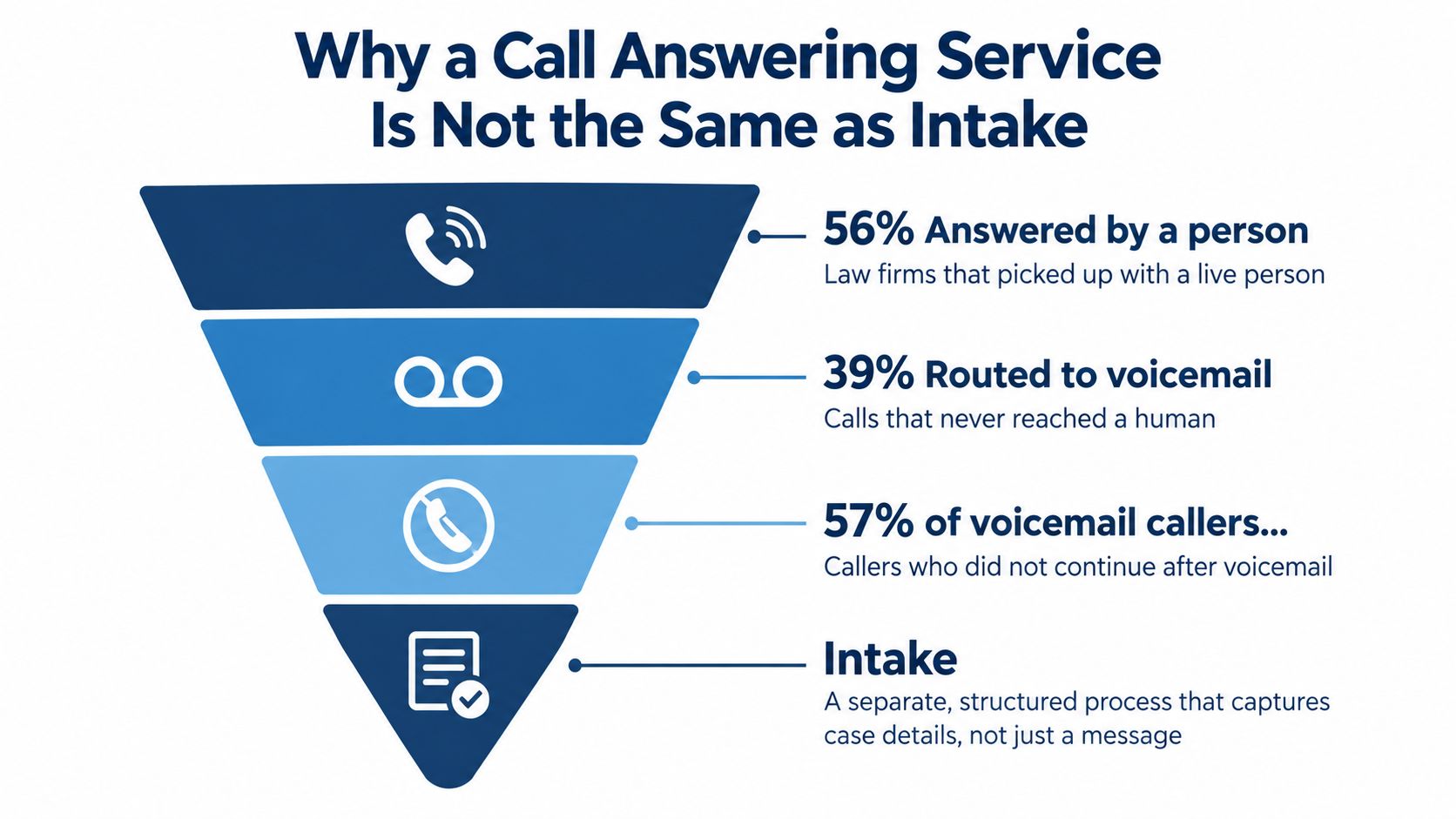
The uncomfortable detail in the Clio secret-shopper findings reported by the North Carolina Bar Association is what happened after voicemail: 57% of messages weren't returned within 72 hours. The study also found that 56% of firms answered through a person, while 39% routed callers to voicemail.
Answering matters. But a pleasant greeting followed by an emailed message still leaves your staff responsible for everything that might turn the inquiry into a client.
The distinction is the handoff from a conversation to an actionable record.
What a usable intake record contains
Require fields for caller identity and contact information, jurisdiction, matter type, incident date, opposing parties, urgency, and preferred consultation time. Add practice-specific questions approved by the firm, rather than asking agents to improvise legal judgment.
- A message tells someone to call the prospect.
- A qualified intake records whether the matter meets the firm's preliminary criteria.
- A documented next action identifies the responsible person, required task, and expected completion time.
Those are different deliverables. A message isn't a conflict check, and an expression of interest isn't a scheduled consultation.
A sensible legal lead qualification process defines what agents can determine, what requires attorney review, and what information must accompany that review.
Practical rule: Every prospective-client call should end with a recorded disposition and an owner, even when the disposition is “awaiting attorney review.”
Test your current setup before buying another one. Review last month's missed calls and voicemail return times, then match those callers to intake records and consultations.
A missing match doesn't prove you lost a viable case. It does prove you can't explain what happened to the opportunity, which is an awkward basis for approving more marketing spend.
What a Legal Call Answering Service Actually Does
Compare two call flows. In the first, a receptionist takes a name and number, emails the office, and moves on. In the second, an intake specialist identifies the caller's need, gathers approved information, checks the required screening stage, and completes or assigns the next action.
Use this sequence as a baseline for evaluating the workflow.
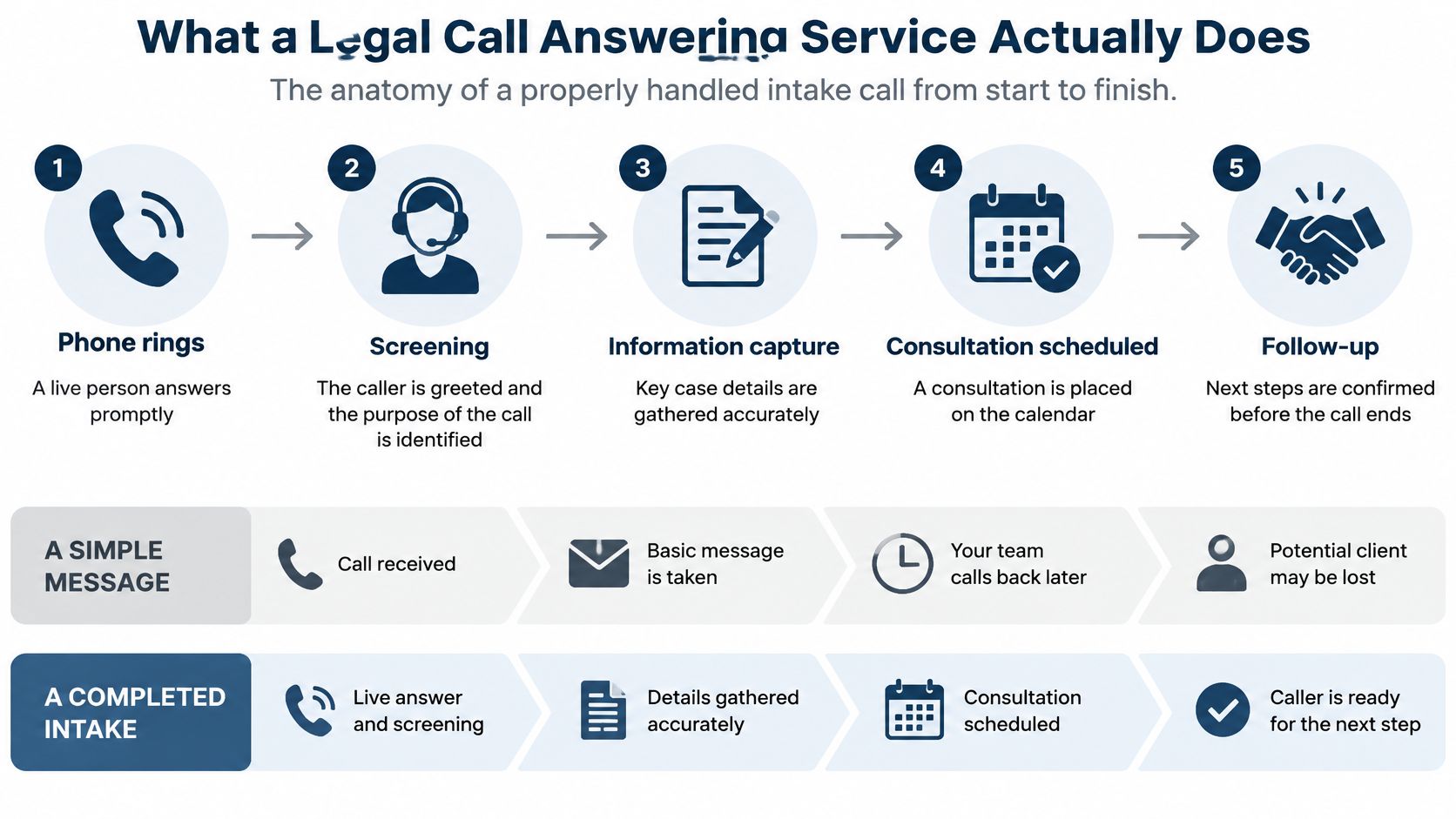
Build decisions into the call flow
The agent should distinguish a new inquiry from an existing-client request before applying the relevant script. A caller requesting a case update shouldn't be marched through new-client qualification because the software enjoys consistency.
For prospective clients, require these operational decisions:
- Screening checkpoint: Collect names and route potential conflicts through the firm's approved process before proceeding into sensitive detail.
- Appropriate next step: Warm-transfer eligible callers, book an authorized consultation, or assign attorney review.
- Failed-transfer recovery: Keep responsibility with the intake team until a callback task, owner, and caller expectation are recorded.
- Follow-up status: Record whether the caller scheduled, declined, needs more time, or couldn't be reached.
A warm transfer isn't complete because an agent dialed an attorney. It's complete when the receiving person accepts the call.
Coverage needs a working fallback
Specify live coverage during nights and weekends, language support in English and Spanish, and structured outreach for prospects who don't retain immediately. Define permitted channels, contact preferences, stop conditions, and ownership rather than telling a team to “keep trying.”
Quality assurance should examine accuracy, empathy, screening compliance, and completion of the promised action. A friendly agent can still create an unusable intake record.
For a closer look at the service approach, this video provides additional context.
Finally, separate administrative qualification from legal advice. Agents can apply firm-approved criteria and explain approved procedures. Attorneys retain responsibility for legal judgment, acceptance decisions, and advice.
That boundary should appear in training and call reviews, not merely in the vendor contract nobody opens after signing.
The Real Benefits for Law Firms and Their Attorneys
Fast response matters because prospective clients are actively trying to solve a problem, not because a dashboard looks better in green. A lead-response benchmark discussed by Legal Soft reported that contacting an inbound lead within five minutes made qualification approximately 21 times more likely than waiting 30 minutes.
That's a general lead-response benchmark, not a guaranteed legal conversion result. Use it to justify prompt engagement, not to forecast signed cases by multiplying your spreadsheet until everyone feels optimistic.
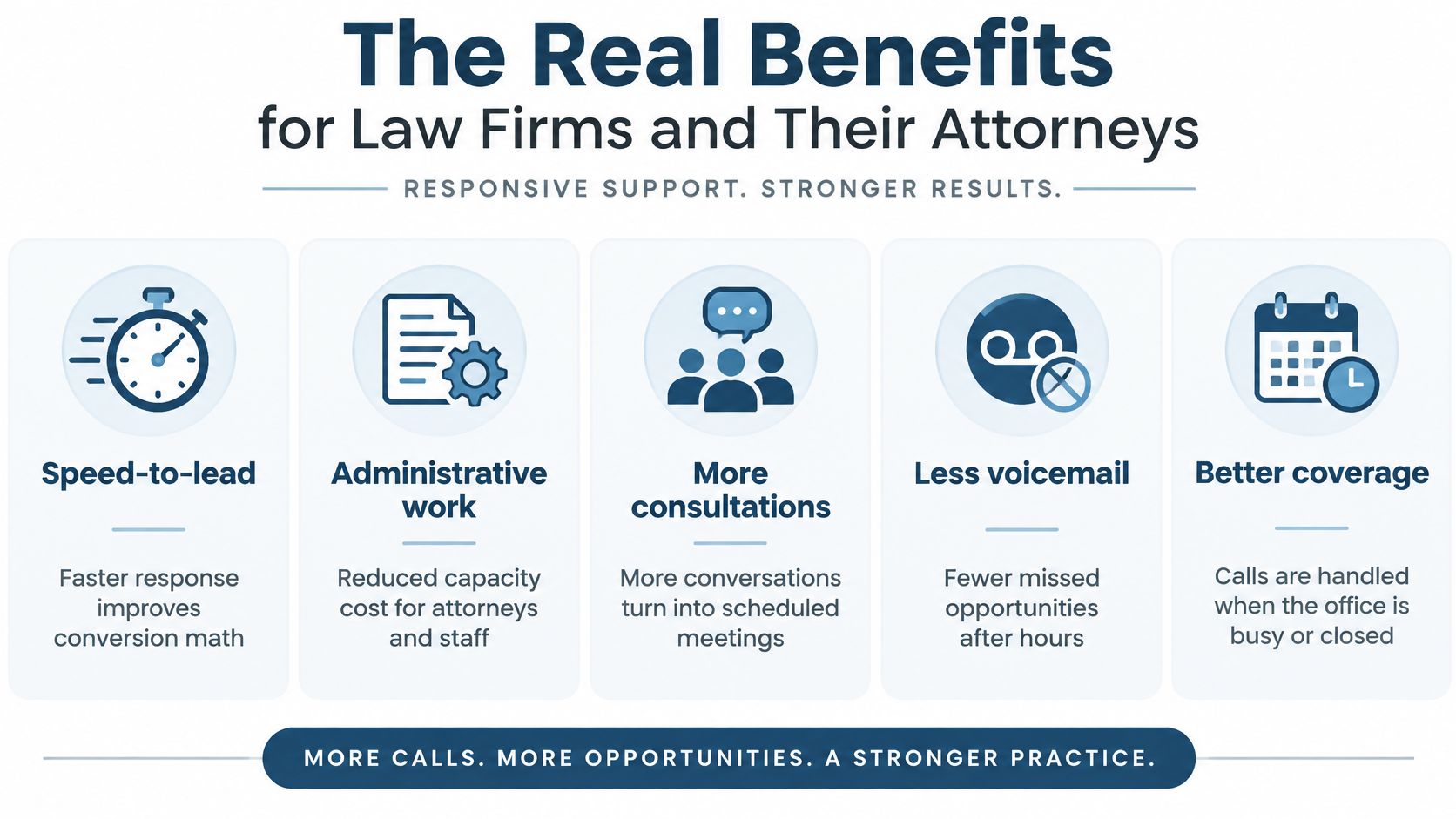
The operational benefits worth testing are straightforward.
Measure capacity as well as conversion
A 2026 report cited by the ABA Journal found that nearly 40% of legal professionals estimated losing four or more billable hours weekly to administrative tasks, equivalent to more than 200 hours annually for a full-time professional.
Not all of that work involves phones. An intake service won't retrieve every missing medical bill or organize a litigation file by answering promptly.
It can, however, take defined intake work off the attorney's desk, provided someone completes the scheduling, documentation, and follow-up.
- Recovered opportunities: Track after-hours inquiries that reach a completed consultation, not merely calls handled.
- Faster booking: Compare the elapsed time between the inquiry and a confirmed appointment.
- Less attorney administration: Log time spent chasing contact details, arranging callbacks, and locating intake notes.
- Better staff allocation: Identify whether reception interruptions fall or whether employees are correcting the provider's work.
Coverage has value when somebody completes the work your internal team would otherwise have to do.
The trade-off is real: meaningful qualification takes more effort than message-taking. Longer conversations can be appropriate when they produce complete records and useful decisions.
Don't reward short calls indiscriminately. An agent who ends quickly by leaving every difficult question for your paralegal hasn't created capacity. They've changed who receives the interruption.
How Call Answering Service Pricing Models Compare
Evaluate action or credit pricing and time-based pricing against your actual call mix. Neither model is automatically cheaper, and neither contract can repair a poorly defined deliverable.
Under an action model, the charge depends on specified completed work. Under time-based billing, the charge depends on minutes used or hours of coverage, subject to the agreement.
Action/Credit vs Time-Based Pricing for Legal Answering Services
| Factor | Action/Credit Model | Time-Based Model |
|---|---|---|
| Billing basis | Defined completed actions or credit usage | Call minutes or coverage hours |
| Budget control | Depends on action definitions and volume | Depends on usage, allowances, and overages |
| Short spam calls | Check whether screening consumes credits | Check whether connected time is billable |
| Complex intake | Verify whether stages consume separate credits | Longer conversations increase usage |
| Failed transfers | Clarify whether an unsuccessful attempt is chargeable | Clarify whether hold and transfer time count |
| Best evaluation method | Compare charges with accepted deliverables | Compare charges with productive handling time |
A firm receiving substantial spam should inspect exclusions before celebrating a low minute rate. A firm handling detailed intake conversations should test how much productive discussion the allowance supports.
Action pricing has its own trap: an “action” must mean something useful. An attempted callback, a completed qualification, and a signed retainer aren't interchangeable outputs.
Read the definitions before the headline price
Ask for a sample invoice using your call patterns. The virtual receptionist pricing considerations are useful preparation, but the contract should answer the operational questions.
- Overages: What triggers them, how are they calculated, and who receives alerts?
- Implementation: Are setup, script changes, integrations, or additional training charged separately?
- Terms: What are the cancellation, renewal, and data-export provisions?
- Exceptions: How are duplicates, wrong numbers, failed transfers, and incomplete intakes treated?
Month-to-month terms can reduce commitment risk. Transparent pricing helps only if the underlying units are transparent too.
A cheap service that leaves your team repairing records has an additional cost: the employee time needed to make its output usable. Compare the complete workflow cost, not just the invoice with the most reassuring font.
How to Choose the Right Call Answering Service
Ask providers to demonstrate an intake in your environment, using your criteria. A feature presentation can show that a calendar integration exists; a test shows whether the correct appointment lands on the correct calendar with usable notes.
Start with responsibilities rather than software logos.
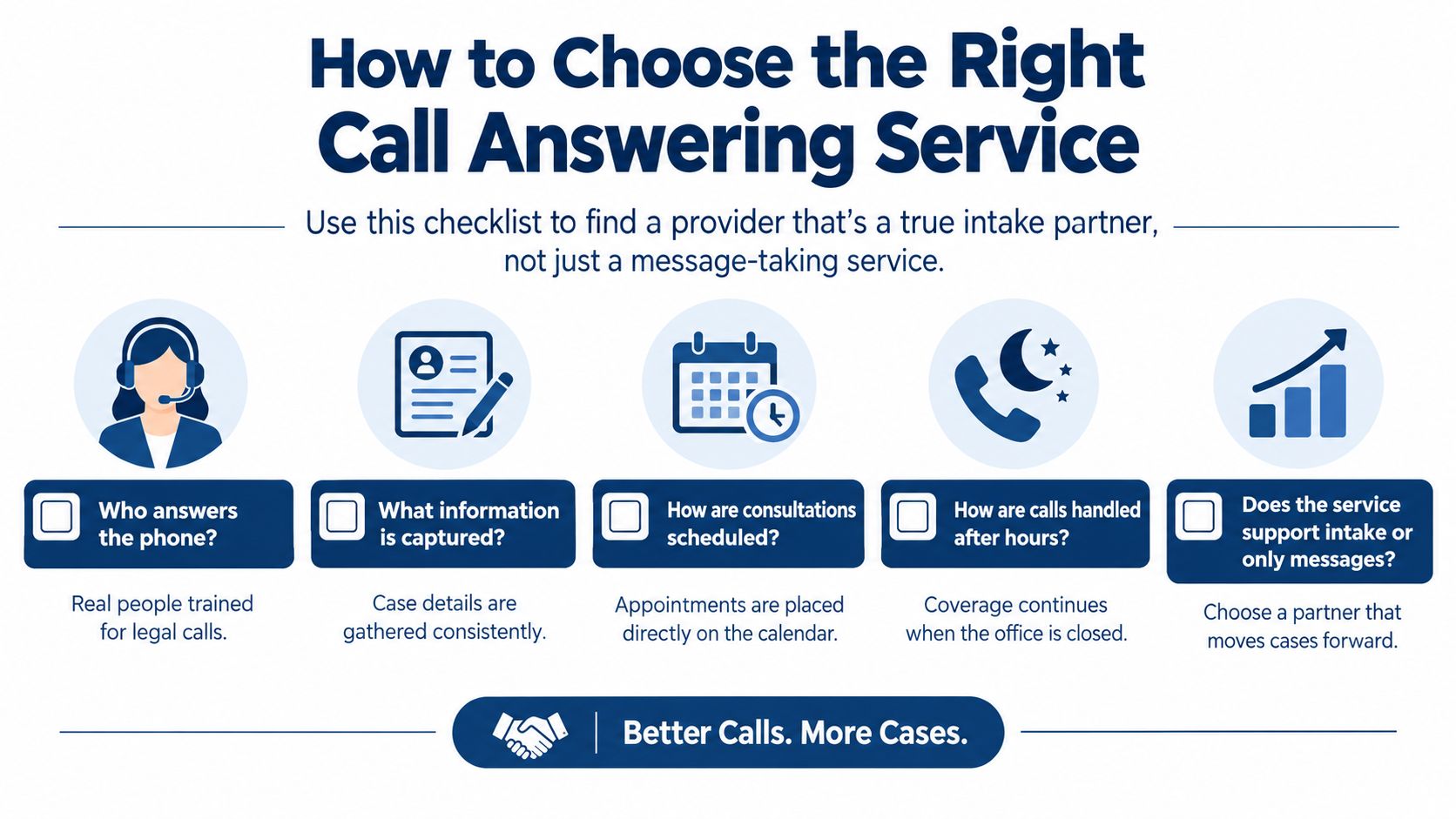
Require evidence of the handoff
- Practice-area rules: Who approves eligibility criteria, exceptions, and script changes?
- Conflict boundaries: Where does screening stop, and who authorizes the next stage?
- CRM delivery: Which fields populate, how are duplicates handled, and what happens if synchronization fails?
- Engagement workflow: Who authorizes sending an agreement, tracks its status, and verifies completion?
- Attribution: Does the record preserve the original campaign source alongside the latest contact?
- Quality review: Can your intake lead inspect calls, corrections, and unresolved tasks?
Test ordinary and awkward scenarios: an eligible prospect, an existing client, an unclear matter, an unavailable attorney, and a caller who isn't ready to schedule. Inspect the resulting records, not just the agent's tone.
Also align intake testing with marketing decisions. If you're evaluating Instagram marketing support for law firms, SimpleLab Digital's resource is a relevant companion to the agency discussion. Separately, ask your intake provider how a campaign-generated inquiry will be identified and handled.
Choose the staffing model that matches the work
A basic receptionist may suit a firm that already has a disciplined internal intake team. A specialist intake team fits a different need: completing qualification and follow-up rather than forwarding them.
Frontline is built for live intake around the clock, including qualification, warm transfers, appointment setting, structured follow-up, and firm-authorized retainer signing. It isn't a message-taking service.
Staffline provides dedicated, full-time legal support professionals working exclusively with a firm inside its systems. Roles can include intake, CRM hygiene, file opening, case management, records retrieval, calendar management, and administration.
The provider sources, vets, and trains these professionals on legal support fundamentals; the firm teaches its specific procedures and preferences, with shared performance oversight. That division matters because nobody arrives knowing your unwritten exceptions.
Choose based on the bottleneck. Shared intake coverage and dedicated operational capacity solve related problems, but they aren't substitutes for each other.
Measuring Intake Performance as a Closed Loop
A provider can answer quickly and still leave your firm with incomplete records, unattended follow-up, and unsigned agreements. Closed-loop intake means you can trace a caller's outcome and identify the person responsible for the next unfinished task.
The need extends beyond phones. A 2025 study of 1,333 U.S. law firms discussed by Reflekt Legal found that 26% never responded to online leads, while 87% of responding firms used phone calls.
Connect operating metrics to case outcomes
| Metric | What to inspect |
|---|---|
| Average speed of answer | How long callers wait for live contact |
| Abandonment rate | Which callers disconnect before reaching an agent |
| Voicemail-to-contact time | Elapsed time until actual contact, not just an attempt |
| Qualified-lead rate | Which completed intakes meet approved criteria |
| Appointment-set rate | Which eligible callers receive confirmed bookings |
| Transfer completion rate | Which transfers reach an accepting recipient |
| Intake completion time | Interval from call receipt to a usable record |
| Notification time | Interval between completed intake and attorney notification |
Segment results by hour, marketing source, practice area, and new versus existing caller. An attractive overall result can conceal poor weekend coverage or mishandling of a particular campaign.
For the attribution component, Netco Design's call tracking guide from Netco Design LLC is a useful starting resource. Establish identifiers that let your team reconcile the call record with the lead record instead of treating the phone dashboard as a separate universe.
Close the unresolved work
Your reporting should connect answered call → qualified matter → consultation held → engagement sent → engagement signed → revenue realized. Track cancellations, no-shows, declines, and unresolved prospects separately rather than burying them under “other.”
Use intake analytics for law firms to locate where ownership or execution breaks down. A consultation booked isn't a consultation held, and an agreement emailed isn't a client retained.
A stage change needs evidence, not optimism.
Assign someone to review stalled records and correct exceptions. Frontline can handle the intake side, while dedicated operational support can maintain the downstream record and handoff.
Software can flag an overdue task. Someone still has to perform it.
Questions Legal Practices Ask Before Switching
How quickly can we go live?
Ask for a readiness checklist rather than accepting a launch promise before anyone has reviewed your workflow. Routing, approved scripts, calendar permissions, system access, and escalation contacts should be tested before calls reach the new team.
Distinguish technical activation from operational readiness. Forwarding calls is not the same as preparing people to handle them.
Can we keep our existing phone number?
Make preserving your published number a requirement, then have your phone administrator confirm the forwarding or routing arrangement. Avoid assuming that a provider requires porting, or that your current phone system supports every desired routing rule.
Test business-hours, overflow, and closed-office behavior separately. Include a rollback procedure so your team can restore the prior arrangement if testing reveals a problem.
Where will intake information be stored?
Specify the authoritative system, approved delivery channels, access permissions, retention expectations, and export process. Ask the provider to demonstrate what happens when record delivery fails.
An email notification can supplement the CRM. It shouldn't become a competing intake database.
What happens when someone needs an attorney immediately?
Provide an attorney-approved urgency definition, an on-call roster, and a backup escalation route. Require acknowledgment from the receiving person rather than treating a sent alert as a completed handoff.
Agents shouldn't promise immediate legal advice or decide unfamiliar legal questions themselves. Document what they can say while arranging attorney contact.
Will an outside team understand our practice?
Require training on representative inquiries, exclusion criteria, terminology, and escalation examples. For dedicated support, the firm must also teach its local procedures, systems, and preferences.
Co-management should make corrections easier to implement, not leave both parties assuming the other provided training. Before switching, review your missed-call and voicemail data so the new team receives a concrete problem to solve.
Your Next Step Toward Reliable 24/7 Intake
Pull a month of call records before scheduling another vendor demonstration. Match them to your intake system and ask what you can establish, rather than what everyone remembers happening.
Start with these questions:
- Missed calls: Which inquiries never reached someone capable of moving them forward?
- Voicemail response: How long did callers wait for actual contact?
- Consultation outcomes: Which of those callers booked and attended a consultation?
Unknown outcomes deserve their own category. Don't count missing records as successful follow-up because someone probably called.
Fix the gap you can identify
If the evidence points to an after-hours coverage problem, address that first. If calls are answered but records are incomplete, focus on qualification and documentation rather than purchasing more availability.
Then standardize the follow-up process and connect it to the downstream engagement stages. Use a named process owner to review unresolved work and authorize changes.
Avoid replacing the entire operation because a vendor offers a larger bundle. Define what your internal team will keep, what the outside team will complete, and where responsibility changes hands.
Add capacity where the work lands
More leads don't solve inadequate intake. They give an already overwhelmed team more opportunities to mishandle.
The right call answering service should reduce unfinished work, not produce a busier inbox. If your need extends beyond the initial call, evaluate dedicated support for CRM maintenance, file opening, records, and ongoing case administration.
Frontline signs the case. Staffline carries it. In practice, that means connecting intake execution with the operational capacity required after engagement, under the firm's direction.
Bring your call records, stalled-lead list, and current workflow to the conversation. They're more useful than a general request to improve conversion, and considerably harder to answer with a feature slide.
Attorney Assistant offers Frontline for live intake and structured follow-up around the clock, and Staffline for dedicated, full-time legal support within your firm's workflows. Visit Attorney Assistant to discuss where callers, follow-up tasks, or case-support work are getting stuck, and whether co-managed support fits the gap.
Related Articles

Fear of Talking on Phone: 7 Practical Confidence Tips
Overcome fear of talking on phone with practical scripts, role-play, exposure exercises, and intake tools built for legal teams.

Preferred Method of Contact for Law Firm Intake
Discover how to capture and use the preferred method of contact in legal intake to improve conversions, ensure compliance, and streamline law firm operations.

1st Dollar Coverage in Law Firm Retainers: A Practical Guide
Understand 1st dollar coverage in legal and insurance contexts. Learn how it shapes intake, retainer strategy, firm revenue, and risk.