Cross-selling in law firms: boost revenue with smarter engagement

TL;DR:
- Cross-selling involves recommending related in-house services to meet clients’ evolving legal needs.
- Effective cross-selling boosts revenue, client retention, and enhances overall client service.
- Building a culture requires systems, incentives, training, shared visibility, and ongoing relationship building.
Cross-selling in law firms has a reputation problem. Many partners picture it as an awkward pitch at the end of a client meeting, something that feels more like a car dealership move than a legal service. That reputation is wrong, and it’s costing firms real money. Some lawyers see cross-selling as essential for growth and deeper client service, yet hesitation remains widespread. The firms that get past that hesitation are quietly building stronger client relationships, higher revenue per case, and better retention. This article breaks down what cross-selling actually is, why it works, and how to build it into your practice without feeling like a salesperson.
Table of Contents
- What is cross-selling in law firms?
- Why cross-selling is essential for law firm growth
- How to create a cross-selling culture in your firm
- Smart tools and tactics to boost cross-selling results
- Why most cross-selling advice fails (and what really works)
- Level up your firm’s cross-selling—start today
- Frequently asked questions
Key Takeaways
| Point | Details |
|---|---|
| Cross-selling defined | Cross-selling is offering additional legal services to existing clients based on their real needs. |
| Drives revenue and loyalty | Firms that cross-sell effectively grow revenue per client and build deeper trust. |
| Culture and tools matter | Success requires incentives, collaboration, and using the right technology. |
| Start with client focus | Effective cross-selling comes from listening for opportunities, not pushing services. |
What is cross-selling in law firms?
Cross-selling means recommending additional services your firm already offers to a client who is already working with you, when those services genuinely fit their situation. It is not about pushing products. It is about recognizing that a client who came to you for one problem often has related needs you are already equipped to solve.
Here is the key distinction most people miss. Cross-selling is not the same as upselling. Upselling means expanding the scope of the current engagement, like adding more discovery work to an existing case. Cross-selling means connecting a client to a different practice area within your firm. And it is not the same as a referral, which typically means sending a client to outside counsel or another firm entirely.
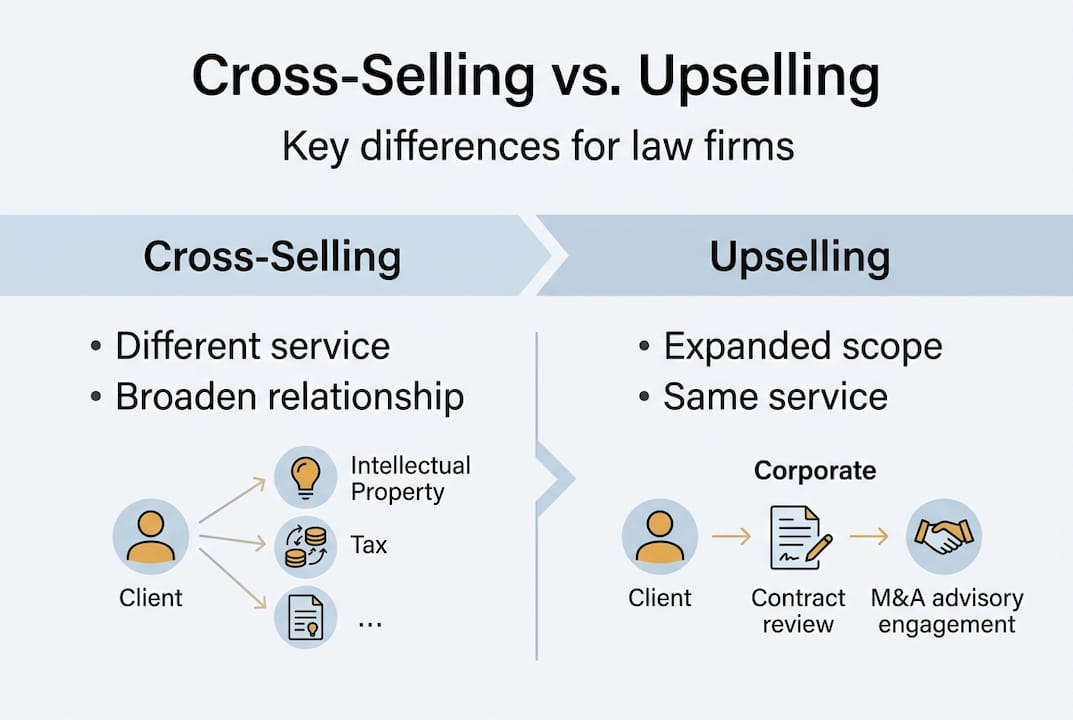
A practical example: a personal injury client settles a significant case. They now have a lump sum, dependents, and no estate plan. Your firm has an estate planning practice. That client has a real, pressing need. Connecting them to your estate planning team is not a sales move. It is good lawyering.
Here is a quick comparison to keep these concepts clear:
| Concept | Definition | Example |
|---|---|---|
| Cross-selling | Offering a different service within your firm | PI client referred to estate planning |
| Upselling | Expanding the scope of the current service | Adding expert witnesses to an existing case |
| Referral | Sending client to outside counsel or another firm | Sending a client to a specialist you don’t employ |
Common cross-selling opportunities in personal injury firms include:
- Workers’ compensation claims for clients injured on the job
- Social Security disability for clients with long-term injuries
- Estate planning after a significant settlement
- Employment law if the injury involved workplace misconduct
Lawyers are sometimes reluctant to cross-sell, but that reluctance often fades when the practice is reframed. You are not pitching. You are making sure your client knows all the ways you can help them.
Pro Tip: Before any client meeting, review their file for life events or legal needs that fall outside the current matter. A two-minute review can surface a genuine opportunity to serve them better.
Why cross-selling is essential for law firm growth
The business case for cross-selling is straightforward. Acquiring a new client costs far more than retaining and expanding a relationship with an existing one. When you cross-sell effectively, you increase revenue per client without increasing your marketing spend. That is one of the cleanest growth levers available to a small or mid-sized firm.
But the client-side benefit is just as compelling. Clients who trust you for one matter are already past the hardest part of the relationship: the decision to hire you. They know how you communicate. They know your team. When a new legal need arises, they would rather call someone familiar than start the search all over again. Cross-selling gives them that option.
“Cross-selling is not just a revenue strategy. It is a client service strategy. Firms that treat it as both tend to outperform those that treat it as neither.” — Legal industry observer
Some view cross-selling as essential for firm growth and client service, yet most firms leave this opportunity untouched. The three most common objections, and why they don’t hold up:
- “It feels awkward.” It only feels awkward when it’s not grounded in a real client need. When it is, it feels like good advice.
- “I don’t want to seem pushy.” Clients rarely feel pushed when a trusted advisor mentions a relevant service. They usually feel grateful.
- “We don’t have the internal collaboration for it.” This is the most honest objection, and it is solvable. Firms that optimize law firm intake and invest in law firm lead management systems create the structure needed for cross-practice collaboration.
Firms that treat cross-selling as a core part of their strategies to grow your law firm consistently report stronger client retention and higher average case value. The data is not complicated. Serve more of each client’s needs, and they stay longer and refer more.

How to create a cross-selling culture in your firm
Knowing the why is one thing. Building it into how your firm actually operates is another. Culture does not change through memos. It changes through systems, incentives, and repeated behavior.
Hesitation to cross-sell is common, but incentives and collaboration tools can shift attitudes quickly when implemented with intention. Here is a five-step framework to build a cross-selling environment that actually sticks:
- Map your service intersections. Identify which practice areas naturally connect. Personal injury and workers’ comp. Estate planning and probate. Employment and civil rights. Build a simple reference guide your team can use.
- Train staff to listen for triggers. A client mentioning a job loss, a new baby, or a business dispute is signaling a potential need. Train everyone, not just attorneys, to recognize these moments and flag them.
- Tie lawyer incentives to cross-referral behavior. Compensation structures that reward siloed performance kill collaboration. Reward attorneys who successfully refer clients across practice areas.
- Create shared visibility. Use a CRM or shared client file system so any attorney can see a client’s full history with the firm. This removes the “I didn’t know they had that issue” excuse.
- Track and celebrate wins. When a cross-referral leads to a signed case, make it visible. Share it in a team meeting. This builds momentum and normalizes the behavior.
Pro Tip: Schedule a monthly cross-practice meeting where each team shares one client success story that involved a referral to another practice area. These stories become the most powerful training tool you have.
Building a culture that supports improve law firm engagement across teams requires patience, but the compounding effect is significant. Firms that do this well report that cross-referrals eventually become second nature, not a formal process.
Smart tools and tactics to boost cross-selling results
With your team aligned, the next step is making cross-selling easy to execute every single day. The right tools reduce friction and create natural moments for identifying client needs.
Intake is the most underused cross-selling opportunity in most firms. When a new client calls or fills out a form, the questions you ask shape everything that follows. Asking about family situation, employment status, or prior injuries is not intrusive. It is thorough. It also surfaces needs your firm can address.
Collaboration tools including AI-powered systems help firms overcome hesitation and make cross-selling easier and more profitable. Here is a comparison of tools commonly used by personal injury firms:
| Tool | Key feature for cross-selling | Ease of use | Cost range |
|---|---|---|---|
| Clio Grow | Client intake forms with custom fields | High | $$ |
| Lawmatics | Automated follow-up and client tagging | Medium | $$ |
| HubSpot CRM | Cross-team visibility and pipeline tracking | Medium | Free to $$$ |
| Salesforce | Advanced segmentation and reporting | Low | $$$$ |
| Attorney Assistant | Intake, follow-up, and workflow automation | High | $$ |
Beyond software, daily habits matter just as much. Three habits your staff can build right now:
- Review the client’s full file before every call, not just the matter at hand. Patterns emerge when you look at the whole picture.
- Ask one open-ended question per client interaction about what else is going on in their life or business. You will be surprised what surfaces.
- Log every unmet need you hear in your CRM, even if it is not actionable today. Future follow-ups become much more relevant.
Staying current on legal intake trends and applying client intake strategies that go beyond the basics will consistently surface more cross-selling opportunities than any script ever could.
Pro Tip: Send a short client satisfaction survey at case close. Include one question like “Are there other legal matters we can help you with?” This is a low-pressure, high-return tactic that many firms overlook entirely.
Why most cross-selling advice fails (and what really works)
Here is the uncomfortable truth: most cross-selling training focuses on scripts, talking points, and pitch timing. That approach misses the point entirely.
Clients do not respond to polished transitions. They respond to being genuinely understood. The attorneys who generate the most cross-referrals are not the best pitchers. They are the best listeners. They notice when a client mentions a divorce in passing. They remember that a client’s business is growing. They connect dots across time.
The real engine of cross-selling is trust built through repeated contact and shared context. A single meeting rarely surfaces a cross-selling opportunity. But six months of consistent follow-up, check-ins, and case updates? That relationship generates referrals and cross-practice work naturally.
Conventional advice tells you to train your team on what to say. We think you should train them on what to hear. The law firm growth strategies that actually move the needle are rooted in relationship depth, not sales technique. Listen first. See patterns. Match solutions to what is actually happening in your client’s life.
Level up your firm’s cross-selling—start today
If you have read this far, you already know cross-selling is not about being pushy. It is about being present and organized enough to serve clients well across their full range of legal needs.
Attorney Assistant helps firms build exactly that kind of structure. From intake workflows that surface client needs early to automated follow-up that keeps relationships warm, we handle the operational side so your attorneys can focus on the relationship side. Explore our free law firm tools to see what fits your practice, check out our virtual cross-selling webinar for a live walkthrough of these strategies, or learn more about our lead follow-up services built specifically for personal injury firms ready to grow.
Frequently asked questions
How is cross-selling different from upselling in a law firm?
Cross-selling means offering a different service within your firm that fits the client’s needs, while upselling means expanding the scope of the current matter, such as adding more work to an existing case.
Why are some lawyers hesitant to cross-sell?
Hesitation is common because attorneys fear seeming pushy or worry about internal competition, but a client-service mindset and clear incentive structures resolve both concerns quickly.
Are there ethical considerations when cross-selling legal services?
Yes. Any additional service you recommend must genuinely serve the client’s interests and must not create a conflict of interest with the current representation.
What are practical first steps to start cross-selling in my firm?
Start by training staff to recognize client needs during intake and case management, then build a simple incentive program that rewards attorneys for successful cross-practice referrals.
Recommended
- Law firm engagement: convert more leads in 2026 | Attorney Assistant
- Optimize law firm intake and convert 80% more leads | Attorney Assistant
- Boost client intake: top communication strategies for law firms | Attorney Assistant
- Law firm lead management: convert more clients in 2026 | Attorney Assistant
Related Articles

Inbound Calls Management for Law Firms: 2026 Guide
Discover what is inbound calls management for law firms. Learn strategies to convert leads, improve client retention, and optimize operations.

Lead Management Best Practices for Law Firms in 2026
Discover effective lead management best practices for law firms in 2026. Improve client conversion and maximize your marketing spend.

How to Reduce Intake Errors at Your Law Firm
Learn how to reduce intake errors at your law firm. Discover steps and tools to enhance client data accuracy and streamline your processes.