How to optimize legal practice workflow for PI firms

TL;DR:
- Inefficient workflows cause significant revenue loss in personal injury firms due to missed calls and manual processes.
- Automating intake and case management systems improves conversions, reduces admin hours, and accelerates case resolution.
- Successful workflow optimization relies on leadership, staff buy-in, and continuous measurement of key performance indicators.
Most personal injury law firms are not short on leads. They are short on systems. Missed calls, slow follow-ups, and manual intake processes quietly drain revenue every single month. Attorneys spend hours on redundant data entry instead of building cases. Staff scramble to chase unsigned retainers while new inquiries go cold. The result is a firm that feels perpetually busy but never quite grows. Optimizing your workflow is not about adding more tools for the sake of it. It is about fixing the specific gaps that cost you signed cases, faster settlements, and client trust.
Table of Contents
- Assess your legal practice workflow: Pinpoint the bottlenecks
- Upgrade client intake: Deploy automation and AI tools
- Integrate end-to-end case management systems
- Address compliance, client experience, and edge cases
- Measure and verify results: KPIs for continuous workflow optimization
- Why small PI firms should rethink workflow optimization myths
- Transform your PI firm’s workflow with proven solutions
- Frequently asked questions
Key Takeaways
| Point | Details |
|---|---|
| Spot workflow bottlenecks | Audit intake and case processes to find where time and revenue are lost most. |
| Automate intake and follow-up | Use AI tools and automation to cut intake times by half and boost conversions. |
| Centralize case management | Implement cloud-based software to streamline casework and save over 1,300 admin hours yearly. |
| Balance tech with compliance | Apply hybrid workflows and manual checks for edge cases and HIPAA compliance. |
| Track KPIs and adapt | Regularly measure the right metrics and adjust workflows for continuous improvement. |
Assess your legal practice workflow: Pinpoint the bottlenecks
Before you fix anything, you need to see the problem clearly. Most PI firm owners know something feels off, but they cannot name exactly where time and money are slipping away. That vagueness is expensive. Small and mid-sized firms lose 40% of revenue to inefficiency and missed follow-ups, which means the leaks are not small.
The most common bottlenecks show up in predictable places: manual intake forms that require staff to re-enter data, slow or inconsistent follow-up after a first call, and case status miscommunications that frustrate clients and paralegals alike. These are not isolated problems. They compound.
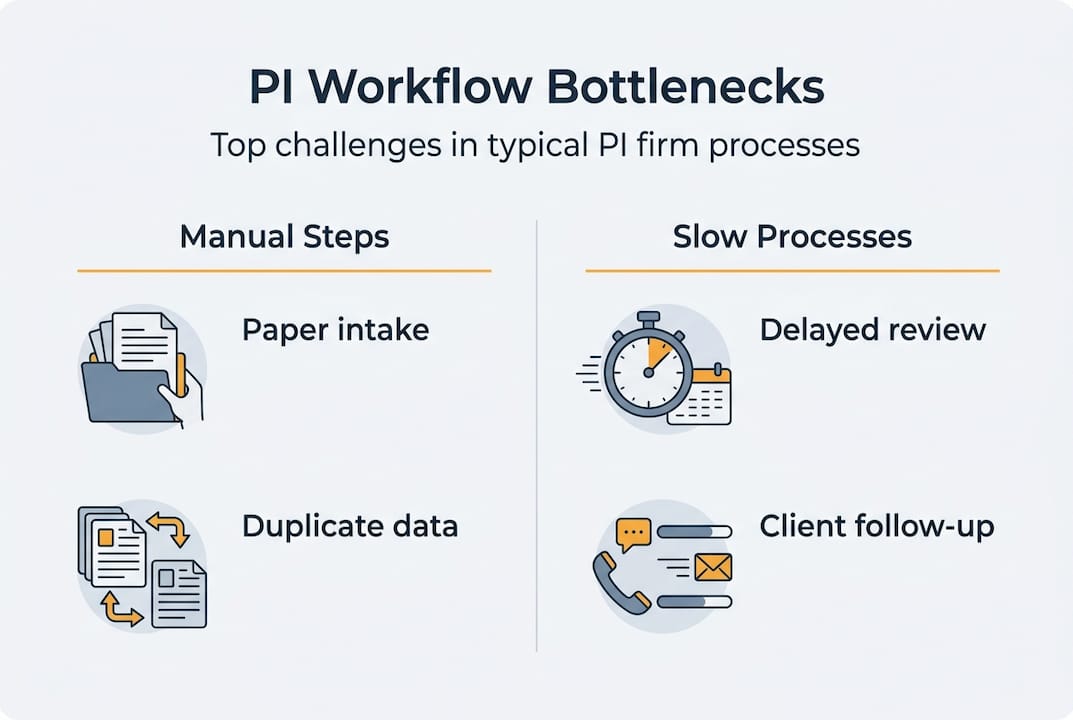
Here is a snapshot of where time typically disappears each week:
| Task | Avg. time lost per week | Potential savings with optimization |
|---|---|---|
| Manual data entry | 6-8 hours | Up to 7 hours |
| Follow-up calls and emails | 4-5 hours | Up to 4 hours |
| Status update requests | 3-4 hours | Up to 3 hours |
| Document chasing | 3-5 hours | Up to 4 hours |
Warning signs that your workflow has serious gaps include:
- High intake drop-off rates after first contact
- Retainers sitting unsigned for more than 48 hours
- Demand packages delayed by missing documentation
- Staff regularly working outside business hours to catch up
Reviewing intake best practices is a strong starting point, and comparing your process against case management benchmarks can reveal exactly where you fall behind.
Pro Tip: Walk every intake step yourself as if you were a new client. Document every place a task waits longer than one to two days. Those delays are your highest-priority targets.
Upgrade client intake: Deploy automation and AI tools
Once you know where the gaps are, intake is the most powerful place to start fixing them. It is the front door of your firm, and right now, for many PI practices, that door is slow, inconsistent, or outright broken. AI and automation tools reduce intake time by 50% and boost conversions by 30 to 40 percent. That is not a marginal improvement. That is a structural shift.
Here is a step-by-step process to overhaul your intake:
- Audit your current intake flow. Map every touchpoint from first call to signed retainer. Identify where prospects drop off.
- Select the right tools. Platforms like Clio, Litify, and EvenUp are built for PI firms. Choose based on your case volume and team size.
- Standardize your intake forms. One consistent form eliminates redundant data entry and reduces errors.
- Automate follow-up sequences. Set triggers so leads receive a response within minutes, not hours.
- Add AI pre-qualification. Chatbots and AI intake tools screen cases before a staff member ever picks up the phone.
See how AI in intake success transformed one firm’s caseload from 25,000 to 250,000 cases. The numbers are real.
| Factor | Manual intake | Automated workflow |
|---|---|---|
| Average intake time | 45-60 minutes | 15-20 minutes |
| Lead conversion rate | 20-25% | 35-45% |
| Staff hours per case | 3-4 hours | 1-1.5 hours |
| Follow-up consistency | Inconsistent | Automated and reliable |
For intake optimization steps and how to boost PI case conversions, your firm can find detailed frameworks worth building around. You can also explore automation tools for law firms to find options that fit your current setup.
Pro Tip: For cases above a certain value threshold or with complex medical histories, use a hybrid model where AI handles pre-qualification and a trained intake specialist closes the conversation. Automation should accelerate empathy, not replace it.
Integrate end-to-end case management systems
Intake improvements stall fast if the rest of your case management is fragmented. Once a client is signed, the workflow needs to carry that momentum forward without creating new bottlenecks. Firms using integrated case management save over 1,300 admin hours per year, which translates directly into more time on billable work and faster case resolution.

Cloud-based platforms are the standard now. Eighty-one percent of small PI firms have adopted cloud legal practice management, compared to 38 percent of mid-sized firms, which means smaller firms are actually ahead of the curve here. The flexibility to access case files, communications, and deadlines from anywhere is no longer a luxury.
Key features to look for in platforms like Litify, Clio, and CasePeer:
- Centralized client records that eliminate duplicate files
- Automated scheduling and deadline reminders
- Integrated communication logs so every team member sees the full picture
- Document management with version control
- Reporting dashboards for case status and staff workload
For a real-world look at how these systems work in practice, the PI workflow example from CasePeer and the Clio PI law guide are worth reviewing before you commit to a platform.
| Metric | Before integration | After integration |
|---|---|---|
| Admin hours per week | 18-22 hours | 8-10 hours |
| Cases managed per attorney | 40-50 | 70-90 |
| Annual software cost per case | $180-$220 | $90-$120 |
Phase your adoption. Start with intake and scheduling, then layer in document management and reporting. Trying to change everything at once is the fastest way to get staff resistance and a failed rollout. Focus on improving client conversion at each phase before moving to the next.
Address compliance, client experience, and edge cases
Technology creates efficiency. It also creates new risks if you are not deliberate. HIPAA compliance does not pause because you switched to a digital workflow. Every platform you use must have a signed Business Associate Agreement, and your staff needs training on what data can and cannot flow through automated systems.
Personal injury clients are often in pain, scared, and confused. That emotional context matters. Automation handles volume, but it cannot replace a human voice for sensitive conversations. Hybrid human-AI models and compliance protocols reduce risk while preserving the personalized service that builds trust and referrals.
Common edge cases your workflow must account for:
- Unsigned retainers after 72 hours: trigger a personal call, not just another automated email
- Cases involving minors or wrongful death: route immediately to a senior intake specialist
- High-value cases above $1 million: require manual review at every stage
- Clients with limited English proficiency: ensure your tools support multilingual communication
- Conflicting medical records: flag for attorney review before proceeding
“Manual override for any case exceeding $1 million or where response quality is critical.”
For a deeper look at how to manage intake communication strategies in high-emotion situations, there are frameworks built specifically for PI firms. You can also review best intake system practices for compliance-focused checklists. Monitor your AI tools regularly for false positives, especially in pre-qualification, where an incorrect rejection could cost you a strong case.
Measure and verify results: KPIs for continuous workflow optimization
Systems without measurement drift. You need to track specific numbers to know whether your workflow changes are actually working or just feeling better. AI adopters are 3x more likely to grow revenue, and 93 percent of mid-sized firms now use AI in some form. The firms pulling ahead are the ones tracking outcomes, not just activity.
Here is how to build a KPI tracking routine that actually sticks:
- Set your baseline first. Before any change, document your current intake response time, conversion rate, and admin hours per week.
- Pick five core metrics. Intake response time, lead conversion rate, admin hours saved, case settlement velocity, and client satisfaction score.
- Review monthly, not quarterly. Workflow problems compound fast. Monthly reviews catch drift before it becomes expensive.
- Assign ownership. One person on your team should own each metric and report on it at your monthly operations meeting.
- Adjust one variable at a time. If conversion drops, isolate whether it is the follow-up timing, the form, or the pre-qualification script before changing everything.
For AI benchmarks for law firms in 2026, Clio’s research offers specific targets worth benchmarking against. And for the human side of this equation, understanding how legal assistants PI intake specialists drive conversions is just as important as any software metric.
Pro Tip: Target a response time under five minutes for new leads. Firms that hit this benchmark consistently see conversion rates in the 35 to 45 percent range. Every minute past five costs you a measurable percentage of that lead.
Why small PI firms should rethink workflow optimization myths
Here is what most workflow advice gets wrong: it treats the problem as purely technical. Buy the right software, flip the right switches, and watch efficiency appear. That is not how it works in practice.
The firms that see the biggest gains are not the ones with the most sophisticated tools. They are the ones where leadership commits to the process change and brings the team along. Staff who understand why a new intake system exists will use it correctly. Staff who feel like it was imposed on them will work around it.
Many PI firms over-invest in features and under-invest in process mapping and staff buy-in. They spend weeks evaluating platforms and two hours on training. That ratio is backwards. The tool is the easy part. Getting a paralegal to stop using the old spreadsheet because they trust the new system is the hard part.
AI should augment your intake team, not replace them. For empathy-critical conversations, a trained intake specialist will always outperform a chatbot. The best workflows use automation to handle volume and humans to handle nuance. Firms that audit their processes quarterly, train their staff consistently, and iterate based on real data are the ones that compound their gains year over year.
Transform your PI firm’s workflow with proven solutions
If you have read this far, you already know your firm has room to convert more leads, save more admin hours, and serve clients better. The question is where to start and how to avoid the common mistakes that stall most optimization efforts.
Attorney Assistant offers hands-on resources built specifically for PI firms ready to act. Join our virtual webinar for a deep-dive into intake systems that convert. Access free workflow tools you can deploy immediately. Or explore our intake and reception services designed to stop the revenue leaks that slow your firm down. Your next signed case should not depend on luck. It should depend on a system.
Frequently asked questions
What is the fastest way to improve client intake for my PI firm?
Automating intake forms and follow-ups while adding AI-powered pre-qualification can cut intake times in half and meaningfully boost your conversion rate. Start with follow-up automation first since that is where most firms lose leads the fastest.
Is cloud-based case management safe and worth it for smaller firms?
Over 81% of small PI firms already use cloud legal practice management, and legal-specific platforms include built-in security controls that address most compliance concerns. The efficiency gains typically outweigh the transition costs within the first quarter.
How can I balance technology and personal touch during intake?
Use a hybrid AI-human workflow where automation handles initial screening and a trained specialist manages sensitive or high-value conversations. This approach scales your capacity without sacrificing the empathy that PI clients need.
What metrics should I track to measure workflow improvement?
Focus on intake response time, lead conversion rate, admin hours saved per week, case settlement velocity, and client satisfaction scores. Firms tracking these KPIs are three times more likely to grow revenue than those that do not measure outcomes consistently.
Recommended
Related Articles

Optimize law firm intake and convert 80% more leads
Learn how PI firms can optimize intake and follow-up to convert more leads into signed cases, reduce revenue loss, and build a scalable growth process.

Legal assistants in PI intake: boost conversions fast
Discover how legal assistants drive intake efficiency, improve case conversion, and reduce attorney overload at personal injury law firms.

Lead leakage in law firms: capture more PI cases
Learn what lead leakage costs PI law firms and get actionable strategies to capture more personal injury cases through faster, smarter intake.