8 Good Welcome Messages for Law Firms
Welcome emails average an 83.63% open rate, compared with 39.64% for email overall, and welcome clicks average 26.9%. Good welcome messages work because they do three jobs at once: reassure the prospective client, establish what the firm handles, and make the next step unmistakably easy.
Most advice on good welcome messages obsesses over wording as if the greeting itself closes the case. It doesn't. A polished hello cannot rescue an intake process that answers quickly, says something pleasant, then loses the lead in the handoff. Technically, calling someone back four days later is follow-up. It is not particularly useful follow-up.
A good welcome message is a short operational handoff. It should build trust, identify fit, set expectations, and move the person toward a documented next step. That applies whether the first touch happens on a live call, an after-hours line, SMS, email, or chat.
For law firms, that matters more than it does in most businesses. Firms miss calls, delay responses, and leave follow-up floating in the general direction of “someone should handle that.” Your CRM cannot follow up with a lead if nobody puts the lead in the CRM. If the message promises a callback, who owns that callback, and where is it recorded?
That's where Attorney Assistant fits naturally into the conversation. Attorney Assistant is a legal workforce solution built for law firms, with Frontline providing 24/7 live intake and Staffline providing dedicated legal support professionals who can support intake, reception, CRM hygiene, and broader case operations. If you want a broader intake framework behind these scripts, this guide on how to convert leads with Ares intake guide is useful background.
Table of Contents
- 1. The Immediate Qualification Welcome
- 2. The Empathy-First Welcome
- 3. The Speed-to-Value Welcome
- 4. The Warm Transfer Welcome
- 5. The Availability-First Welcome
- 6. The Multi-Language Welcome
- 7. The Case-Type Clarification Welcome
- 8. The Context-Setting Welcome
- 8 Welcome Message Types Compared
- Make the Welcome Match the Workflow
1. The Immediate Qualification Welcome
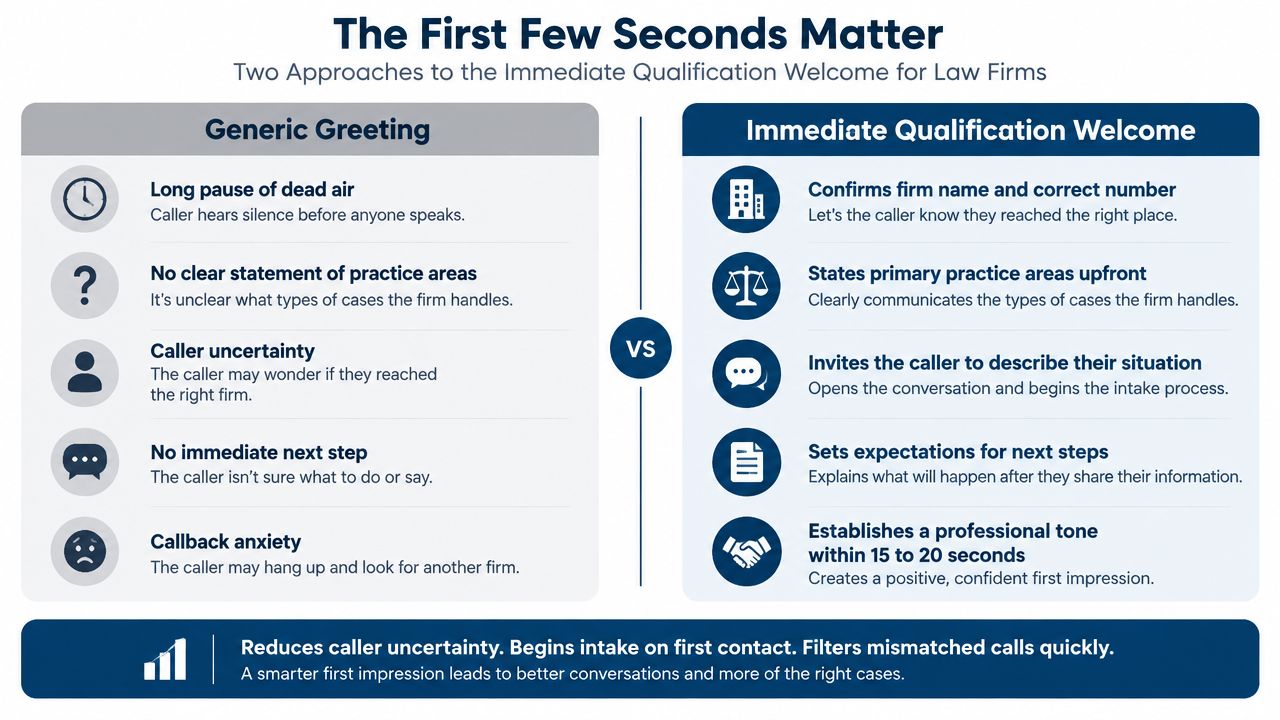
Some welcome messages waste the caller's first ten seconds proving the firm owns a telephone. The better version tells people, immediately, whether they've reached the right place.
A personal injury firm can say, “Thank you for calling [Firm Name]. We handle car accidents, slip and falls, and workplace injuries. Can you tell me what happened?” A medical malpractice firm can say, “You've reached [Firm Name], where we handle medical negligence cases. What brings you to us today?”
This works because it removes uncertainty fast. The caller knows they aren't speaking into a generic front desk void, and the intake person gets a cleaner opening to start qualification.
Keep it short enough to invite a real answer
Good immediate-qualification welcomes should usually stay within about 15 to 20 seconds before the caller gets the floor. Anything longer starts to sound like a prerecorded disclaimer that accidentally became sentient.
Use natural language. Practice-area labels matter, but conversational phrasing matters more. “Can you tell me what happened?” will outperform a stiff script if your team listens to the answer.
Practical rule: The first line should help routing, not just branding.
Teams that need stronger intake consistency usually benefit from defining what counts as qualified, what gets redirected, and what gets escalated. If that's the bottleneck, not the script itself, lead qualification services for law firms is the more relevant operational fix.
A final point. If the caller is outside your practice area, staff need backup language ready. “We don't handle that” ends the conversation. “That's outside our practice, but I can point you in the right direction” preserves trust.
2. The Empathy-First Welcome
Some practice areas need a human acknowledgment before anything else. Family law, medical malpractice, elder abuse, wrongful death, and many injury matters fall into that category. A rushed qualifier can sound efficient and still feel cold.
An empathy-first version might sound like this: “I'm sorry to hear you've been hurt. You've reached [Firm Name]. We help people in situations like this, and I'm here to listen to what happened.” A family law variation could be: “I know this is a difficult time. You've reached [Firm Name], and we help with family law matters. Let me make sure we can help.”
That opening lowers the temperature of the call. It tells the person they reached a law firm, not a call maze dressed as a receptionist.

Empathy has to survive the handoff
This approach fails when only the first person sounds caring. If intake is warm, then the next person is abrupt, repetitive, or obviously has no idea what was already discussed, the welcome becomes theater.
Document the tone-setting moment in the CRM. A short note like “caller upset about recent ER discharge, empathy expressed, prefers calm pace” is not fluff. It keeps the second conversation from starting back at emotional zero.
Independent customer-service guidance says a strong welcome message should identify who is responding, set a response-time expectation, and offer a next step, but high-stakes legal intake adds another requirement: the first message also has to reduce friction while gathering useful facts. That tension is why so many firms sound either robotic or vague. The article on welcome message examples and response expectations is useful on the baseline elements, but law-firm intake has to go further.
- Pause after the opening: Give people a second to speak. Silence is often where the useful facts show up.
- Match tone to the matter: Empathy in catastrophic injury sounds different from empathy in collections or business disputes.
- Carry it forward: The rest of the workflow has to honor the same tone, or the welcome feels like bait.
3. The Speed-to-Value Welcome
Not every call needs a soft landing. Some callers are at work, in the car, on another line, or comparing firms in real time. They don't need ceremony. They need a competent person to move the process forward.
For those situations, a speed-to-value welcome is better: “You've reached [Firm Name], personal injury and accident cases. When did your accident occur?” Or, in a collections practice, “Thank you for calling [Firm Name]. We handle consumer debt collection matters. Can you provide the account or debtor name?”
The strength of this script is momentum. It confirms the practice area and immediately starts collecting useful information.
Fast is good. Confusing is not.
Law-firm response data makes the operational case for this approach. A 2024 law-firm lead form response time study reported that 28% of firms respond to online leads in under 5 minutes, 35% respond in 10 minutes or less, and 56% respond in 2 hours or less. Response speed is being measured in minutes, not “we'll get to it after lunch.”
That doesn't mean every intake interaction should sound brisk to the point of indifference. It means the welcome should help the staff member gather enough information to route, schedule, or escalate without creating friction.
Fast scripts only work when note-taking keeps up. Otherwise you gain speed and lose facts, which is an expensive hobby.
This format works best in practices with high volume and repeatable intake patterns. It works less well when the matter is emotionally loaded, legally complex, or likely to involve multiple related issues. In those situations, speed still matters, but clarity matters more.
4. The Warm Transfer Welcome
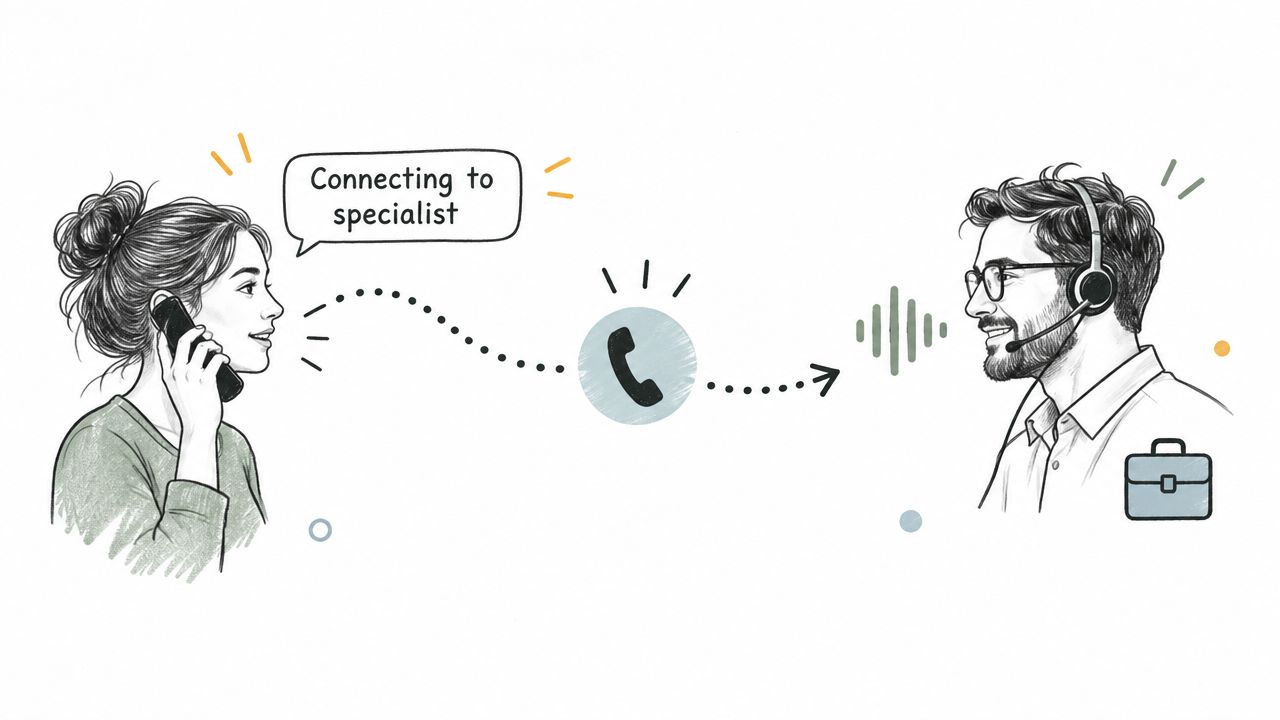
A cold transfer tells the caller, in corporate subtext, “Good luck.” A warm transfer tells them who they're speaking to next, why that person is the right person, and what happens now.
A good script sounds like this: “I'm going to transfer you to Sarah Chen, our lead attorney on medical malpractice cases. She's reviewed your information and will discuss your options. You'll hear her in just a moment.” Or: “Let me connect you with Marcus, who handles medical record acquisition and can get those records ordered.”
The point isn't politeness alone. It's continuity.
Introduce the next person like they matter
A warm transfer should include the caller's name, a one-sentence summary of the issue, and confirmation that the receiving person is available. Sending someone to an endlessly ringing extension is not a transfer. It's a betrayal with hold music.
Use language like: “Sarah, this is James calling about a surgical error after a recent procedure. James, I've got Sarah here now.” That tiny bit of choreography keeps the caller from repeating everything from scratch.
A lot of firms lose cases in this exact moment. Clio reporting found that more than half of firms did not respond to voicemail within 72 hours, only 40% responded to email, and 56% of phone calls were answered by a person. The Clio legal trends findings on inquiry response failures make the larger point clearly. The handoff itself is often the leak.
If your team still treats transfers as a technical phone function instead of an intake skill, this breakdown of warm transfer vs cold transfer in law firms is worth reading.
5. The Availability-First Welcome
This one matters most when the firm does not have reliable live coverage around the clock. The welcome has to answer the question the caller won't phrase politely: Is anyone going to get back to me?
An after-hours example: “Thank you for reaching [Firm Name] after hours. We've received your call. A member of our team will return it within 24 hours. If this matter is urgent, please say that in your message so we can route it appropriately.” A weekend version might promise a Monday-morning response and make that timing specific.
Specificity is doing the work here. “We'll call you back soon” sounds nice and means nothing.
Promise only what someone owns
A lot of content about welcome messages ignores the issue which is speed and ownership. Law-firm lead data summarized in legal-marketing reporting showed a median first response time of 13 minutes, 28% of firms respond in under 5 minutes, and 56% respond within 2 hours or less. The same reporting makes the practical point that many firms still miss the narrow moment when prospects are actively comparing providers, which is exactly why law-firm marketing automation and response-time systems matter.
If your message promises a callback, assign the callback. Name the queue, the shift, or the person responsible in your internal workflow. Otherwise the script is just hope in a pleasant tone.
Taking a message is not intake.
Use this format when coverage is inconsistent, but don't let it become a permanent substitute for actual availability. Firms that regularly lose nights, weekends, and overflow calls usually don't have a messaging problem. They have a staffing and intake-ownership problem.
6. The Multi-Language Welcome
If your market includes a significant Spanish-speaking population, a bilingual welcome should not sound like a panicked afterthought. It should sound normal, because for the caller it is.
A simple version works well: “Thank you for calling [Firm Name]. Do you prefer English or Spanish? Gracias por llamar a [Nombre de la Firma]. ¿Prefiere inglés o español?” If you use phone routing, keep both language prompts brief and easy to follow.
This is less about branding than access. When language choice appears immediately, the firm reduces friction before the caller has to ask for help twice.
Don't offer what the workflow can't support
Attorney Assistant's Frontline service is relevant here because it offers English and Español intake, but the same rule applies to any firm-run operation. If you offer Spanish, the intake path, follow-up path, and document path all need support behind them.
Law firms already miss too many first contacts. Clio's secret-shopper research found only 40% of firms answered the phone when a prospective client called, and CallRail analysis found 28% of calls to law firms go unanswered. The summary in legal client intake statistics on missed calls and unanswered inquiries underscores the obvious point. If a caller faces both a missed call and a language barrier, the lead is not warming up. It is leaving.
How bilingual virtual assistant support works for law firms is useful if you're evaluating the staffing side, not just the script.
- Use a fluent speaker: Conversational ability isn't enough for legal intake.
- Keep forms aligned: Intake forms and follow-up templates should exist in the languages you offer.
- Route consistently: Don't make bilingual callers start over with a second staff member unless that handoff is intentional.
7. The Case-Type Clarification Welcome
Multi-practice firms often create bad phone trees because they're trying to solve a legitimate routing problem with a clumsy menu. There's a better option. Ask naturally.
“Welcome to [Firm Name]. What brings you in today. Are you calling about a car accident, a workplace injury, a product liability issue, or something else?” A business firm could ask, “Are you looking for help with contract review, business formation, employment matters, or a dispute?”
That sounds like a conversation starter instead of a small hostage situation with keypad options.

Route the matter, not just the call
This script is useful when one firm handles multiple distinct case types and each type has a different next best step. The intake person should listen for the actual legal issue, not just match a keyword and pass the caller along like checked luggage.
Operationally, this matters because law firms still struggle with response and follow-up. Later reporting on lead response found a median response time of 13 minutes, 25% of firms replied in under 5 minutes, and 26% never responded at all. The summary discussed in the legal lead response timing benchmark is not about routing specifically, but it supports the larger reality: your front door has very little margin for confusion.
For firms with overlapping categories, train staff to note more than one issue. An employment matter may also involve a contract issue. A business dispute may also trigger collections or insurance questions. Good welcome messages should surface that complexity early, not hide it.
8. The Context-Setting Welcome
Some callers give better information when they know why you're asking. A context-setting welcome does that before the questions begin.
For example: “I'm going to ask you a few questions about your accident and injuries, then our attorney will review the information and decide whether we can help. This will take about 10 minutes. Does that work for you?” Or, for malpractice intake: “Here's how this works. I'll gather information about what happened with your medical care, then our attorney will review it and follow up.”
This script reduces resistance because it replaces uncertainty with a roadmap.
The roadmap has to be real
Recent guidance on welcome messages often emphasizes greeting, identity, expectation-setting, and a clear next step. That advice is directionally right, but legal intake needs one additional layer: diagnostic clarity. The opening has to tell the caller what is about to happen and why.
The same principle shows up in email welcome performance. A welcome email benchmark summary reports an average welcome open rate of 83.63%, compared with 39.64% for all email, along with a 26.9% click-through rate. It also notes that promotional placement can cut engagement by 50% or more. The lesson for firms is simple. First-contact messages perform best when they are immediate, clear, and focused on the next useful step.
If your script says the attorney will review the file next, someone needs to know where that file lands and when.
This format is especially useful when you'll ask difficult questions or when attorney review is required before a consultation is scheduled. It tells the prospective client what the process is, how long it takes, and what happens after the call.
8 Welcome Message Types Compared
| Approach | Complexity (🔄) | Resources & Training (💡) | Expected Outcomes (⭐📊) | Ideal Use Cases & Key Advantages (⚡) |
|---|---|---|---|---|
| The Immediate Qualification Welcome | 🔄 Moderate, short scripted delivery with live adjustment | 💡 Live intake staff; concise script; clear practice-area definitions | ⭐ High relevance filtering; 📊 faster qualification and fewer mismatches | ⚡ Quick decisioning; best for firms with clear practice areas; reduces caller uncertainty |
| The Empathy-First Welcome | 🔄 Higher, requires emotional intelligence and pacing | 💡 Trained empathetic staff; coaching and consistent tone across follow-up | ⭐ Very high trust/retention; 📊 deeper disclosures and higher conversion | ⚡ Slower but higher-quality engagement; ideal for PI, medical malpractice, family law |
| The Speed-to-Value Welcome | 🔄 Low, streamlined, repeatable script | 💡 Staff trained on fast intake and efficient note-taking; structured forms | ⭐ Good effectiveness for throughput; 📊 increases completed intakes per shift | ⚡ Optimized for high-volume practices (PI, collections); maximizes efficiency |
| The Warm Transfer Welcome | 🔄 Moderate–High, needs real-time coordination | 💡 Availability checks, short summary handoffs, trained transfer protocol | ⭐ High caller retention and smoother attorney handoffs; 📊 fewer hang-ups | ⚡ Maintains continuity across touchpoints; valuable when transferring to attorneys/specialists |
| The Availability-First Welcome | 🔄 Low, clear promises and logging required | 💡 After-hours system, call timestamps, coordination to meet callback windows | ⭐ Improves caller perception; 📊 reduces repeat callbacks and anxiety | ⚡ Essential for after-hours/overflow intake; sets realistic expectations |
| The Multi-Language Welcome | 🔄 Moderate, depends on number of languages offered | 💡 Fluent bilingual staff or native recordings; translated intake docs | ⭐ Expands market reach; 📊 increases inquiries from non-English speakers | ⚡ Competitive differentiator in diverse markets; ROI-positive when staffed correctly |
| The Case-Type Clarification Welcome | 🔄 Moderate, requires knowledgeable routing decisions | 💡 Trained staff, documented routing protocols, limited practice-area scope | ⭐ Better routing accuracy; 📊 fewer wrong transfers and smoother intake | ⚡ Best for medium firms (3–5 practice areas); feels more human than automated menus |
| The Context-Setting Welcome | 🔄 Moderate, relies on confident, honest framing | 💡 Staff trained to explain process and timelines; reliable follow-through | ⭐ Higher quality data and less defensive responses; 📊 improved intake completeness | ⚡ Useful when intake is lengthy or sensitive; clarifies expectations and reduces anxiety |
Make the Welcome Match the Workflow
Good welcome messages are not interchangeable. The right one depends on the caller's context, the practice area, the urgency of the matter, and what your team can do next.
Choose the message based on the operational moment in front of you. Use immediate qualification when relevance matters first. Use empathy-first when stress is the dominant emotion. Use speed-to-value when the intake path is repeatable and volume is high. Use warm transfers when continuity matters. Use availability-first when coverage gaps exist. Use multilingual language when access is part of the intake challenge. Use case-type clarification when routing is the issue. Use context-setting when callers need a roadmap before they answer well.
Keep the opening concise. Personalize the practice-area language. Define the next action clearly. Then record the interaction in the CRM with enough detail that the next person can continue the conversation instead of restarting it. If the script promises a callback, audit whether the callback happened. If it promises a transfer, audit whether the receiving person was ready. If your intake process lives primarily inside someone's memory, you have built the world's least reliable CRM.
That same discipline applies across email, SMS, and chat. Identify the firm. Acknowledge the inquiry. State the response window. Ask one useful next question. Give the person an obvious way to reply. In email, that might mean a short acknowledgment with a matter-type question and a named contact. In SMS, it usually means brief confirmation plus one qualifying prompt. In chat, it means a clear opener that doesn't pretend a bot is a paralegal with mystical intuition.
The larger point is simple. The script is only as reliable as the team and workflow behind it. A beautiful welcome message attached to a weak follow-up process is still a weak intake process.
That's also why welcome messages should not be treated as a copywriting side quest. They sit inside staffing, training, response ownership, routing logic, and case-support capacity. Bloomberg Law survey reporting found attorneys spend 2.9 hours out of every 8 working hours on administrative duties, and a LexisNexis survey found 50% of respondents ranked administrative or practice-management tasks among the top two contributors to nonbillable work hours, as summarized in this review of legal administrative burden. Your attorneys went to law school to practice law. Ideally, they should occasionally get to do that.
For firms losing opportunities after hours, missing handoffs, or asking attorneys to perform repetitive intake and follow-up themselves, it's worth reviewing where operational ownership is breaking down. In some firms, the fix is tighter scripting and better CRM discipline. In others, the answer is added capacity through dedicated support and 24/7 live intake. Attorney Assistant's Frontline and Staffline services are relevant when the problem isn't knowing what to say. It's not having enough trained people to say it, record it, and follow through consistently.
Attorney Assistant gives law firms two things most welcome-message advice skips: actual coverage and actual ownership. Through Frontline, AA provides 24/7 live intake that answers, qualifies, follows up with, and helps sign cases, and through dedicated Staffline support, firms can add consistent help for intake, reception, CRM hygiene, records, and administrative work. If your welcome message sounds fine but the workflow behind it keeps dropping people, take a practical look at Attorney Assistant.
Related Articles
24 7 Phone Answering Service: Law Firm Guide
Discover how a 24 7 phone answering service can help your law firm capture every lead and provide round-the-clock client support. Learn best practices here.
How to Call Answer Phone for Your Law Firm
Learn how to call answer phone professionally at your law firm. A practical guide to building 24/7 intake, scripting, and follow-up that signs cases.

Live Virtual Receptionists for Law Firms: A Practical Guide
Learn how live virtual receptionists help law firms capture more leads, qualify intake, and operate 24/7 without adding attorney workload.