How to Prevent Lost Leads: A Law Firm Guide

TL;DR:
- Most law firms experience lead loss due to operational failures rather than marketing issues. Implementing quick response times, clear ownership, centralized tracking, and automated follow-up processes significantly improves lead retention. Using AI reception and dashboards to monitor stalled leads further reduces unseen revenue leaks.
Lead loss is defined as the failure to capture, engage, or convert a potential client after they have already made contact with your firm. Most law firms do not have a lead generation problem. They have a lead retention problem. Research shows that contacting leads within 5 minutes increases connection likelihood roughly 100 times compared to waiting 30 minutes. That single fact explains why firms with strong intake processes consistently outconvert firms with larger marketing budgets. Knowing how to prevent lost leads starts with owning your intake process, not adding more spend to the top of the funnel.
How to prevent lost leads before they enter your pipeline
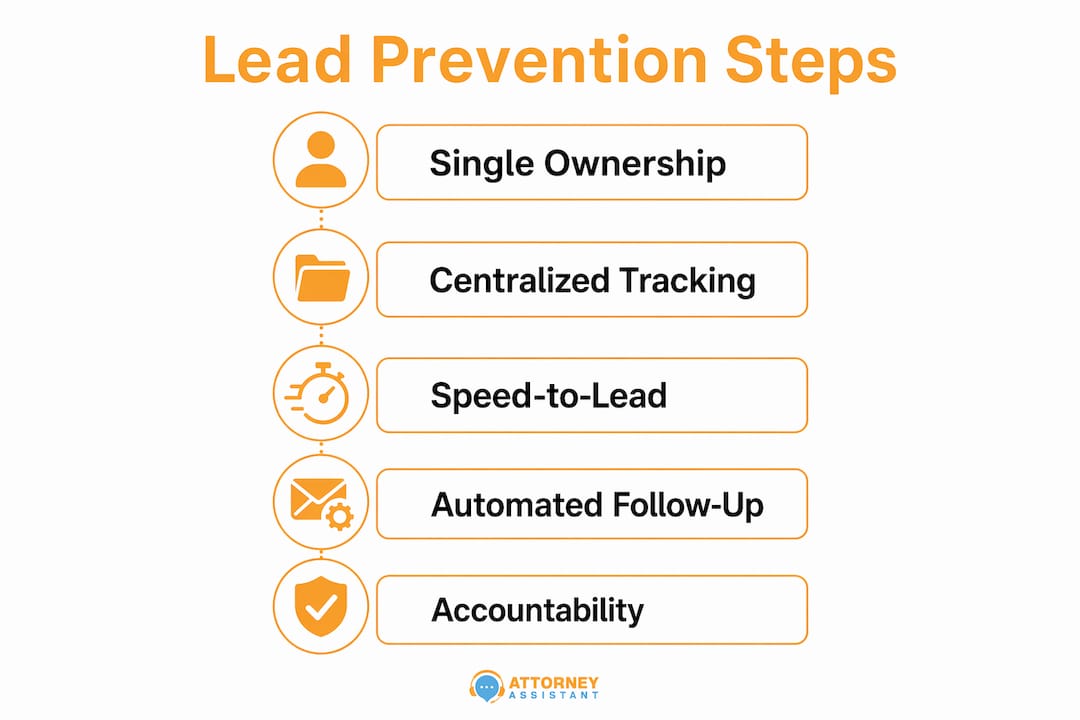
Preventing lead loss requires three foundational elements in place before any follow-up strategy can work: clear ownership, centralized tracking, and a defined response time target.
Single-threaded ownership is the most critical prerequisite. Most lead loss results from shared inboxes with no assigned owner. When everyone is responsible, no one is. Every lead that enters your firm must be assigned to one person the moment it arrives.
Centralized lead tracking means every channel feeds into one system. Phone calls, web forms, chat widgets, and referrals all generate leads. Mapping all lead channels into a single CRM with automatic contact creation eliminates the channel islands where leads quietly disappear. Tools like Clio Grow, Lawmatics, and HubSpot each offer intake pipeline views designed for this purpose.
Speed-to-lead targets must be measurable and enforced. Set a firm-wide standard: first contact within 5 minutes during business hours, and automated acknowledgment within minutes after hours.

Here is a quick comparison of the three foundational prerequisites:
| Prerequisite | Without It | With It |
|---|---|---|
| Single lead owner | Leads stall in shared queues | Clear accountability at intake |
| Centralized CRM | Channel islands, invisible losses | Full pipeline visibility |
| Speed-to-lead target | Inconsistent response times | Measurable, enforceable standard |
Pro Tip: Set your CRM to auto-assign leads by practice area or intake coordinator the moment a form is submitted or a call is logged. Remove the manual assignment step entirely.
Technology accelerates all three prerequisites. AI voice reception handles overflow and after-hours calls. Auto-response emails confirm receipt within seconds. Workflow automation generates the next task at each pipeline stage without anyone remembering to do it manually.
What does an effective intake and follow-up process look like?
A reliable intake process is a defined sequence, not a set of habits. Here is the workflow law firms use to convert more leads without adding headcount.
- Log the lead immediately. Every inquiry, regardless of channel, enters the CRM within minutes of contact. The intake timestamp is recorded automatically.
- Assign an owner at intake. Immediate CRM assignment at the intake timestamp minimizes pipeline stalls. The assigned person receives an automatic task to make first contact.
- Make first contact within 5 minutes. This can be a live call, an AI voice interaction, or a personalized text. The goal is a real response, not an auto-reply that says “we received your message.”
- Follow a multi-touch cadence. Most deals require 5–12 touches across multiple channels before conversion. A single follow-up call is not a strategy. Build a cadence: Day 1 call, Day 1 text, Day 3 email, Day 7 call, and a re-engagement message at Day 14.
- Automate task creation at each stage. When a lead moves from “contacted” to “consultation scheduled,” the CRM should automatically create the next task. No one should rely on memory.
- Eliminate voicemail as a primary response channel. 85% of missed callers who reach voicemail never call back. Voicemail is where leads go to disappear.
Pro Tip: Build your Day 1 follow-up cadence as an automated sequence in your CRM so it fires without any manual trigger. Reserve human judgment for the consultation itself, not for remembering to send a text.
Here is how a manual process compares to an automated intake workflow:
| Factor | Manual Process | Automated Workflow |
|---|---|---|
| First response time | Hours to days | Under 5 minutes |
| Follow-up consistency | Depends on memory | Stage-triggered, always fires |
| Lead assignment | Done when someone notices | Instant at intake timestamp |
| Missed call handling | Voicemail, rarely returned | AI reception or auto-callback |
Which mistakes cause the most lead loss in law firms?
The most common causes of lead loss are operational, not strategic. They are process failures, not bad marketing.
- Shared inboxes without assignment rules. A lead that sits in a general inbox for two hours is effectively a lost lead. No one owns it, so no one acts on it.
- Slow first response. Waiting beyond the 5-minute window gives competitors time to intervene. Speed-to-lead is the highest leverage factor in lead retention because the prospect is most engaged at the moment they reach out.
- Inconsistent CRM data entry. Leads entered without a source, without a stage, or without an owner create invisible queues. You cannot fix what you cannot see.
- Voicemail reliance for phone leads. Phone calls convert at 10–15 times the rate of web leads. Letting them go to voicemail is one of the most expensive operational habits a firm can have.
- No pipeline visibility. Without alerts for stalled leads or no-response exceptions, leads age silently. Dashboards with SLA alerts on first response time and last activity date convert invisible losses into manageable daily exceptions.
- Ignoring cold or declined leads. A lead who said “not yet” in January may be ready in March. Firms with no re-engagement process leave that revenue on the table permanently.
The biggest operational lead leak is caused by weak ownership and disorganized data flows. Leads do not vanish because of bad marketing. They vanish because no one was watching.
The fix for most of these failures is not a new tool. It is a defined process with assigned accountability and a CRM configured to enforce it. You can read more about where lead leakage happens in personal injury and similar practice areas to see how these patterns play out in real intake workflows.
What advanced strategies improve lead retention long-term?
Once your intake process is solid, the next step is building systems that catch leads your initial process misses and recover leads that went cold.
- Segment lost leads for re-engagement. Not every cold lead is a dead lead. Segment by reason for loss: no response, not ready, cost concern, or chose another firm. Each segment needs a different message and timing.
- Use behavioral signals to prioritize follow-up. If a prospect opens your email three times in one day, that is a signal. CRMs like Lawmatics and HubSpot track email opens and link clicks. Use that data to trigger a same-day call.
- Build dashboards that surface stalled leads. Advanced monitoring via dashboards that track no-response alerts and last contact dates converts invisible lead loss into a daily exception list. Review it every morning.
- Standardize lead source categories. Standardizing lead source data and requiring consistent intake entry enables weekly reporting that shows which channels lose leads most often. Fix the channel, not just the symptom.
- Use AI to recover missed opportunities. AI voice reception captures calls 24 hours a day, 7 days a week. Firms using AI reception report significantly fewer missed leads, with measurable ROI within the first month of deployment.
- Send periodic value-driven outreach. A monthly email with a relevant legal update keeps your firm visible to prospects who are not ready yet. When they are ready, you are the firm they remember.
Here is a breakdown of re-engagement tactics by lead status:
| Lead Status | Re-engagement Tactic | Timing |
|---|---|---|
| No response after Day 7 | Automated text with direct question | Day 14 |
| Said “not ready” | Value email with no ask | 30 days later |
| Chose another firm | Check-in call or email | 90 days later |
| Opened email 3+ times | Same-day personal call | Immediate |
Key takeaways
Preventing lost leads in a law firm requires fast response, single ownership, automated follow-up cadences, and pipeline visibility working together as a system.
| Point | Details |
|---|---|
| Speed-to-lead is decisive | Contact within 5 minutes increases connection likelihood roughly 100 times versus a 30-minute delay. |
| Assign one owner per lead | Shared inboxes without assignment rules are the leading cause of leads stalling before engagement. |
| Automate your follow-up cadence | Stage-triggered tasks on Day 1, 3, and 7 replace memory-reliant follow-up and close process gaps. |
| Eliminate voicemail dependency | 85% of callers who reach voicemail never call back, making missed calls one of the costliest intake failures. |
| Monitor with dashboards | SLA alerts on stalled leads and no-response exceptions turn invisible losses into a manageable daily list. |
Speed is the variable most firms underestimate
I have worked with enough law firms to say this plainly: the intake problem is almost never about lead volume. It is about what happens in the first 10 minutes after a lead arrives.
Most firms I talk to have a CRM. Most have a follow-up process on paper. What they do not have is a system that fires automatically, every time, without someone remembering to trigger it. That gap is where revenue disappears.
The instinct is to add complexity: more routing rules, more approval steps, more people in the loop. That instinct is wrong. Every additional step between a lead arriving and a human making contact is a chance for the lead to go cold. The firms that convert best are the ones with the shortest, most automated path from inquiry to first conversation.
I also want to push back on the idea that AI reception is a last resort for firms that cannot afford staff. It is the opposite. AI handles the 6 PM call, the Saturday morning inquiry, and the overflow during a busy trial week. It does not replace your intake coordinator. It covers the hours your coordinator cannot. That is not a compromise. That is a smarter intake operation.
The firms that fix their intake response time first see the fastest lift in conversion. Start there before you touch anything else.
— Nicole
How Attorneyassistant helps firms stop losing leads
Most firms do not need a bigger marketing budget. They need to stop leaking the leads they already have.
Attorneyassistant handles the intake and follow-up workflows that most firms leave to chance. From live and AI-powered intake reception to automated lead follow-up sequences that fire without manual triggers, Attorneyassistant builds the operational layer between a lead arriving and a case getting signed. If your firm is losing leads to slow response times, voicemail, or inconsistent follow-up, the fix is a process problem, not a staffing problem. Book a call to see where your firm is leaking revenue and what it takes to close those gaps.
FAQ
What is the most effective way to prevent lost leads?
The most effective method is contacting every lead within 5 minutes of inquiry and assigning a single owner at intake. Automated CRM workflows that trigger follow-up tasks at each pipeline stage prevent leads from stalling between steps.
How do i track leads to avoid losing them?
Map every lead channel into one CRM and require consistent data entry at intake, including source, stage, and assigned owner. Dashboards with no-response alerts and last-activity tracking surface stalled leads before they go cold permanently.
Why do law firms lose so many phone leads?
85% of callers who reach voicemail never call back. Law firms lose phone leads primarily because calls go unanswered or to voicemail during busy hours, after hours, or during trial weeks without a live or AI reception backup.
How many follow-up attempts does it take to convert a lead?
Most conversions require 5–12 touches across multiple channels. A single follow-up call is not enough. A structured cadence across call, text, and email over 7–14 days significantly increases the chance of conversion.
What tools help law firms manage lead follow-up?
CRMs like Clio Grow, Lawmatics, and HubSpot provide pipeline tracking and automated task creation. AI voice reception tools handle missed calls around the clock. Combining a CRM with automated follow-up sequences covers the two most common points of lead loss.
Recommended
Related Articles

Appointment Setting Online: A Law Firm Guide
Master appointment setting online for law firms with proven strategies that turn leads into booked consultations and grow your practice.

Medical Records Request: A Practical Guide for Law Firms
Run a clean medical records request with HIPAA-compliant steps, sample language, timelines, fees, and follow-up tactics built for law firm operations.

Request for Discovery Template: A Practical Guide
Use our request for discovery template with annotated fields, jurisdictional notes, and filing instructions. Customize it for federal or state court cases.