Intake specialists: the key to higher PI case conversion

TL;DR:
- Poor intake processes cause significant revenue loss, not a lack of leads.
- An intake specialist’s role focuses on client acquisition, qualification, and follow-up.
- Speed, structured scripts, and multi-channel follow-up are key to increasing conversion rates.
Most personal injury law firms believe their growth problem is a lead problem. It is not. The real issue is that leads are already coming in and quietly slipping away because no one is responding fast enough, following up consistently, or qualifying callers with any structure. Poor intake processes can cost firms $80,000 or more per month in lost revenue. That is not a marketing problem. It is an intake problem. This article breaks down what an intake specialist actually does, how they differ from other roles, and what specific strategies will help your firm convert more of the leads you are already paying for.
Table of Contents
- What is an intake specialist?
- Core functions and best practices for intake specialists
- Why speed, coverage, and follow-up impact revenue
- Applying intake specialist strategies to your law practice
- The overlooked impact: Intake specialists as profit multipliers
- Professional intake solutions for your firm
- Frequently asked questions
Key Takeaways
| Point | Details |
|---|---|
| Intake specialist role clarity | Intake specialists focus exclusively on qualifying and acquiring clients, not managing ongoing legal tasks. |
| Speed and empathy drive conversion | Rapid response and an empathy-first approach are central to maximizing signed cases in personal injury law. |
| Follow-up and coverage matter | Multi-channel follow-up and 24/7 intake coverage prevent revenue leakage and increase firm profitability. |
| Actionable integration | Applying structured intake practices and hiring suitable specialists can transform your law practice’s growth. |
| Virtual intake models scale small firms | Virtual or outsourced intake specialists enable smaller firms to compete with larger practices for client acquisition. |
What is an intake specialist?
An intake specialist is the first real point of contact between a potential client and your law firm. Their entire job is focused on one thing: turning inquiries into signed cases. They are not paralegals. They are not legal assistants. Their role is not to support attorneys on active cases. Their role is to acquire and qualify new clients before anyone else in the firm even gets involved.
This distinction matters more than most firm owners realize. When you ask a paralegal to handle intake calls between drafting motions, you are setting up both tasks to fail. Paralegals are trained for post-intake casework. Intake specialists focus on acquisition and qualification, which requires a completely different skill set, mindset, and set of priorities.
Here is a quick comparison to make the difference concrete:
| Role | Primary focus | Intake involvement |
|---|---|---|
| Intake specialist | Client acquisition and qualification | Full ownership of intake process |
| Paralegal | Case preparation and legal support | Minimal, post-sign involvement |
| Legal assistant | Administrative and clerical tasks | Occasional call handling only |
So what does an intake specialist actually do day to day? Their core tasks include:
- Answering inbound calls and web inquiries within minutes
- Running through a structured intake script to qualify the caller
- Conducting conflict checks before moving forward
- Scheduling consultations or transferring warm leads to attorneys
- Following up with prospects who did not convert on first contact
- Logging all interactions in your case management system
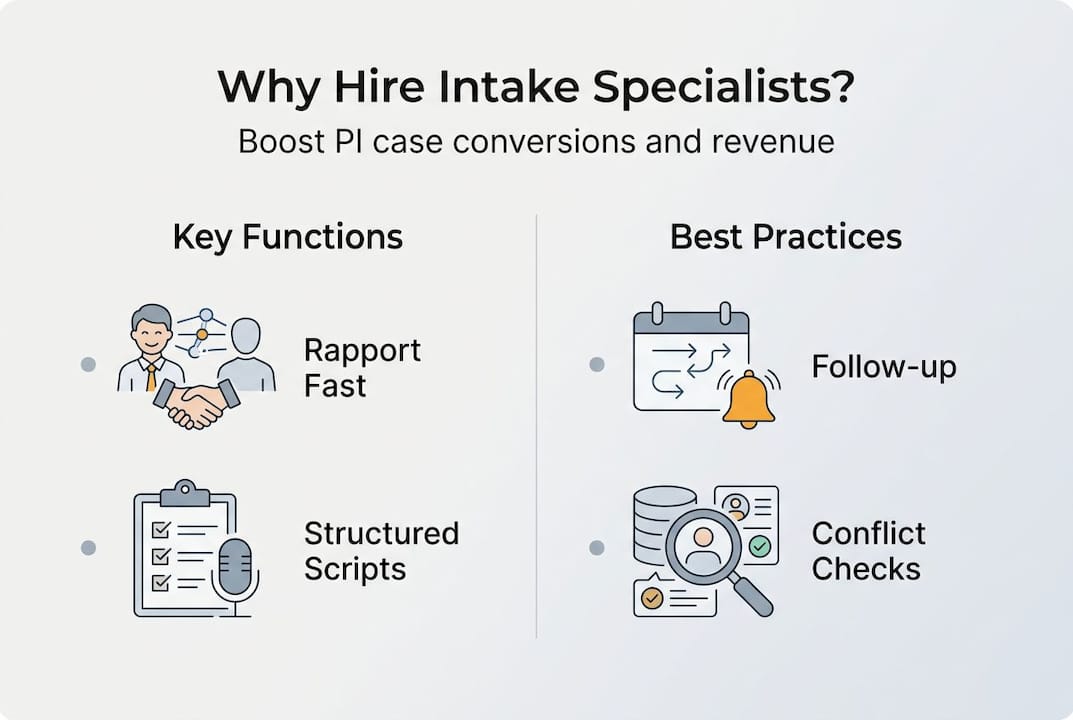
The traits that make a good intake specialist go beyond organization. You need someone who can build rapport fast, handle emotional callers with composure, and stay persistent without being pushy. Understanding the full range of intake specialist functions helps you set clear expectations when hiring or outsourcing this role.
One thing worth noting: intake is a revenue-generating function. It is not overhead. When you frame it that way internally, everything about how you staff, train, and measure the role changes for the better.
Core functions and best practices for intake specialists
Knowing what an intake specialist does is one thing. Understanding how they do it well is what separates firms that convert 20% of inquiries from firms that convert 60% or more. The difference almost always comes down to three things: structure, empathy, and follow-up.
1. Use a structured intake script
A script is not a rigid robot read. It is a framework that ensures every caller gets the same quality of experience and that your team collects the same critical information every time. Structured intake scripts, combined with empathy-first qualification and multi-channel follow-up, are the methodologies that consistently drive conversion.
2. Lead with empathy
Personal injury callers are often scared, in pain, or overwhelmed. The intake specialist who acknowledges that before diving into questions will build trust faster than one who sounds like they are reading a form. Listening is a skill. Train for it.

3. Run conflict checks early
This step is often skipped or delayed, which wastes everyone’s time. Build the conflict check into the script so it happens before the call goes any further.
4. Follow up across multiple channels
Email, text, and phone follow-up should all be part of the workflow. Not every prospect will pick up the phone. Some respond faster to a text. A well-designed effective intake process accounts for this by mapping out exactly when and how follow-up happens after the first contact.
5. Time your follow-ups strategically
Day one, day three, and day seven follow-ups tend to perform best. After that, the probability of conversion drops sharply.
“The intake call is not just a data collection exercise. It is the first moment a potential client decides whether they trust your firm enough to hire you.”
Pro Tip: Record your intake calls and review them weekly. You will spot patterns in where callers disengage, which lets you refine the script and improve conversion without spending a dollar on more leads.
Firms that invest in hiring an intake specialist with dedicated training almost always see faster conversion improvements than firms that try to bolt intake responsibilities onto existing staff. The role deserves its own focus.
Why speed, coverage, and follow-up impact revenue
Here is a number that should change how you think about staffing: 28 to 35% of inquiries arrive after business hours. If your intake process stops at 5 PM, you are handing a third of your potential cases to competitors who pick up the phone at 8 PM.
Speed compounds this problem. The 5-minute rule is not a suggestion. It is a conversion benchmark. Firms that respond to new inquiries within five minutes are dramatically more likely to sign that case than firms that respond in an hour. After 30 minutes, the probability of converting that lead drops by more than half.
Let’s put the revenue picture in plain terms:
| Response time | Estimated conversion likelihood | Monthly revenue risk |
|---|---|---|
| Under 5 minutes | High | Minimal loss |
| 5 to 30 minutes | Moderate | Moderate loss |
| Over 30 minutes | Low | Significant loss |
| After hours, no coverage | Near zero | Up to $80k+ monthly |
Those numbers are not hypothetical. Poor follow-up costs small firms $80,000 or more every month. That is revenue from leads you already paid to generate, simply lost because no one followed up in time.
To fix this, track these KPIs for your intake function:
- Cost per signed case: How much does it cost to convert one inquiry into a retained client?
- Response time: How quickly does your team make first contact after a new inquiry?
- Follow-up rate: What percentage of non-converting inquiries receive at least three follow-up attempts?
- After-hours conversion rate: How many leads that come in outside business hours actually get signed?
Explore the intake strategies that work specifically for PI firms and you will find that most high-performing firms treat intake as a measurable revenue function, not a soft administrative task. The firms that track these numbers improve them. The ones that do not, keep leaking revenue and wondering why their marketing is not working. More detail on legal intake conversion shows just how much is recoverable with the right systems.
Applying intake specialist strategies to your law practice
You understand the value. Now let’s talk about how to actually build this into your firm without overhauling everything at once.
Start by choosing the right intake model for your size and budget:
- In-house specialist: Best for firms with consistent high call volume. You get full control and deep brand alignment, but you carry the full cost of salary, training, and benefits.
- Virtual specialist: A remote employee who handles intake exclusively. Lower overhead than in-house, but requires strong systems and clear communication protocols.
- Outsourced intake service: A third-party team that handles calls, follow-up, and qualification on your behalf. Ideal for firms that need 24/7 coverage without building an internal team from scratch.
For most small and mid-sized PI firms, outsourcing or using a hybrid model makes the most financial sense. You get coverage without the fixed cost of a full-time employee sitting idle during slow periods.
Pro Tip: Before hiring or outsourcing, document your current intake workflow in writing. Most firms discover gaps they did not know existed once they map out every step from first call to signed retainer.
Here are four actionable steps to improve conversion starting this week:
- Set a firm-wide policy that all new inquiries receive a response within five minutes during business hours.
- Build or buy a structured intake script tailored to PI case types your firm handles.
- Implement a three-touch follow-up sequence for every lead that does not convert on first contact.
- Review your intake department goals quarterly and adjust KPIs based on what the data shows.
The research is clear: intake as a revenue engine means speed and follow-up outperform lead quantity every time. You do not need more leads. You need to stop losing the ones you have. Review intake specialist hiring tips to make sure you are evaluating candidates on the skills that actually drive conversion, not just administrative competence.
The overlooked impact: Intake specialists as profit multipliers
Most firm owners think of intake as a cost center. Someone has to answer the phones, so you hire someone to answer the phones. That framing is costing you more than you know.
Intake specialists are not administrators. They are the first revenue-generating function in your firm. Every case they sign is a case that would have otherwise gone to a competitor, been lost to voicemail, or simply aged out because no one followed up. Law firm owners often underestimate the conversion potential that professional intake unlocks.
Here is the contrarian view: investing in intake before investing in more marketing is almost always the smarter move. More leads fed into a broken intake process just means more expensive losses. Fix the conversion rate first, then scale the lead volume.
The firms that treat intake as a strategic function, measure it rigorously, and staff it with purpose-built specialists are the ones that grow without chaos. Boosting client conversion starts not with a bigger ad budget, but with a better answer to the phone.
Professional intake solutions for your firm
If anything in this article made you think about gaps in your current process, you are not alone. Most PI firms we work with are losing cases they never even knew they had.
At Attorney Assistant, we handle intake services built specifically for personal injury firms. From first call to signed retainer, our team manages the follow-up, qualification, and coverage gaps that cost firms revenue every day. Our 24/7 intake support means no inquiry goes unanswered, even at midnight. If you want to see what a purpose-built intake function could do for your firm’s conversion rate, book a call and let’s map it out together.
Frequently asked questions
How quickly should an intake specialist respond to new inquiries?
The 5-minute response rule is considered best practice. Waiting longer than 30 minutes significantly reduces the likelihood of converting that inquiry into a signed case.
What information should an intake specialist collect during the first call?
The specialist should gather contact details, accident date, injury description, current treatment status, insurance information, and the at-fault party’s details. Structured intake ensures this information is collected consistently across every call.
Why is 24/7 coverage important for intake?
Up to 35% of potential client calls occur after normal business hours, meaning firms without after-hours coverage are missing a significant share of their inbound leads.
What KPIs should law firms track for intake specialist performance?
Focus on cost per signed case, average response time, follow-up rate, and after-hours conversion rate. Tracking intake ROI through these metrics makes it easy to identify and fix weak points in the process.
Can small law firms benefit from virtual or outsourced intake specialists?
Absolutely. Virtual and outsourced intake gives smaller firms scalable, after-hours coverage without the fixed cost of a full-time in-house hire.
Recommended
Related Articles

Medical Records Coordinator: What the Role Actually Does
A medical records coordinator manages records retrieval, summaries, billing, and liens for law firms. Learn duties, KPIs, and when to outsource vs hire.

Macs for Lawyers: The Hardware and Compatibility Guide
A practical guide to Macs for lawyers covering hardware choices, software compatibility, security tradeoffs, and recommendations by firm size and workflow.

Business Telephone Answering Service for Law Firms
How a business telephone answering service works for law firms, including 24/7 intake, qualification, warm transfers, pricing models, and what