Legal Admin Automation Examples for Law Firms in 2026

TL;DR:
- Legal admin automation reduces time-consuming tasks like intake and document management, boosting efficiency and capacity. It emphasizes integrating tools with existing systems, standardizing workflows, and measuring impact for continuous improvement. Firms that focus on filtering and decluttering incoming requests can achieve significant operational transformation without replacing their current software.
Manual processes are bleeding time and money from your firm every day. Missed intake calls, late follow-ups, documents sitting in email threads waiting for a signature — these are not random failures. They are structural problems, and they compound. This article covers concrete legal admin automation examples drawn from real firm workflows in 2026, so you can see exactly where automation applies, what it replaces, and what results to expect. Whether you are managing intake, billing, or case documentation, there is a specific solution built for your problem.
Table of Contents
- Key takeaways
- 1. How to evaluate legal admin automation examples before you commit
- 2. Automating client intake and case onboarding
- 3. Workflow automation for document management and task tracking
- 4. Automated invoice review, billing, and financial workflows
- 5. AI-powered agents for legal operations
- 6. Comparison of key legal admin automation options
- 7. How to decide which automation fits your firm
- My honest take on legal admin automation in 2026
- How Attorneyassistant helps you put this into practice
- FAQ
Key takeaways
| Point | Details |
|---|---|
| Intake automation delivers the biggest wins | Automating client intake can reduce admin work by 90% and increase client capacity by 25%. |
| Integration beats replacement | Adding automation as a layer on top of existing tools like Outlook and your DMS reduces friction and speeds up adoption. |
| Data quality determines outcomes | Standardizing your intake process before automating prevents replicating broken workflows at machine speed. |
| Start with repetitive, structured tasks | The best automation candidates are tasks with clear rules, consistent inputs, and no need for legal judgment. |
| Measure impact after implementation | Track time saved, error rates, and conversion metrics within 30 days to validate and refine your automation setup. |
1. How to evaluate legal admin automation examples before you commit
Not every task in your firm is a good candidate for automation. The first step is identifying what fits.
Automation works best on tasks that are repetitive, structured, and rule-based. Drafting a contract from a template, routing an intake form, sending a follow-up email after a consultation — these have clear logic and predictable inputs. Complex legal judgment does not belong in an automated workflow. Mixing the two creates more risk than it removes.
When evaluating tools, consider these factors:
- Integration capability. Tools built around familiar platforms like Outlook and iManage reduce data duplication and see higher staff adoption because they fit into how lawyers already work.
- Ease of use. If your team needs weeks of training before they can use a new system, adoption will stall before results appear.
- Operational impact. Measure what changes: time saved per task, error frequency, capacity per attorney, and lead conversion rate.
- Scalability. A solo practice has different needs than a 40-attorney firm. Choose tools that grow with your caseload.
- Customization. Off-the-shelf workflows rarely match real firm processes. Look for tools that let you configure rules, triggers, and approval chains without hiring a developer.
Pro Tip: Before evaluating any tool, map your current workflow on paper first. Identify the exact step where delays, errors, or handoffs break down. Automating a broken process just makes the breakdowns happen faster.
2. Automating client intake and case onboarding
Client intake is where most firms lose the most revenue without realizing it. A lead calls, gets voicemail, moves on to the next firm. Or a form gets filled out, sits in an inbox, and goes uncontacted for 48 hours. By the time someone follows up, the case is gone.

AI-driven intake portals solve this by triaging and routing inquiries automatically based on case type, urgency, and practice area. A prospective client fills out a form, the system categorizes the matter, assigns it to the right attorney or paralegal, and triggers a follow-up notification — all without a human touching it first.
The results are measurable. Intake automation can reduce administrative work by 90%, save over 780 hours annually, and increase client capacity by 25%. Those numbers come from a documented case study, not a vendor’s marketing page.
AI triage at the intake stage can also reduce legal volume by 50 to 80% by filtering, routing, or resolving simple matters before they ever reach an attorney’s desk. That frees your legal team to focus on billable work.
Additional benefits at the intake stage include:
- Elimination of manual data entry errors from phone-to-spreadsheet handoffs
- Immediate confirmation emails to prospective clients, which reduces drop-off
- Integration with your CRM and case management system from the first touchpoint
- Consistent intake data that makes downstream automation more reliable
If you want a deeper look at intake-specific strategies, legal intake best practices covers the design decisions that determine whether your intake converts or leaks.
3. Workflow automation for document management and task tracking
Document-heavy firms spend enormous amounts of time on tasks that add no legal value. Drafting a standard NDA, chasing a signature, updating a case status after receiving a court notice — these eat hours every week across every role in the firm.
Automated document creation tools pull from pre-approved clause libraries and populate templates with case-specific data. What used to take 45 minutes takes three. AI-driven document analysis results in 6x faster task completion and a 70% reduction in manual verification time — not because the lawyer is faster, but because the system handles the mechanical work.
Task tracking automation pulls real-time status updates directly from communications. When a court filing confirmation lands in your email, the system updates the case file automatically. No one needs to forward the email, log into the case management system separately, and manually change a status field.
Pro Tip: The most underused feature in legal workflow tools is the automated reminder chain. Set it once for each stage of your matter lifecycle and your team will stop missing deadlines without a single additional calendar entry.
Here is a breakdown of common document and task automation applications:
| Automation Type | Manual Process Replaced | Time Impact |
|---|---|---|
| Template document generation | Manual drafting from scratch | 45 to 60 minutes per document |
| E-signature workflow | Printing, signing, scanning, filing | 1 to 3 days per document |
| Status update automation | Manual case file updates after emails | 10 to 20 minutes per update |
| Deadline reminder automation | Calendar management across staff | Eliminates missed deadlines |
| Approval routing | Email chains for internal sign-off | Reduces approval time by hours |
Centralizing these workflows in a dashboard connected to your document management system and email platform removes the biggest source of internal chaos: information living in multiple places that no one fully controls.
4. Automated invoice review, billing, and financial workflows
Billing is one of the most error-prone areas in legal administration. Manual invoice review means someone reads through every line item to find entries that fall outside client guidelines. That takes time, introduces human error, and slows payment cycles.
AI-powered billing review tools flag out-of-policy entries automatically. Block billing, vague task descriptions, and excessive time entries get surfaced before the invoice goes to the client. The attorney or billing coordinator reviews only the exceptions, not the entire document.
Benefits of automating legal billing workflows include:
- Faster approval cycles. Automated routing sends invoices to the right approver without a manual handoff.
- Fewer write-offs. Catching non-compliant entries before submission reduces client disputes and write-down requests.
- Better budget tracking. Real-time dashboards show matter spend against approved budgets, so no one is surprised at invoice time.
- Integration with accounting platforms. Data flows directly from the billing system to accounts receivable without re-entry.
Centralized approval automation saves at least 30 minutes of manual coordination daily per billing workflow. Across a team of five, that is over 600 hours per year returned to billable or higher-value work.
Vendor management is another area that benefits. Automated workflows track contract renewals, rate agreements, and payment terms without someone maintaining a spreadsheet by hand.
5. AI-powered agents for legal operations
This is where legal admin automation examples have moved well past document generation. Agentic legal operations now involve autonomous AI agents handling end-to-end workflows: collections, billing appeals, budget approvals, and even initial screening of legal talent.
An AI agent in a legal ops context does not just complete a single task. It manages a sequence. For example, when a billing dispute arrives, the agent pulls the original invoice, checks it against the engagement letter, drafts a response, and routes it for attorney review. The attorney reviews and approves in one click rather than starting from scratch.
This kind of automation is no longer experimental. Firms using AI-powered agents for legal operations report measurable reductions in legal volume routed to attorneys, which is where the real efficiency gains appear. Reducing incoming legal volume transforms firm operations more profoundly than speeding up individual lawyer tasks.
The practical entry points for most firms are narrow but high-impact: automated follow-up for outstanding invoices, AI-assisted responses to routine client questions, and autonomous routing of standard contract requests based on category and risk level.
6. Comparison of key legal admin automation options
| Automation Example | Core Function | Integration | Efficiency Gain | Best For |
|---|---|---|---|---|
| Client intake automation | Triage, routing, and follow-up | CRM, email, case management | 90% admin reduction, 25% more capacity | High-volume consumer practices |
| Document workflow platforms | Template generation, e-signatures | DMS, Outlook, cloud storage | 6x faster document completion | Transactional and litigation firms |
| Billing automation tools | Invoice review, approval routing | Accounting software, billing systems | 30+ minutes saved daily | Firms with complex billing guidelines |
| AI-powered legal ops agents | End-to-end workflow management | Full-stack legal platforms | 50 to 80% volume reduction | Mid-to-large legal departments |
| Task and deadline automation | Status updates, reminders | Calendar, case management | Eliminates missed deadlines | All firm sizes |
No single tool covers every category well. Most firms benefit from combining two or three targeted solutions rather than deploying a single platform that does everything at a lower quality.
7. How to decide which automation fits your firm
Start with your pain. Not what sounds interesting or what a vendor is pitching — what is actually costing you time, clients, or money right now.
Ask these questions before committing to any tool:
- Where do cases fall through the cracks most often?
- Which tasks take your team the most time relative to their legal value?
- What errors happen repeatedly because of manual data entry?
- Which follow-ups get delayed because no one owns the next step?
- Where does client communication break down between intake and retainer?
Once you have answers, prioritize by impact and ease of implementation. Intake automation typically delivers the fastest, most measurable return because it directly affects revenue. Document automation comes next for firms with high document volume. Billing automation matters most for firms managing multiple client billing guidelines simultaneously.
Pro Tip: Implement one automation at a time and measure its impact over 30 days before layering in the next. Firms that automate everything at once often end up with disconnected systems that create new coordination problems.
Integrating automation as a layer on top of existing tools rather than replacing systems reduces implementation time and gets your team using the new workflow faster. The goal is to add capability without adding chaos.
My honest take on legal admin automation in 2026
I have seen a consistent pattern in firms that struggle with automation projects. They focus on making lawyers faster when the real leverage is reducing what reaches lawyers in the first place.
Think about it this way. If your intake process is filtering, categorizing, and resolving 60% of incoming requests before an attorney sees them, you have effectively expanded your firm’s capacity without hiring. That is operational transformation in the most practical sense.
The other thing I have learned is that the quality of your input data determines everything. Standardizing intake before you automate is not optional. Automate a messy intake process and you get a faster, messier intake process.
Cultural resistance is real, but it is almost always driven by fear of replacement rather than resistance to the tool itself. Positioning automation as drudgery removal rather than headcount reduction changes the conversation. It works because it is true. No one in your firm wants to manually update case statuses for four hours a week.
Start narrow. Prove value quickly. Then expand. Firms that treat automation as an operational partner rather than a technology project get results.
— Nicole
How Attorneyassistant helps you put this into practice
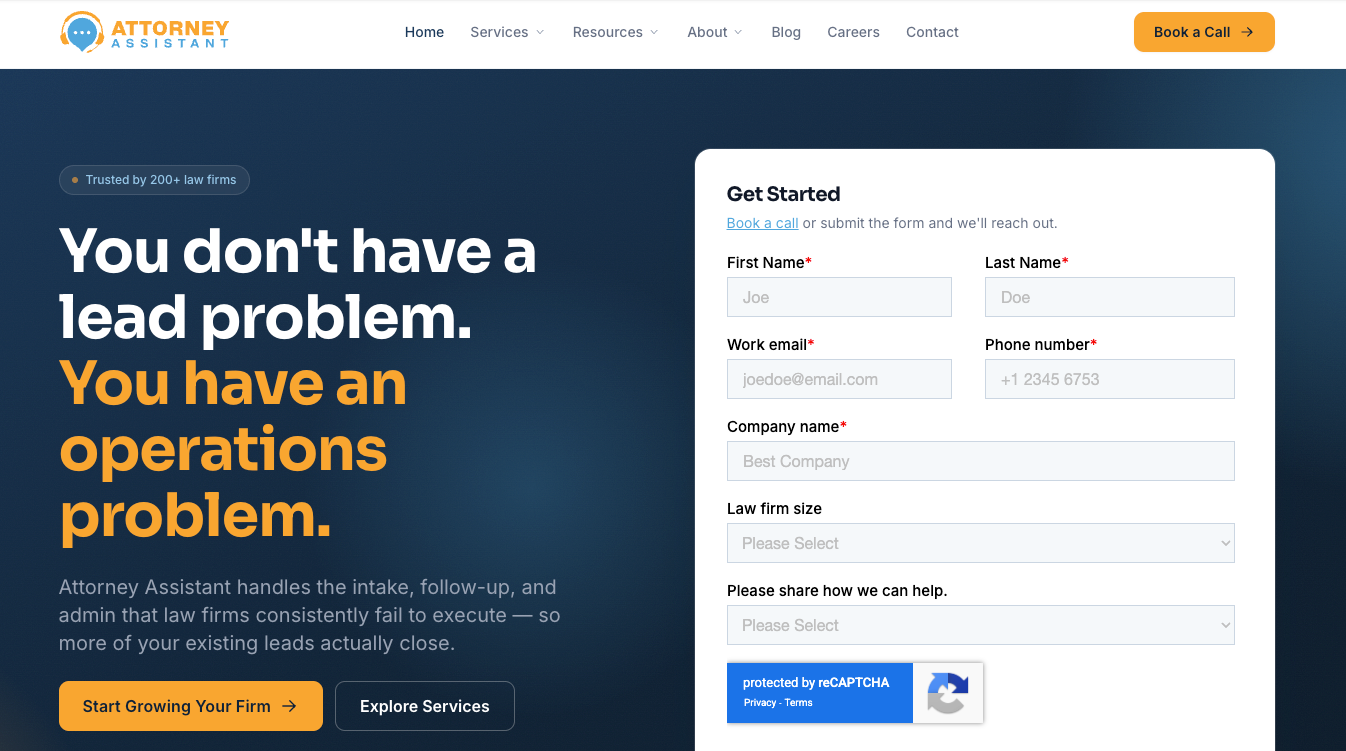
Attorneyassistant works directly with law firms to fix the intake and follow-up gaps that cost firms signed cases every week. If your firm is missing calls, responding slowly, or losing leads because no one owns the follow-up, that is a workflow problem — not a lead volume problem.
Firms working with Attorneyassistant have achieved up to 90% reductions in administrative workload and saved over 780 hours annually through structured intake automation. We do not replace your team. We handle the workflows your team does not have capacity for.
If you want to see how this applies to your specific firm, join our free webinar to walk through real intake and automation case studies. You can also explore our free firm tools to identify where your firm is losing time right now. And if you are ready to talk through your specific situation, book a call directly.
FAQ
What are the best legal admin automation examples for small firms?
Client intake automation, automated deadline reminders, and document template generation deliver the highest return for small firms because they address the highest-volume, lowest-judgment tasks. These can be implemented without replacing existing systems.
How much time can automation save in legal administration?
Automation saves firms over 780 hours annually through intake alone, and billing workflow automation saves at least 30 additional minutes per day per workflow. Total savings depend on firm size and automation scope.
What is the biggest risk when automating legal admin tasks?
The biggest risk is automating a broken process. Poor-quality input data perpetuates inefficient workflows at speed. Standardize your intake and task processes before deploying any automation tool.
Do legal admin automation tools replace existing software?
No. The most effective automation in legal administration works as a layer on top of tools your team already uses, like Outlook, your DMS, and your billing system. Replacement approaches take longer and face more resistance.
How do I measure whether my legal automation is working?
Track four metrics in the first 30 days: time per task before and after, error rate on key workflows, lead response time, and conversion rate from inquiry to signed retainer. If these do not improve within 60 days, the implementation needs adjustment.
Recommended
Related Articles

Keep the Conversation Going: 8 Intake Follow-Up Tactics
Learn how to keep the conversation going with law prospects using eight practical intake and follow-up tactics, from speed-to-lead to attorney handoffs.

Preferred Method of Contact for Law Firm Intake
Discover how to capture and use the preferred method of contact in legal intake to improve conversions, ensure compliance, and streamline law firm operations.

1st Dollar Coverage in Law Firm Retainers: A Practical Guide
Understand 1st dollar coverage in legal and insurance contexts. Learn how it shapes intake, retainer strategy, firm revenue, and risk.