Medical Records Request Law: Rules, Deadlines and Fees

The chart you need is sitting in a provider's fax queue. Your file is open, the client is asking for an update, and nobody on your side can say whether the request even arrived. Medical records request law is the unglamorous part of a personal-injury or disability file that decides whether the case moves or waits another month.
The useful question is not whether the patient has a right to the chart. It is which route you are using, because the fee and the clock change with the route. Send the wrong one and you will spend the next two weeks arguing about an invoice that never should have existed.
Table of Contents
- The Federal Floor for Medical Records Requests
- Choosing the Right Request Pathway
- How State Law Changes the Answer
- Counting Deadlines and Proving a Delay
- What Providers Can and Cannot Charge
- How to Send a Request That Gets Usable Records
- Confirm the Pathway Before You Send Another Request
The Federal Floor for Medical Records Requests
A request leaves your office on a Tuesday. By Friday it is one more page in a hospital fax queue, and the calendar is already running. That wait is not a favor the front desk grants when someone has a spare hour. Under medical records request law, it is a timed duty.
The federal floor is the HIPAA Privacy Rule, enacted under the Health Insurance Portability and Accountability Act of 1996. As the HHS right-of-access guidance explains, individuals and their personal representatives may inspect, review, and receive copies of protected health information in a designated record set held by covered health plans and providers, with limited exceptions. Covered entities generally must act within 30 days after receiving an access request. If the records are not maintained or accessible on-site, that period may extend to 60 days, and one further 30-day extension is allowed only when the entity gives a written explanation and an expected completion date.
| Rule element | Federal HIPAA baseline | What it means for your request |
|---|---|---|
| Who may request | Individual or authorized personal representative | Attorneys need documented authority from the patient |
| Response deadline | 30 calendar days | Confirm whether the 2026 change to 15 days is in effect |
| Extension | One additional 30-day period | Requires written notice with the reason and expected completion date |
| Requested format | Form or format requested, if readily producible | Ask for a searchable PDF or electronic files |
| Stronger state rules | Applies where state law gives more access | Check state law before assuming federal limits apply |
What each row asks you to do
Who may request. The patient, or a personal representative with documented authority, holds the access right. An attorney does not step into that role because the firm's letterhead looks official. You need a signed authorization or representative papers in the file before you send anything.
The clock. Thirty calendar days runs from receipt, not from the day a clerk opens the envelope. Diary that date the same afternoon. A proposed HHS revision would shorten the federal window, so confirm the effective date before you build a workflow around a shorter number. The row to check first is still the deadline. That is where most delays begin.
The extension. One extra 30-day period is lawful only with written notice that states the reason and the expected completion date. Silence is not an extension. A phone message that “records are backed up” is not one either.
Format. If a searchable PDF or an electronic file is readily producible, that is what you should receive, including electronic delivery where it is available. “We printed it” is not the same answer.
State law. HIPAA does not preempt a state rule that gives greater access, including a ban on fees or a lower fee. Fee components get their own treatment below so this table stays scannable. Firms that want a practitioner's walk-through of authorizations and follow-up can also use Nares Law Group on record requests as a plain-language companion, then check the statute that governs the custodian.
Choosing the Right Request Pathway
Pick the route before you pick the form. A patient access request, an attorney request on a signed authorization, a subpoena, and a court order do not share one fee schedule or one due date. A provider's “standard per-page fee” does not travel with you from one route to the next.
| Pathway | Who makes the request | How fees are set | Where the deadline comes from |
|---|---|---|---|
| Patient portal or inspection | Patient | Free inspection and automated electronic access | HIPAA access rule |
| Patient access request | Patient or personal representative | Reasonable, cost-based under HIPAA | HIPAA access rule |
| Attorney request with patient authorization | Attorney holding a signed authorization | Set by authorization terms and state law | Authorization terms and state law |
| Subpoena | Party issuing the subpoena | Set by state rules and subpoena terms | Date stated in the subpoena |
| Court order | Court-directed requester | Set by the order | Date set by the court |
Why the route changes the bill
A patient access request stays inside HIPAA's cost-based fee rule and the federal response clock. An attorney request follows the authorization you drafted and the state statute that covers that custodian. A subpoena carries the return date printed on it. A court order carries the date the court set. Mixing those up is how a firm ends up paying a litigation copy rate for a request the patient could have made directly.
Colorado is a clean illustration, not a national template. The 2026 Colorado medical-record bill caps attorney-requested records at $400 when production exceeds 664 pages, requires an invoice within 30 days, and generally makes the records free if the provider misses the deadline without timely extension notice. The same HHS revision distinguishes free inspection and automated electronic access from chargeable copying, requires fee information in advance, and limits allowable charges to specified labor, supplies, postage, or an agreed summary.
Practical rule: If the patient can open the portal today, start there. Free inspection is not the same transaction as a paid copy job.
The order that actually saves time
Check the portal or an in-person inspection first. Choose the route second. Send the request third. Sending four letters to the same custodian does not make the chart arrive faster. It gives the records clerk four reasons to ask which one you meant.
That mistake is expensive in a personal-injury practice. A thin authorization, an invoice nobody can explain, and the wrong mechanism create delay and a client who thinks the firm has gone quiet. The clinical chart and the bill are also different productions. A useful contrast is this discussion of medical chart versus billing records, which shows why a subpoena aimed at one may not produce the other. For the day-to-day sequence firms use once the route is chosen, see how firms acquire medical records without losing the thread.
How State Law Changes the Answer
A provider may meet the federal rule and still miss the mark under state law. State statutes can set shorter deadlines, lower fee limits, or prohibit fees in situations where federal rules allow them. Colorado, for example, has a statute that combines a fee cap with consequences for delay. Its rules are not a template for Texas, Pennsylvania, or New Jersey.

The type of record can change the rules, too. Mental-health records and substance-use-disorder records may carry additional protections. Federal 42 CFR Part 2 governs records from substance-use-disorder programs, recognizes patient access, and adds confidentiality controls. If a request covers both ordinary treatment records and records governed by Part 2, check the applicable requirements for each before sending it.
Before relying on a deadline or fee limit, answer four questions:
- Which statute applies to this custodian? Hospitals, physicians, and health plans may be covered by different state provisions.
- Does the statute cap or prohibit fees? A state ceiling may limit what the provider can charge.
- What is the deadline, and what follows if it passes? State laws differ on extensions and on whether a missed deadline affects fees.
- Does the state distinguish attorney requests from patient requests? If it does, the request pathway may affect both the deadline and the cost.
Check the state medical-records statute and relevant guidance from the state health department, medical board, or attorney general. Confirm the current text before quoting a fee limit or deadline in a demand letter or client update.
Counting Deadlines and Proving a Delay
A request arrives on Monday, but the provider's records team opens it days later. For deadline purposes, the important date is generally when the provider received a valid request, not when someone began processing it. Record the delivery date, then identify the request pathway: patient access, attorney authorization, subpoena, or court order. The rules can differ, so a deadline from one route should not be applied automatically to another.
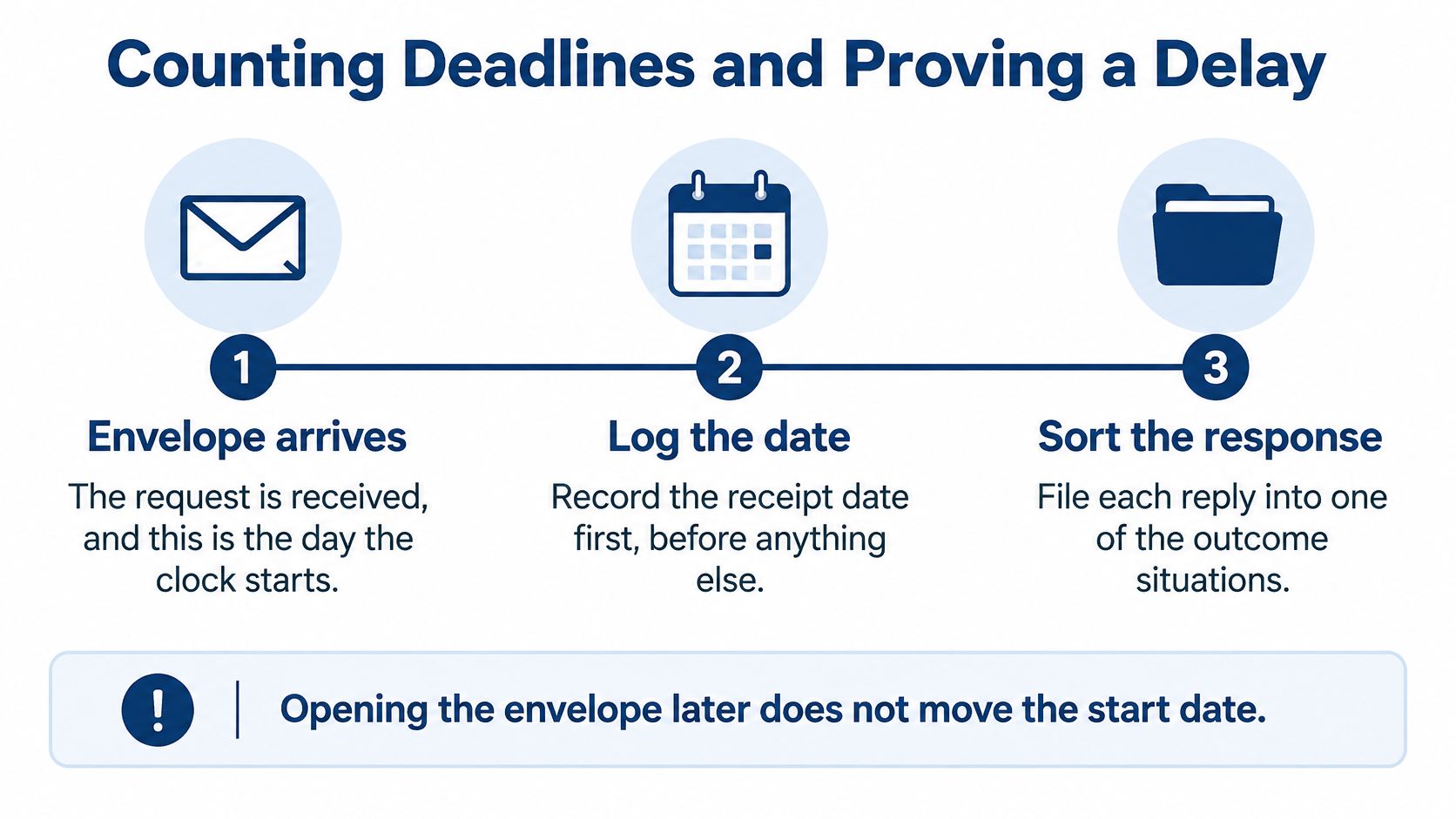
For a HIPAA patient-access request, the current federal rule generally allows 30 calendar days to respond, with one extension of up to 30 additional days if the provider gives written notice within the initial period, explains the delay, and states when access will be provided. HHS has proposed shortening the initial period to 15 days. Treat that as a proposed change, and confirm whether it has taken effect before relying on it. A vendor backlog or technical problem does not by itself establish that a delay is permitted. Electronic-access issues may also raise a separate information-blocking question.
| Situation | What the provider did | Response |
|---|---|---|
| Lawful extension | Sent timely written notice with a reason and expected date | Calendar the stated date and track delivery |
| Silence | Sent no response or extension notice by the applicable deadline | Document the missed date and send a written follow-up |
| Incomplete production | Delivered only part of the requested chart but called it complete | Identify missing providers, records, or date ranges in writing |
| Denial | Refused access | Request the written basis and any available review procedure |
| Redaction dispute | Withheld specific portions and gave reasons | Address the disputed redactions in writing |
| Blanket withholding | Withheld the entire file without a specific basis | Escalate the request to the provider's privacy office |
The file that proves the delay
A clear timeline makes a delay easier to assess. Keep the receipt date, request scope, proof of identity or authority, fee disclosures, extension notices, partial productions, and dated follow-ups together. For a large chart, separate requests by provider or date range can make each outstanding portion easier to track.
A phone statement that access is denied leaves little to document. Ask for the decision and its basis in writing. If only specific notes are disputed, address those separately from any records the provider has not produced. For blanket withholding, consider escalating to the provider's privacy office and then to the appropriate state or federal complaint channel.
On a fatal-injury matter, records follow-up can run alongside efforts at preserving evidence after a fatal accident. Keep the request log current so the status and next follow-up date are clear.
What Providers Can and Cannot Charge
For a patient access request, the fee has to be reasonable and cost-based. The HHS individual right-of-access page limits what that charge may include. Labor for copying, supplies or electronic media the person asked for, postage when you want paper mailed, and an agreed summary are in bounds. Searching for the chart and retrieving it are not. An unpaid medical bill cannot be used to block the copy.
| Charge | Allowed under HIPAA access? | Note |
|---|---|---|
| Copy labor | Yes, cost-based | Reasonable labor for copying |
| Paper copy supplies | Yes | Only for paper copies |
| Mailing postage | Yes | Only for records sent by mail |
| Agreed summary or explanation | Yes, if the requester agrees | Fees may apply |
| Searching or retrieving records | No | Not chargeable |
| Per-page fee on electronic records | Not automatically | Must be reasonable and cost-based |
| Charge tied to an unpaid medical bill | No | Access cannot be denied for unpaid bills |
| Fee on an attorney or subpoena request | Separate from the access-fee rule | Follow the authorization, the subpoena, or the state statute |
Bookmark that table. It is the page you want when an invoice arrives with a retrieval line and a per-page rate on a file that never left the electronic record. Electronic copies are not priced, by default, like a paper chart. Attorney, subpoena, and court requests can follow different fee rules, so do not use this table as the last word on those routes.
Intake controls before the request stalls
Get the estimate in writing. Record the amount, the stated basis, and whether anyone has paid it. Note, in the same entry, whether production is being held until the check clears. Challenge a retrieval charge or a flat per-page electronic fee before the request goes quiet. A tracker that only says “fee requested” will not help you three weeks later.
Keep the signed authorization with that note. Limit the request to the custodians and dates you need. A dispute is much shorter when the invoice and the request describe the same chart.
How to Send a Request That Gets Usable Records
A complete request is a short procedure, not a longer letter. Each step below has a reason and a common way it fails.
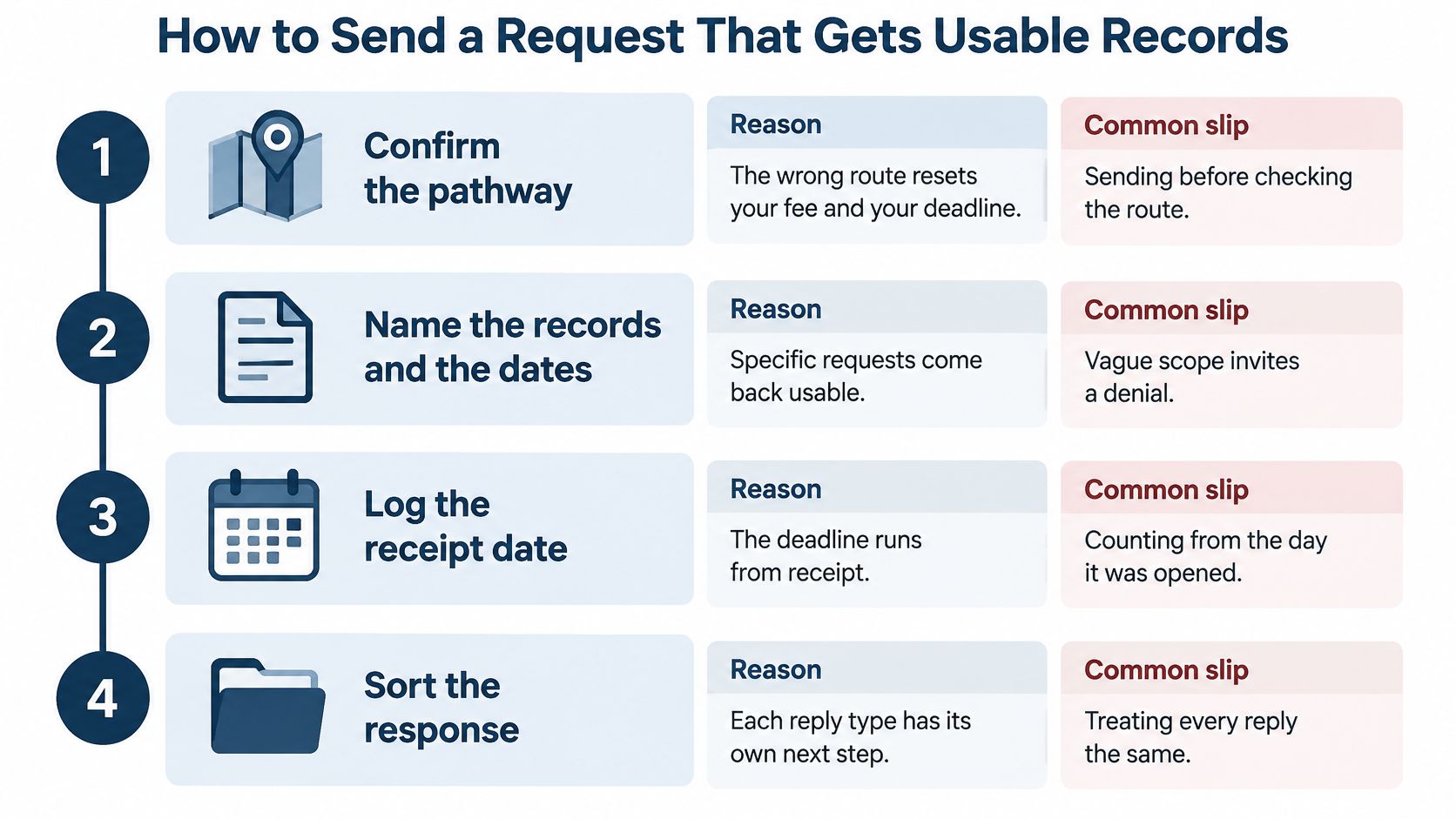
- Confirm the pathway. The wrong route resets your fee assumption and your deadline. The slip is sending the letter because the template was already open.
- Verify identity and authority. Use a current signed authorization, or papers showing a personal representative. A two-year-old form with a fuzzy scope is an easy stall, and custodians use it.
- Limit the scope. Name the provider, the date range, and the record type, including billing if you need it. “Any and all records, all dates” invites delay and a larger bill.
- Specify the format. Ask for a searchable PDF, an electronic billing file, or another file your review team can use.
- Log receipt and start the clock. Count from the custodian's receipt. If the shorter federal window is in effect for that request, set a check at that earlier date, not at day 30 out of habit.
- Ask for the fee estimate in writing before production starts, so a surprise invoice is not the first time you see the number.
- Confirm the file is usable. A disk that will not open, or a scan with no dates, is not the milestone you think it is.
Under the HHS electronic-access guidance, a covered entity must provide the protected health information in the form or format requested when that format is readily producible. If it is not, the provider must offer a readable hard copy or another format you both agree to. A summary is allowed only with the requester's agreement, and a fee may apply. Write down the requested format, the custodian's answer, and any agreed fallback. An informal “we'll just send paper” is not a documented refusal, and it is not an agreement either.
Receiving something and receiving a usable file are different milestones. Do not close the task on the first one.
A complete request file holds the pathway note, the authorization, the scope, the format request, the receipt proof, the fee estimate, and the production log. The person who keeps that file from living in one attorney's inbox is often a medical records coordinator rather than the lawyer who has a hearing in the morning.
Confirm the Pathway Before You Send Another Request
Take one open request and audit it before you send anything new. Check four items against the evidence file: route, deadline, fee basis, and requested format. If the route is wrong, correct it. Another letter on the same bad route will not fix the fee or the date.
If the route is right and the custodian is late, escalate in order.
- Write the deficiency. Name the missing providers or date ranges. “Please send the rest” is not a deficiency notice.
- Call the privacy office with the receipt date and the missed date in front of you.
- Complain to the state regulator that licenses or oversees that custodian.
- Use the appropriate federal channel only after the written record shows what you asked for and when.
That sequence fails when it lives in someone's memory. Our document collection includes tracking down signed fee agreements, requesting medical records, and handling follow-ups until every document is in hand. Outstanding medical records and bills get requested, tracked, and escalated until every provider delivers. Dedicated assistants who do that work are HIPAA certified, and the follow-up can sit on a weekly rhythm instead of a Friday scramble.
Staffline is built for that kind of records and bill retrieval inside the firm's own systems, one firm at a time. It is worth a look when the tracking is eating hours the attorneys cannot spare. It is not a substitute for reading the statute that applies to the custodian in front of you. A closer look at how lawyers review medical records once they arrive is the next problem, and it only starts after the right chart is in the file.
The best records request is the one that never needs escalating.
Attorney Assistant supports law firms with trained Staffline professionals for records retrieval, bill follow-up, and the rest of the operational work that stalls a file, plus Frontline's 24/7 live intake when the issue is missed calls rather than missing charts. If your attorneys are still chasing custodians between hearings, see how Attorney Assistant staffs that work so the case can move.
Related Articles

Client Experience Coordinator for Law Firms
See what a client experience coordinator owns in a law firm, from intake and status updates to the skills that keep matters moving.

Answering Service for Business: A Practical Guide for 2026
Learn how an answering service for business works, which options exist, and how fast, consistent call handling protects leads, intake and client trust.

Legal Secretary or Paralegal: Which Role Fits Your Firm
Compare legal secretary or paralegal roles by duties, pay, training and cost, then pick the one your firm needs for intake, records and attorney time.