Missed Call Solutions for Law Firms: Real Examples

TL;DR:
- Missed call solutions prevent lead loss by automatically responding to unanswered calls and booking consultations. They include automated SMS follow-up, AI phone agents, and integrated workflows that improve conversion rates and recover lost leads. Implementing these systems is essential for law firms to maximize revenue and avoid unnecessary client attrition.
Missed call solutions are systems that detect unanswered calls and trigger an immediate response to prevent lead loss. Law firms lose an average of $332,000 yearly to missed calls, with 35–50% of new client calls going unanswered during business hours and nearly 100% after hours without dedicated coverage. The examples of missed call solutions covered here range from automated SMS follow-up to AI phone agents and CRM-integrated intake workflows. Each one addresses a specific gap in how firms handle inbound calls, and each one is deployable without hiring additional staff.
1. Automated SMS follow-up systems
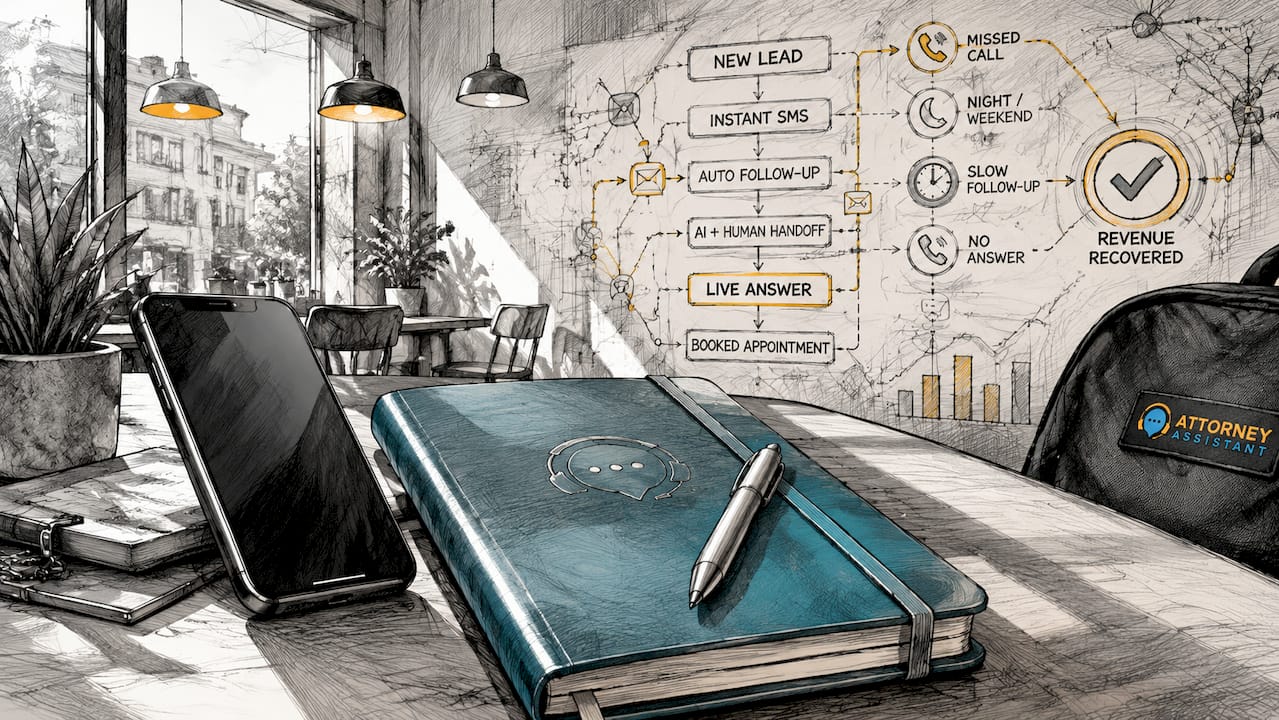
Automated SMS follow-up is the most widely deployed example of a missed call solution in legal intake. When a call goes unanswered, the system detects the missed call event through a VoIP webhook or API, then fires a text message to the caller within 30–60 seconds. That speed matters: sub-5-minute follow-up converts leads 7–10 times better than follow-up that happens after four hours. For a firm fielding dozens of calls daily, that gap in response time is the difference between a signed case and a caller who moved on to the next firm in Google’s search results.
The typical workflow runs like this:
- A call goes unanswered on the firm’s VoIP line
- The phone system sends a webhook event to the automation platform
- An SMS is dispatched to the caller with a short message and a link to book a consultation
- A contact record is created automatically in the firm’s legal CRM
- A follow-up task is assigned to the intake coordinator
This workflow runs identically at 2:00 PM and 11:00 PM. The after-hours message can be adjusted to set expectations: “We received your call and will follow up first thing tomorrow morning.” Suppressing after-hours texts is counterproductive. Prospects calling late expect immediate acknowledgment even when callbacks happen the next business day.
Compatibility with legal CRMs like Clio Manage and MyCase is well established. VoIP providers including RingCentral, Vonage Business, and Grasshopper expose the missed call webhook events that make this automation possible. Traditional landlines do not support this integration.
Pro Tip: Write two SMS templates: one for business hours that offers immediate booking, and one for after hours that confirms receipt and sets a callback window. A single generic message performs worse than a message that matches the caller’s timing.
2. AI phone agents and 24/7 virtual receptionists
AI phone agents eliminate missed calls entirely by answering on the first ring, around the clock. This is a fundamentally different approach from voicemail or a human answering service that takes messages. 80% of callers who reach voicemail hang up without leaving a message, and callbacks often arrive too late to retain the lead. An AI phone agent removes that failure point entirely.
A well-configured AI agent handles the full intake sequence in real time:
- Answers the call on the first ring, any time of day
- Identifies the caller’s practice area need (personal injury, family law, criminal defense, etc.)
- Qualifies the lead by asking intake questions
- Assesses urgency and flags high-priority cases
- Books a consultation directly into the firm’s calendar in Clio or MyCase
“AI phone agents act as an AI-native intake engine, providing lead qualification and booking consultations in real time, unlike traditional answering services that only take messages.”
The cost difference between service types is significant. AI receptionist services run $199–$699 per month. Human legal answering services cost $350–$1,000 per month. Full virtual receptionist services range from $1,200–$4,500 per month. AI handles simultaneous calls without additional cost, which human services cannot match during high-volume periods.
64% of legal calls occur after business hours, meaning firms without 24/7 coverage are wasting their marketing spend. Every paid ad click that converts to an after-hours call and hits voicemail is a direct loss. AI agents recover that spend by converting those calls into booked consultations.
3. CRM-integrated intake workflows
Connecting missed call detection to CRM intake workflows is where individual tools become a full missed call management system. The integration chain works across three layers: the VoIP phone system, the SMS dispatch platform, and the legal CRM.
Here is how a complete integrated workflow runs:
- A call goes unanswered on the firm’s VoIP line
- The VoIP system sends a webhook event to an automation platform such as Twilio
- Twilio dispatches an SMS to the caller within 60 seconds
- A contact record is created automatically in Clio Manage, MyCase, or Lawmatics
- A follow-up task is assigned to the intake coordinator with a due time
- If the caller does not respond within 24 hours, an escalation SMS or email is triggered
- The intake coordinator receives a summary of the lead’s practice area and call time
Firms that implement this full chain see measurable results. Integrated workflows that connect phone events, SMS dispatch, and CRM logging can increase consultation conversion rates from under 5% to over 14%. A three-attorney personal injury firm demonstrated this improvement after deploying the integrated approach.
Segmenting calls by practice area adds another layer of precision. A caller who presses “1” for family law gets a different SMS template and a different CRM task owner than a caller who presses “3” for criminal defense. That segmentation reduces the time intake coordinators spend routing leads manually.
Pro Tip: Build a real-time consultation booking link directly into your SMS template. Callers who can self-schedule convert at a higher rate than those who wait for a callback.
4. AI-powered voicemail recovery
Voicemail inboxes in most law firms function as a graveyard for leads that were never properly followed up. Structured AI follow-up on these voicemail graveyard leads can recover 20–40% of lost contacts. For a small firm, that recovery generates $30,000 to $80,000 or more in revenue from a single batch of old leads, without any new marketing spend.
The process involves exporting the list of unanswered calls and voicemails, then running an automated outreach sequence. The sequence sends an SMS, waits 48 hours, sends a follow-up, and flags any replies for immediate human response. Leads that respond get routed directly into the intake workflow as active prospects. This approach treats the voicemail inbox as a recoverable asset rather than a dead end.
5. Smart call routing and overflow design
Call routing is a preventive missed call solution. It reduces the volume of calls that go unanswered in the first place by directing calls to the right person or team based on time of day, practice area, or staff availability. Overflow routing, time-of-day routing, and spam filtering are the three core components of a well-designed call flow.
Overflow routing sends calls to a backup line or answering service when the primary line is busy. Time-of-day routing switches the destination automatically after business hours, sending callers to an AI agent or virtual receptionist instead of voicemail. Spam filtering blocks robocalls before they reach staff, protecting productivity and reducing the noise that causes real calls to be missed.
After-hours greetings should include an immediate SMS confirmation. A caller who hears “We are closed, but you will receive a text message in the next 60 seconds” is far less likely to call a competitor than a caller who hears a generic voicemail prompt.
6. Unified inbox for all inbound channels
A unified inbox consolidates calls, texts, web chat messages, and social media inquiries into a single interface. This matters because lead leakage happens across channels, not just on the phone. A prospect who calls and gets no answer may send a Facebook message or fill out a web form. Without a unified inbox, that follow-up message sits unread in a separate platform while the intake coordinator focuses on the phone queue.
Unified communication platforms assign every inbound contact a single thread, regardless of channel. The intake coordinator sees the full history: the missed call, the web form submission, and the text reply, all in one view. That context prevents duplicate outreach and speeds up the qualification process.
7. Regular intake audits
An intake audit is a scheduled review of how calls are handled from first ring to signed retainer. Firms that audit their intake workflows regularly identify gaps that technology alone cannot fix: intake scripts that ask the wrong questions, CRM tasks that go uncompleted, or SMS templates that generate low reply rates.
A basic audit covers four areas: call answer rate, SMS reply rate, consultation booking rate, and time from first contact to signed retainer. Tracking these metrics monthly gives firms a clear picture of where leads are dropping out of the intake process. The audit results then drive changes to scripts, routing rules, and follow-up sequences.
Key Takeaways
The most effective missed call solutions for law firms combine automated SMS follow-up, AI phone agents, and CRM-integrated intake workflows to capture and convert leads that would otherwise be permanently lost.
| Point | Details |
|---|---|
| SMS follow-up timing | Send automated texts within 60 seconds of a missed call to maximize conversion rates. |
| AI agents vs. voicemail | AI phone agents answer on the first ring and book consultations; voicemail loses 80% of callers. |
| CRM integration impact | Integrated workflows can lift missed call conversion rates from under 5% to over 14%. |
| After-hours coverage | 64% of legal calls happen after hours, making 24/7 intake a revenue requirement, not a luxury. |
| Voicemail recovery | Structured AI follow-up on old voicemails can recover 20–40% of previously lost leads. |
Why most firms are solving the wrong problem
Law firm administrators spend a lot of time asking how to get more leads. The harder question is how many leads the firm is already losing before anyone picks up the phone. After working with firms across practice areas, the pattern is consistent: the intake process breaks at the point of first contact, not later in the pipeline.
The financial math is uncomfortable. A firm missing eight calls per week with an 80% no-callback rate and a $5,000 average case value loses $1.66 million annually. That is not a marketing problem. That is an operational failure that no amount of ad spend will fix.
What I have seen work is treating missed call solutions as infrastructure, not as a patch. Firms that deploy SMS automation, connect it to their CRM, and add AI coverage for after-hours calls stop bleeding revenue immediately. The ones that see the biggest gains are not the firms with the largest budgets. They are the firms that commit to measuring their answer rate and follow-up speed every single week.
The technology is not the hard part. The hard part is accepting that voicemail is not a safety net. It is where leads go to die. Once a firm accepts that, the path forward is clear: answer every call, follow up within 60 seconds, and log everything in the CRM. The tools to do all of that exist right now, at a cost that is a fraction of the revenue being lost.
— Nicole
Attorney Assistant handles the calls your firm is missing
Law firms that fix their intake process stop losing revenue from leads they already paid to generate. Attorney Assistant’s intake and reception services are built specifically for this problem: missed calls, slow follow-up, and intake workflows that fall apart after hours.
Attorney Assistant integrates with Clio Manage, MyCase, and Lawmatics to automate contact creation, task assignment, and follow-up sequences from the moment a call goes unanswered. Firms get faster response times, higher consultation booking rates, and a clear record of every inbound lead. If your firm is ready to stop losing cases to missed calls, book a call with the Attorney Assistant team to see how the intake process can be fixed.
FAQ
What are the most common examples of missed call solutions?
The most common examples include automated SMS follow-up triggered within 60 seconds of a missed call, AI phone agents that answer 24/7, and CRM-integrated intake workflows that log every missed contact automatically.
How much does a 24/7 AI receptionist cost for a law firm?
AI receptionist services cost $199–$699 per month, compared to $350–$1,000 per month for human legal answering services and $1,200–$4,500 per month for full virtual receptionist services.
How do I reduce missed calls after business hours?
Deploy an AI phone agent or virtual receptionist to answer calls after hours, and configure your VoIP system to send an automated SMS to every caller who does not reach a live person.
What is the best way to follow up on a missed call?
Send an automated SMS within 60 seconds of the missed call. Sub-5-minute follow-up converts leads 7–10 times better than follow-up that happens after four hours.
Can law firms recover leads from old voicemails?
Structured AI follow-up on voicemail leads can recover 20–40% of lost contacts, generating $30,000 to $80,000 or more in revenue per batch without additional marketing spend.
Recommended
- Why Law Firms Miss Calls: Root Causes and Solutions | Attorney Assistant
- We Answer Your Phones — 24/7 | Attorney Assistant | Attorney Assistant
- How phone answering boosts client acquisition in law firms | Attorney Assistant
- Legal Answering Service for Law Firms | Attorney Assistant | Attorney Assistant
Related Articles
Business Telephone Answering Service for Law Firms
How a business telephone answering service works for law firms, including 24/7 intake, qualification, warm transfers, pricing models, and what

Call Flow Customer Service for Law Firms: A Practical Guide
Design a call flow customer service system for your law firm that captures leads, qualifies matters, and signs cases. Practical guide
Fear of Talking on Phone: 7 Practical Confidence Tips
Overcome fear of talking on phone with practical scripts, role-play, exposure exercises, and intake tools built for legal teams.