It's 4:52 on a Tuesday. Your receptionist is already on a call, one attorney is in a hearing, the other is at a deposition that started late, and a number nobody recognizes rings twice and stops. That caller found you, read enough to trust you, and tapped the number. Then they got silence, and now they're deciding whether to dial the next firm on the list.
None of that is a marketing failure. You bought the click. The phone rang. What broke was the handoff between an unanswered ring and a human being who could talk about the matter.
The fix that most firms reach for first is a missed call text back. It's cheap, it's fast, and it's frequently installed and then abandoned, because a text that fires and then forgets the person is just a receipt with better branding. The firms that get real cases out of it treat the text as the opening move in a handoff, not the whole intake process.
Table of Contents
- The Call That Already Told You They Want Help
- How Fast a Missed Call Text Back Must Fire
- The First Text and the TCPA Line
- What Happens After the Text Goes Out
- When Law Firms Actually Need the Text
- Numbers That Show the Text Is Working
- Put a Person Behind the Text
The Call That Already Told You They Want Help
A caller who dials your firm has done more work than any web form will ever require. They searched, they compared, they picked a number. That intent is the most valuable thing your intake desk will touch all day, and it has a short shelf life.
Missed call text back is an automated SMS that fires when a call to the firm goes unanswered. It names the firm, acknowledges the missed call, and offers one clear next step, such as a reply or a callback window. That is the entire mechanic. It isn't a consultation, it isn't a case evaluation, and it isn't a person. It's a bridge across the ninety seconds in which a prospective client decides whether you exist.
Compare that with what most firms have running instead:
- Voicemail nobody retrieves until morning. The message sits in a mailbox that gets checked between crises, and by then the caller has retained someone else.
- The sticky note. A name and number on a yellow square that lives in someone's memory, which is the world's least reliable CRM.
- The four-day callback. Technically, calling someone back four days later is follow-up. It is not particularly useful follow-up.
The plumbing is worth understanding before you buy another tool. If you want to see how the trigger side works in practice, this walkthrough of how SnapDial recovers missed calls covers the notification mechanics, from detecting the unanswered call to getting the alert in front of a person who can act on it.
Practical rule: the text exists to protect the call, not to replace it. If nobody owns the next step, you've automated the acknowledgment of a lost case.
What follows is the operating detail that separates a working workflow from a subscription: how fast the message has to fire, what sequence runs after it, what the first text may legally say, when firms need it, and which numbers prove a person reached the lead. Marketing volume does not fix an intake desk that can't absorb the call. Adding a fourth ad campaign to a phone system that rings out is a creative way to spend money on silence.
How Fast a Missed Call Text Back Must Fire
The rule is simple and firms violate it constantly. The text fires the moment the call ends unanswered, and the first live attempt is measured in minutes, not hours later. Speed isn't a personality trait of well-run intake teams. It's a specification you can set, log, and audit.
The benchmark most intake programs still build around comes from the Lead Response Management study, which analyzed more than 15,000 inbound leads and over 100,000 call attempts across six companies. Contacting a lead within five minutes rather than waiting 30 made organizations roughly 21 times more likely to qualify that lead, with the odds of reaching the person about 100 times higher.
| Response window | Odds of reaching the person | Odds of qualifying the lead | What the firm does |
|---|---|---|---|
| Within 5 minutes | About 100 times higher than a 30-minute wait | About 21 times higher than a 30-minute wait | Send the text immediately and start a live attempt |
| At 10 minutes | About 5 times lower than a 5-minute response | About 4 times lower than a 5-minute response | Treat the text as late and do not queue the callback |
| At 30 minutes | Baseline in the study | Baseline in the study | A text alone is a receipt; a person still has to own the lead |
The study wasn't a law-firm texting experiment, so treat those ratios as a speed benchmark rather than a promised retainer rate. The direction of travel is what matters: delay decays intent almost immediately. Moving from a five-minute response to a ten-minute response cut the odds of reaching the prospect by roughly five times and qualification odds by about four times. Ten minutes is not a rounding error. It's a different business.
What each window actually looks like on the desk
Inside five minutes, the text is out and a live specialist is already dialing. At ten minutes, the text is late and the callback cannot wait for someone's lunch break. At thirty minutes, the message that says "we'll call you back" is doing administrative work, not intake work. It confirms the call arrived. It does not advance the matter.
The practical discipline is timestamping. Every missed call should carry the caller number, the time, the tracking source, and a clock for the next human attempt. If your phone system can't produce those four fields, the text-back tool is guessing.
If you're still mapping the wider relationship between response time and signed cases, this breakdown of speed to lead in legal intake covers the measurement side in more depth. For the automation mechanics themselves, auto text replies for missed calls explains how platforms trigger the message and where the handoff usually gets dropped.
The First Text and the TCPA Line
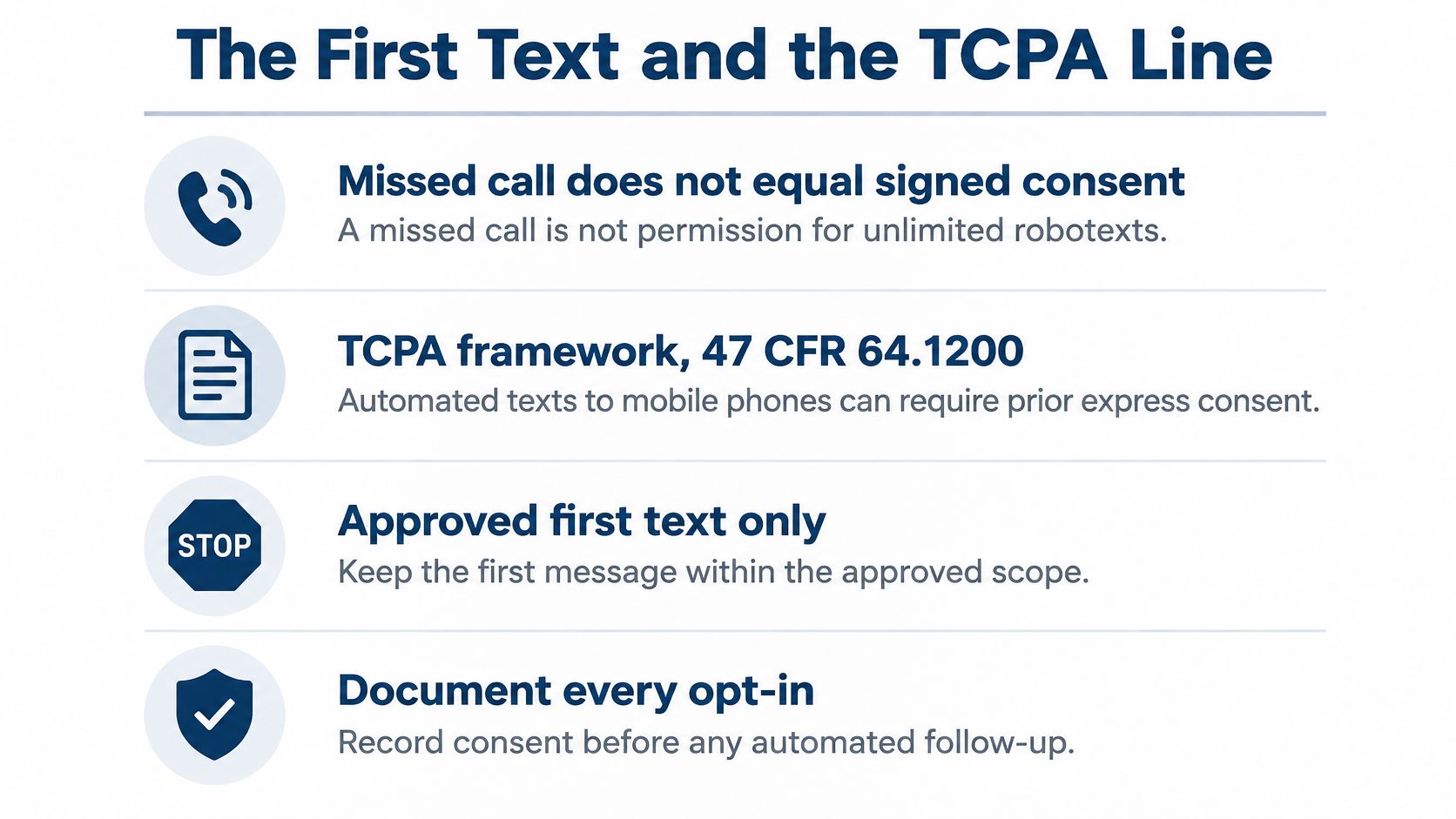
Here is the mistake vendors skip past. A missed call is not a signed permission slip for unlimited automated texting. Under the FCC's TCPA framework in 47 CFR 64.1200, automated texts to mobile phones can require prior express consent, and marketing or telemarketing messages sent through an autodialer or artificial or prerecorded voice generally require prior express written consent, as outlined in this review of the 47 CFR 64.1200 framework.
That distinction decides what your first message is allowed to be. Keep it narrowly transactional.
The message that works and the one that gets you sued
An acceptable first text identifies the firm, acknowledges the missed call, and offers one path forward:
Hi, this is [Firm Name]. We missed your call. Reply CALL and a team member will reach out, or tell us a good time to call you back. Reply STOP to opt out.
Now the version to kill on sight: "Free case review this week. Call now and we can get your settlement moving." It promotes. It urges. And it invites the caller to send injury facts, immigration status, or criminal history into an SMS thread that nobody trained is monitoring.
| Message job | Consent bar | What it may say | After STOP or similar |
|---|---|---|---|
| Missed-call acknowledgment | Prior express consent can be required for automated texts to mobiles | Firm name, missed call, how to reach the firm or request a callback | Honor it and send at most one nonmarketing confirmation |
| Marketing or telemarketing text | Prior express written consent when an autodialer or prerecorded voice is used | Promotions and unrelated offers, only with that written consent | Stop the promotional sequence; do not try to talk them back in |
The recognized opt-out terms include STOP, QUIT, END, REVOKE, OPT OUT, CANCEL, and UNSUBSCRIBE. Honor the request, send at most one nonmarketing confirmation, and never argue the person back into the conversation. Recipients can also reply HELP to get assistance, and they can opt out at any time by replying STOP to any message. We don't share SMS opt-in consent or mobile phone numbers with third parties or affiliates for their own marketing purposes, which is the standard every firm should hold its vendors to.
Document the consent, not just the send
A defensible workflow logs the consent source, the timestamp, the phone number, the message category, the exact disclosure shown, the delivery status, and any opt-out request. Replies that mention an injury, an arrest, a deadline, or an immigration status go to a trained human, not a drip sequence. If you're weighing whether a caller would rather be texted or called, this piece on choosing a preferred method of contact is worth reading alongside your consent policy.
Applicability depends on the technology, the consent, the message purpose, and the recipient. Have counsel validate the stack you build. A missed call is permission to be useful. It is not permission to run a campaign.
What Happens After the Text Goes Out
An unanswered call is an event, so treat it like one. The text is step two of six, and the other five are where cases get signed. Here's the sequence laid out end to end.
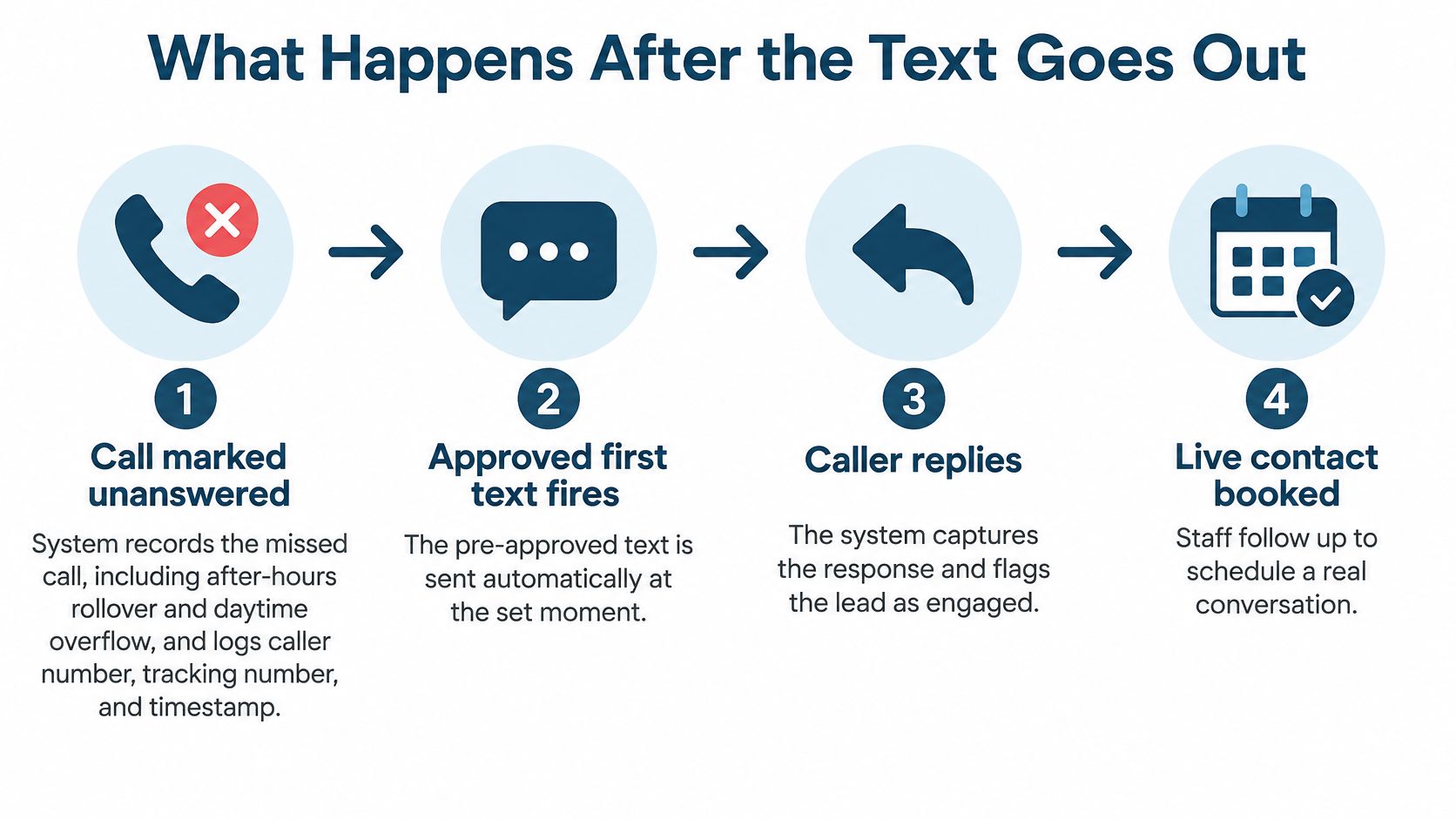
- The phone system records the miss. That includes after-hours rollover and daytime overflow, not just the calls that ring out at 2pm. The record captures the caller number, the tracking number, and the timestamp.
- The approved first text fires immediately. Firm name, one reply path, no case questions, no links that look like spam.
- The event creates a lead record. Source, time, language, and practice area go into the system. Your CRM cannot follow up with a lead unless someone puts the lead in the CRM.
- A live specialist makes the first human attempt inside the window the firm has set. They qualify only if the matter fits, run conflicts at the firm's standard, then either warm-transfer, book a time, or flag the file for attorney review.
- The cadence continues if nobody connects. A second attempt within the hour, a third later that day, then more on following business days. One text and silence is how leads fall through the cracks while everyone assumes someone else handled it.
- Every reply updates the record before anyone sends another message. That includes a stop request, which should suppress the number across every campaign the firm runs.
The division of labor is the point. Automation acknowledges and logs. A person qualifies and owns the next step.
Two edge cases that change the route
An existing client texting about a hearing goes to the case team, not the new-inquiry queue. Answering that message with a generic "we missed you" script is a small insult delivered at scale.
A brand-new injury inquiry gets the full sequence, including the second and third attempt, because injury calls are time sensitive and the caller is usually talking to three firms at once.
Taking a message is not intake. A message is proof that a call happened. Intake is the conversation that determines whether there's a case, who owns it, and what happens next.
The failure this prevents is the one every firm recognizes: one ring, one generic text, and then nothing at all.
When Law Firms Actually Need the Text
Start with the phone problem, not the software. A secret-shopper study of 500 firms, cited from the 2024 Legal Trends Report, found that only 40% of firms answered the phone when a prospective client called, according to this analysis of legal client intake statistics. Including callbacks, only 52% ultimately made contact, and roughly 20% of firms that missed the original call returned it.
Read those numbers from the caller's side. Six in ten people who dialed a law firm never spoke to anyone live on the first attempt, and half never spoke to anyone at all. The text-back workflow exists because that gap is structural, not because someone forgot to be helpful.
After hours, overflow, and the calls that need a person
After close of business and on weekends, the text keeps the caller from dialing the next firm while your office is dark. The lights are off, but somebody still has to be able to talk, which is a staffing question rather than a messaging question.
Daytime overflow is the same failure with better lighting. The receptionist is already on a call, the second line rings, and the caller hears a voicemail greeting. Marketing numbers and web forms deserve the same clock as the main line, or the ad budget is buying unanswered rings.
Caller type changes the routing without requiring a second compliance lecture. A new prospect needs a short acknowledgment and a fast human. An existing client needs routing to the right case team. A possible adverse party, or a shared family phone, needs an identity-safe message with no case facts in it at all.
Practice area matters too. A fresh personal-injury call is time sensitive; a caller with a two-year-old injury still deserves a callback today. Immigration and criminal defense inquiries are poor places for a chatbot fishing for facts, and they're worse places for a message that names the practice area on a lock screen someone else can see.
A speed benchmark that shows the window is still open
A 2025 mystery-shopper study of nearly 1,400 U.S. law firms found a 13-minute median response to an online lead, down from 20 minutes in 2023, with only 28% of firms responding within five minutes, per Hennessey Digital's lead form response study. Use it as a speed-to-lead comparison rather than proof that texting converts. Most firms still leave a substantial window, and a message that merely promises a callback is not an intake process.
One more scenario that gets overlooked. If a meaningful share of your callers speak Spanish, an English-only text is a missed call wearing a different hat. Coverage in English and Español belongs in the workflow design, not in a later phase.
Numbers That Show the Text Is Working
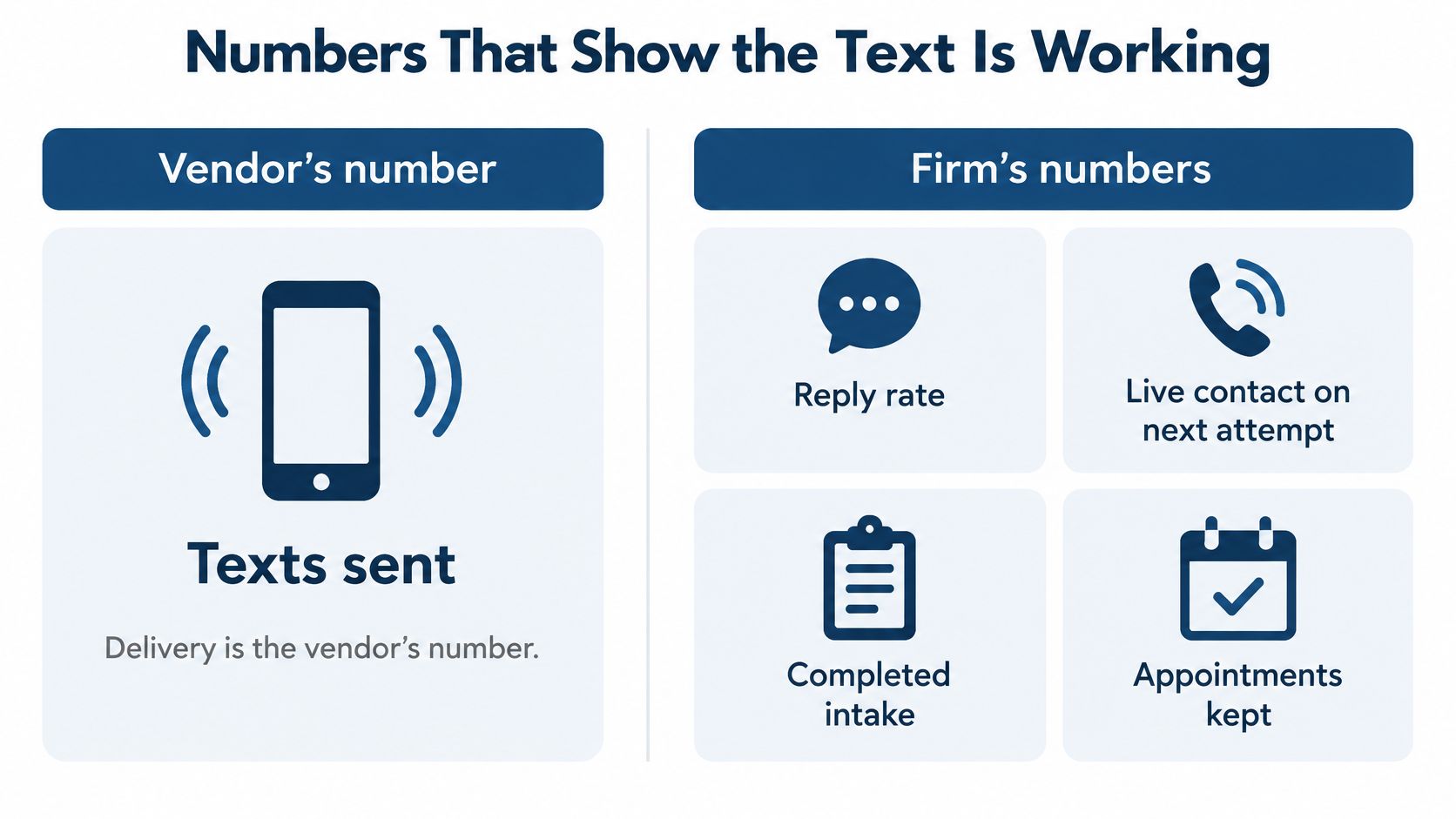
Most dashboards celebrate the wrong number. Texts sent is the vendor's metric. Delivery rate proves the carrier accepted a message, which is roughly as impressive as a printer confirming it received a document.
The firm's numbers are reply rate, live contact on the next attempt, completed intake, appointments kept, opt-outs, and retained matters, split by practice area, source, hour, and language. Those tell you whether a person got the lead.
Speed doesn't create trust on its own. Recent consumer data cited in coverage of missed call text back statistics reports that approximately 80% of unidentified calls are unlikely to be answered, 42% of consumers ignore business phone calls compared with 8% who ignore business texts, and 57% expect a business response within 15 minutes. That supports text-back as a channel. It doesn't hand you a law-firm conversion rate, and you shouldn't invent one to fill a slide.
| Metric | What it proves | Failure pattern |
|---|---|---|
| Delivery rate | The message reached the carrier | High delivery with near-zero replies: wrong copy or a number that looks like spam |
| Reply rate | The caller saw the text and engaged | Replies with no completed intake: nobody owns the thread |
| Live contact on next attempt | A person reached the caller inside the window | Replies with low contact: the handoff is too slow |
| Completed intake | The lead was qualified and documented | Intake stalls before qualification: missing script or owner |
| Appointments kept | The lead reached a consultation | No-shows: scheduling or reminder gap |
| Opt-outs | The copy stayed transactional | Climbing opt-outs: the copy drifted into marketing |
| Matters retained | The intake produced a retained matter | Split by practice area, source, hour, and language to find the weak channel |
Read it weekly, not quarterly. A missed-call program that gets reviewed at the end of the quarter is a marketing expense with a mystery attached.
The diagnostics matter more than the totals. Rising opt-outs mean someone rewrote the message to sell something. Replies that never became intakes mean the thread was allowed to die in a shared inbox. Good reply rates with poor appointment completion mean the scheduling step is the problem, not the text.
Put a Person Behind the Text
A missed call text back fails for one unglamorous reason. The only people who can call the lead back are the same attorneys and staff who missed the call in the first place. Adding automation to an understaffed desk produces faster documentation of the problem.
Three gaps are worth checking this week, and none of them require buying anything:
- Calls that still land in voicemail after hours and during overflow, especially on marketing numbers that never touch the main line.
- Leads with no named owner and no second attempt, sitting in a queue that everyone assumes someone is working.
- Attorneys doing intake administration that a trained specialist should own, which is the most expensive possible way to collect a phone number.
The live half of the workflow is where most firms need capacity rather than software. Frontline is 24/7 live intake, not an answering service, because taking a message is not intake. Every after-hours caller reaches a live person who knows the firm, its scripts, and its intake process. Inbound handling covers live answering for spillover from missed firm calls and direct routing from marketing numbers and websites, including intake when criteria are met, warm transfers or appointment scheduling, and flagging a matter for review where that applies. Outbound follow-up runs up to five attempts per lead, which is the cadence the text was supposed to start. The daytime work the text creates, from CRM hygiene to file opening, sits with Staffline, where a dedicated professional works with one firm.
The blend of automation and judgement is worth getting right on its own terms. This discussion of balancing AI speed and human judgment makes the case for keeping a person inside the loop rather than at the end of it. If you're comparing coverage models for the front desk, this look at live virtual receptionists covers what gets handled versus what gets written down.
You don't have to guess where your unanswered calls go. Call your own firm from a number nobody recognizes, at 8pm, and see what happens. Then use the Book a Call button on attorneyassistant.com to walk through what a live handoff would look like for your intake volume.
Attorney Assistant staffs the part of intake that most firms leave to chance. Trained legal support teams handle 24/7 live intake, structured follow-up, and the administrative work that surrounds it, so a missed call becomes a conversation instead of a line in a log. If you want to know what happens to the calls your firm misses now, visit Attorney Assistant and start with an intake audit.
Related Articles
Speed to Lead for Law Firms: How Fast Is Fast Enough
Speed to lead is how fast your firm answers new inquiries. Learn what to measure, how to cut response times, and where intake breaks down.
After Hours Service for Law Firms: Models, Costs and KPIs
Learn how after hours service works for law firms: three operating models, what unanswered calls cost, and the metrics that prove coverage works.

Call Screening Service for Law Firms: A Practical Guide
Learn how law firms set up a call screening service: intake criteria, routing rules, consent checks and the metrics that prove it works.