What Is Intake Consistency for Law Firms in 2026

TL;DR:
- Most law firms mistake their intake issues as lead volume problems, but process consistency matters more. Intake consistency involves uniform data collection, clear process stages, timely responses, and designated ownership to prevent lost cases. Implementing structured workflows and automation enhances conversion rates, operational efficiency, and overall firm health.
Most law firms assume their intake problem is a volume problem. They’re not getting enough leads, so they spend money on marketing. But what is intake consistency, and why does it matter more than lead count? Intake consistency is the operational discipline of capturing the same structured data, following the same process steps, and responding within the same time windows for every prospective client who contacts your firm. When that discipline breaks down, you lose cases you already paid to attract.
Table of Contents
- Key takeaways
- What intake consistency means in legal practice
- Why intake consistency matters for conversion
- Operational benefits of consistent intake workflows
- How to assess and implement intake consistency
- My take on what intake consistency actually requires
- How Attorneyassistant helps firms fix intake at the root
- FAQ
Key takeaways
| Point | Details |
|---|---|
| Intake consistency defined | It means uniform data capture, process steps, and response times across every prospective client contact. |
| Conversion depends on process | Inconsistent intake causes measurable lead loss, not just inefficiency; tracking three core KPIs reveals exactly where. |
| Operational benefits are concrete | Structured workflows reduce duplicate data entry, conflict-check errors, and attorney time spent reconstructing context. |
| Measurement drives improvement | Mapping intake by stage and assigning ownership turns a vague problem into a fixable one. |
| Automation enforces consistency | Technology handles confirmation, routing, and reminders so human judgment gets applied where it actually counts. |
What intake consistency means in legal practice
The intake consistency definition most firms operate with is wrong. They treat it as a call quality issue: did the receptionist sound friendly, did she follow the script? That framing misses the real problem entirely.
Intake consistency is about process and data uniformity across every touchpoint a prospective client encounters. It covers four distinct dimensions:
- Data capture: Are the same 14 to 18 fields collected on every inquiry, regardless of who takes the call or which channel the lead comes from?
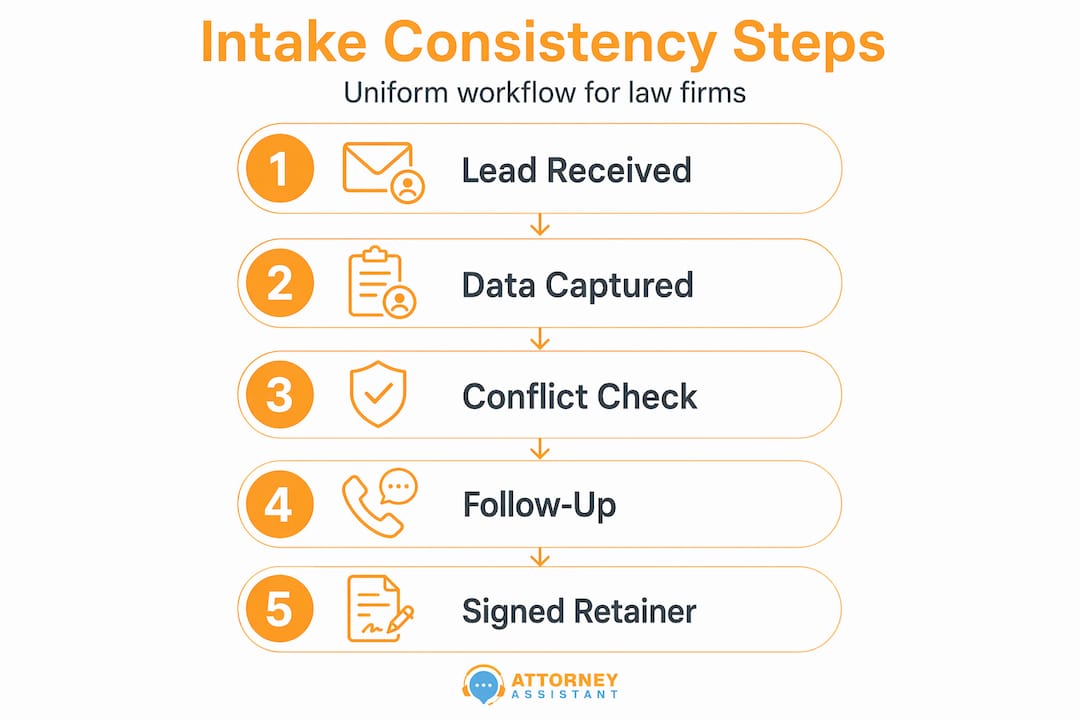
- Workflow structure: Does every lead move through the same documented stages, from first contact through conflict check, consultation booking, and signed retainer?
- Response time: Are there defined time windows for callback, follow-up, and consultation scheduling that apply equally to all leads?
- Stage ownership: Does a named person bear responsibility for each stage, so nothing stalls in a gray zone between two staff members?
Consistent, structured intake forms that capture 14 to 18 data points save firms hours per matter compared to under-designed forms. Small firms that re-enter client information across four to six systems spend 20 to 40 minutes on duplicate data entry per matter. Getting it right upfront cuts that to around ten minutes.
Pro Tip: Build your intake form around the fields that feed directly into your conflict-check system and your retainer agreement. If a field doesn’t serve a downstream workflow, question whether it belongs in intake at all.
Poor conflict-check inputs at the intake stage are a primary cause of ethics complaints. Structured intake forms that feed automated conflict systems prevent those errors before they become liability.
The word “consistency” in this context doesn’t mean robotic uniformity. It means that every lead gets the same quality of information captured about them, the same speed of response, and the same structured path through your intake funnel.
Why intake consistency matters for conversion
Here is where the stakes become financial rather than operational.
Most firms track leads loosely. Someone calls, someone talks to them, something happens. If they don’t sign, the lead just disappears from view. That invisibility is the conversion killer. When you can’t see where leads are dropping out, you can’t fix the leak.
Intake consistency creates a traceable funnel. And a traceable funnel reveals what’s actually costing you revenue. The 3 Number Rule framework identifies the three KPIs that matter most for intake performance:
- Win rate: Of the leads your firm contacts, what percentage become signed clients?
- Response speed: How quickly does your firm respond to a new inquiry, from first contact to first live conversation?
- Lead loss rate: At which specific stage do most leads disappear from your pipeline?
These three numbers tell you more about your intake health than any marketing dashboard. Firms that focus on just these three metrics see meaningful improvement in weeks, while firms tracking dozens of KPIs often get lost in data and make no changes at all.
“Consistent intake discipline, more than rewritten scripts, drives conversion gains. Process timing SLAs and ownership matter most.” — Law Firm Intake Process Playbook, HireSava
Inconsistent intake creates what practitioners call “stale lead handling.” A lead calls on Monday, no one logs the inquiry properly, the follow-up happens on Thursday, and by then the prospect has already signed with another firm. Inconsistent lead handling creates downstream friction that directly reduces your conversion rate. Rewriting your script won’t fix that. A documented process with time-bound follow-up will.
If you want to understand where your firm is actually losing revenue, start by reading more about how to boost conversion with consistent intake at the process level.
Operational benefits of consistent intake workflows
The payoff from intake consistency goes well beyond conversion rates. It changes how your whole firm operates.
Reduced attorney time on administrative reconstruction
When intake is inconsistent, attorneys spend time at the beginning of every matter piecing together context. Who referred this client? What did they say they needed? Was a conflict check run? Single-source-of-truth records built at intake improve downstream workflow and client onboarding quality. The attorney opens the file and everything is already there.

Accountability through stage tracking
A documented intake workflow reduces guesswork by enforcing stage-by-stage tracking. When you know that a lead is at “booked consult,” “conflict check pending,” “no-show,” or “stalled,” you can assign follow-up actions with precision. Without that structure, stalled leads go cold and no one notices until it’s too late.
Automation applied where it counts
Here’s a comparison of what manual versus automated intake handling looks like across key moments:
| Intake moment | Manual handling | Automated handling |
|---|---|---|
| Confirmation after inquiry | Depends on staff memory | Sent immediately, every time |
| Reminder before consultation | Often forgotten | Triggered 24 hours in advance |
| Conflict-check data entry | Re-keyed from notes | Pulled from intake form directly |
| Lead routing to attorney | Inconsistent, delayed | Rules-based, immediate |
| Follow-up for no-shows | Ad hoc | Scheduled sequence launches automatically |
Automation in intake reduces delay and inconsistency compared to manual handling. The practical result is that your team’s attention goes toward phone calls where human judgment actually matters. Everything procedural runs on its own.
Pro Tip: Don’t automate everything at once. Start with confirmation emails and appointment reminders. Once those are stable, add routing rules and follow-up sequences. Firms that try to automate all intake in one go usually create a different kind of mess.
A poor intake form creates problems that cascade for months. Structured intake forms with enforced required fields prevent roughly 80% of fee disputes downstream by setting clear expectations from the first contact.
How to assess and implement intake consistency
Knowing why intake consistency is important is one thing. Building it in your firm is another. Here’s how to start without creating chaos.
-
Map your current process before you change anything. Walk every lead through your system on paper. Where does it start? Who touches it? What gets recorded, and where? Most firms discover three or four handoffs with no documentation and no clear ownership.
-
Identify stage-by-stage drop-off. Firms that track source and stage improve conversion by finding exactly where leads are lost. You can’t fix a leak you can’t locate.
-
Assign ownership to each stage. Every intake stage needs a named owner and a time-bound SLA. “Someone will follow up” is not a process. “The intake coordinator follows up within two hours of a missed consultation” is a process.
-
Right-size your intake form. Forms that are too short miss critical data. Forms that are too long kill completion rates. Aim for the fields that serve a downstream purpose. Legal intake form design is a discipline worth studying separately.
-
Roll out improvements in waves. Successful firms stabilize response speed first, then standardize qualification criteria, then layer in automation and quality-assurance review. Trying to do everything at once produces inconsistency of a different kind.
-
Measure only what you’ll act on. Track win rate, response time, and lead loss rate. Add metrics only when those three are consistently reviewed and driving decisions.
Understanding the factors affecting intake consistency also means acknowledging the human side. Training matters. Staff who understand why the process exists, not just what to do, follow it more reliably. That is especially true during high-volume periods when shortcuts become tempting.
If you want a practical framework, the guide on optimizing your case intake workflow covers the workflow documentation piece in detail.
My take on what intake consistency actually requires
I’ve worked with enough law firms to say this plainly: most intake problems are not training problems. They are design problems.
When I look at where firms are losing cases, the pattern is almost always the same. Nobody sat down and designed the intake process as an intentional system. It evolved organically, which means it reflects whoever happened to handle intake at each point in the firm’s history rather than what actually serves conversion.
The uncomfortable truth is that intake consistency is more about what gets recorded than how the call sounds. I’ve seen firms with warm, skilled intake staff who are losing 40% of their leads because no one ever tracks where those leads go after the first conversation. The data never gets captured, so the problem never gets measured, so it never gets fixed.
The firms that improve fastest share one characteristic: they treat intake like a contract with a new client record. Every field matters. Every stage has a responsible person. Every time window is defined. This framing comes from a principle I think more firms need to hear: define the job record precisely at intake so that every downstream workflow operates without ambiguity.
What I’ve found is that the biggest conversion gains don’t come from more leads or a better script. They come from fixing the part of the funnel that nobody’s been watching.
— Nicole
How Attorneyassistant helps firms fix intake at the root
Attorneyassistant works with law firms that are losing revenue from the leads they already have. Missed calls, slow follow-up, and inconsistent intake are costing firms signed cases every week, and most of them don’t realize it until they run the numbers.
Attorneyassistant handles intake workflows, lead follow-up sequences, and the administrative structure that makes consistency possible without adding headcount. If you want to understand where your firm’s intake is leaking revenue, the lead follow-up service is a direct fix for the most common and costly gap. You can also attend a free virtual webinar to walk through intake optimization with a team that does this work daily. If you prefer to start with your own analysis, the free tools for law firms give you a practical starting point. Book a call when you’re ready to move from diagnosis to action.
FAQ
What is intake consistency in a law firm?
Intake consistency is the practice of capturing the same structured data, following the same documented process steps, and responding within defined time windows for every prospective client contact. It is an operational standard, not a call quality standard.
Why does intake consistency matter for conversion rates?
Inconsistent intake creates untraceable lead loss. When firms can’t see where leads drop out of their pipeline, they can’t fix the gap. Tracking win rate, response speed, and lead loss rate by stage reveals exactly where revenue is being lost.
How do you assess intake consistency in your firm?
Start by mapping every step a lead takes from first contact to signed retainer, then identify who owns each stage and what gets recorded. Gaps in ownership and data capture are where most lead loss occurs.
What are the main factors affecting intake consistency?
The primary factors are form design, stage ownership, response time standards, and whether automation handles procedural steps so staff attention goes where judgment matters. Training reinforces the process once it’s designed correctly.
How does intake consistency relate to law firm health and efficiency?
Consistent intake reduces duplicate data entry, conflict-check errors, and attorney time spent reconstructing client context. It also creates the funnel visibility needed to make intake performance measurable and improvable over time.
Recommended
Related Articles

Call Flow Customer Service for Law Firms: A Practical Guide
Design a call flow customer service system for your law firm that captures leads, qualifies matters, and signs cases. Practical guide

Fear of Talking on Phone: 7 Practical Confidence Tips
Overcome fear of talking on phone with practical scripts, role-play, exposure exercises, and intake tools built for legal teams.

Appointment Setting Online: A Law Firm Guide
Master appointment setting online for law firms with proven strategies that turn leads into booked consultations and grow your practice.