What Is Lead Follow-Up for Law Firms: 2026 Guide

TL;DR:
- Lead follow-up is a structured process of contacting prospects after their initial inquiry to build trust and increase conversion chances. Effective follow-up involves rapid responses, multi-channel sequences, and value-driven messaging over 14 to 21 days, with most conversions occurring after multiple touchpoints. The primary challenge for law firms lies in operational gaps such as lack of ownership, inconsistent cadence, and poor segmentation, which can be addressed with disciplined systems and tracking.
Lead follow-up is the structured process of contacting a prospective client after their initial inquiry, with the goal of building enough trust and urgency to convert them into a retained case. For law firms, this process is not optional. Responding within 5 minutes increases conversion likelihood by 391%, and waiting even 24 hours drops that advantage by a factor of seven. Most firms believe their intake problem is a volume problem. The real problem is that leads arrive, get a single call attempt, and then disappear into a spreadsheet nobody checks.
What is lead follow-up and how does it work for law firms?
Lead follow-up is the deliberate, repeatable sequence of outreach attempts a firm makes after a prospect first contacts them. In sales and CRM literature, this is often called a “follow-up cadence” or “lead nurturing sequence.” Both terms describe the same operational reality: a structured series of touchpoints designed to move a prospect from inquiry to signed retainer.
For law firms, an effective follow-up process has three distinct phases.
- Immediate response (0 to 5 minutes). The first contact attempt happens the moment a lead comes in. This applies to web forms, missed calls, and chat inquiries. Speed signals professionalism and availability, two qualities legal prospects weigh heavily when choosing counsel.
- High-frequency early outreach (days 1 to 5). During the first 48 hours, contact attempts should be frequent. Phone calls carry the highest response rates at 15 to 25%, compared to email at 5 to 15% and LinkedIn at 10 to 20%. Combining all three in a coordinated sequence outperforms any single channel by roughly 300%.
- Value-based nurturing (days 6 to 21). After the initial burst, follow-up shifts to spaced outreach every two to five days. Each message should deliver something useful: a relevant case outcome, a FAQ document, or a brief explanation of what the legal process looks like for their situation.
The full cadence typically spans 14 to 21 days and includes 6 to 12 contact attempts across multiple channels. Multi-channel sequences yield approximately three times higher conversion rates compared to single-channel efforts. That gap exists because different prospects respond to different mediums, and a firm that only calls is invisible to the prospect who only reads email.
Pro Tip: Segment leads by intake source before building your cadence. A prospect who filled out a detailed web form has higher intent than someone who clicked a display ad. High-intent leads warrant phone-first, same-day outreach. Lower-intent leads can enter a slower email-driven nurture sequence.

Why is lead follow-up especially important in law firm client intake?
Law firms operate in a trust-sensitive environment. A person searching for a personal injury attorney or a family law firm is often in a stressful situation. They contact multiple firms simultaneously. The firm that responds first, follows up consistently, and communicates clearly wins the case, regardless of whether it has the best website or the lowest fee.
The operational gaps that cause inconsistent follow-up are predictable:
- No assigned ownership. When follow-up is “everyone’s job,” it becomes no one’s job. Leads sit in a shared inbox or CRM queue with no clear next action.
- Single-attempt abandonment. 44% of sales reps quit after only one contact attempt, yet 80% of successful conversions happen between the fifth and twelfth touchpoint. Law firm intake staff follow the same pattern.
- No structured cadence. Without a defined sequence, follow-up depends on individual memory and motivation. Both are unreliable at scale.
- Poor lead segmentation. Treating a high-intent inbound call the same as a cold web form submission wastes time and misses prioritization opportunities.
The financial impact is direct. Failing to follow up systematically results in lost revenue, and the problem is structural, not behavioral. A firm that spends $5,000 per month on Google Ads but abandons 60% of its leads after one call attempt is not a marketing problem. It is an operations problem.
Most legal prospects also require multiple interactions before they feel confident enough to retain counsel. Initial resistance is rarely a hard “no.” It is more often a signal that the prospect needs more information, more reassurance, or simply more time. Interpreting that resistance as disinterest and stopping follow-up is one of the most expensive mistakes a firm can make. You can explore how intake specialist roles address this gap directly.
Best practices for lead follow-up at law firms
Effective lead follow-up strategies share four qualities: they are fast, persistent, varied, and value-driven. Here is how to build a system with all four.
- Respond within five minutes. Set up automated acknowledgment messages for after-hours inquiries so prospects know their inquiry was received. Assign a live intake specialist to handle calls during business hours without delay.
- Build a defined touchpoint sequence. A multi-touch cadence with high-frequency early contact followed by value-based spaced follow-ups significantly improves engagement. Map out exactly which channel gets used on which day, and what message gets sent.
- Use a 3:1 value-to-ask ratio. “Just checking in” emails generate a 1% reply rate. Every three messages that provide something useful, a case study, a process explainer, a relevant FAQ, should precede one direct ask for a consultation.
- Time your outreach strategically. Contacting leads on Wednesdays and Thursdays between 10 and 11 AM and 4 and 5 PM local time yields the best response rates. This is not a minor detail. Timing affects whether a call gets answered or sent to voicemail.
- Send a breakup email. When a lead has gone silent after multiple attempts, a professionally worded final message stating that you will close their file unless you hear back can recover 10 to 20% of previously unresponsive prospects. The message triggers a loss aversion response. Many firms avoid this tactic out of fear of seeming pushy, but the data supports it.
Pro Tip: Vary the subject line, channel, and message angle with every touchpoint. Sending the same email three times is not persistence. It is noise. Rotate between phone, email, and text. Change the angle from urgency to empathy to information.
For a detailed breakdown of how these steps apply to legal intake specifically, the law firm follow-up process guide covers sequencing and channel selection in depth.
Common pitfalls that kill follow-up results
Most follow-up failures at law firms come down to five recurring mistakes. Recognizing them is the first step to fixing them.
- Stopping too early. A single unanswered call is not a rejection. Firms that abandon follow-up after one or two attempts lose the majority of convertible leads before the relationship has a chance to form.
- Generic messaging. “Just checking in” is not a message. It is a placeholder. It signals that the firm has nothing useful to say and is following up out of obligation rather than genuine interest in helping the prospect.
- Single-channel dependency. A firm that only calls will miss the prospect who only responds to text. Varying channels and message angles reduces the perception of harassment and increases engagement over time.
- No lead segmentation. A prospect who called after a car accident yesterday has different urgency than someone who downloaded a divorce FAQ three weeks ago. Treating both identically wastes resources and frustrates high-intent leads who need immediate attention.
- No accountability structure. Without assigned ownership and tracked activity, follow-up becomes inconsistent. CRM tools like Clio Grow, Lawmatics, or HubSpot provide the infrastructure to track attempts, flag stalled leads, and hold intake staff accountable.
Pro Tip: Audit your current intake process by pulling the last 30 leads and counting how many received more than three contact attempts. If fewer than half did, your follow-up system has a structural gap, not a staffing gap.
Key takeaways
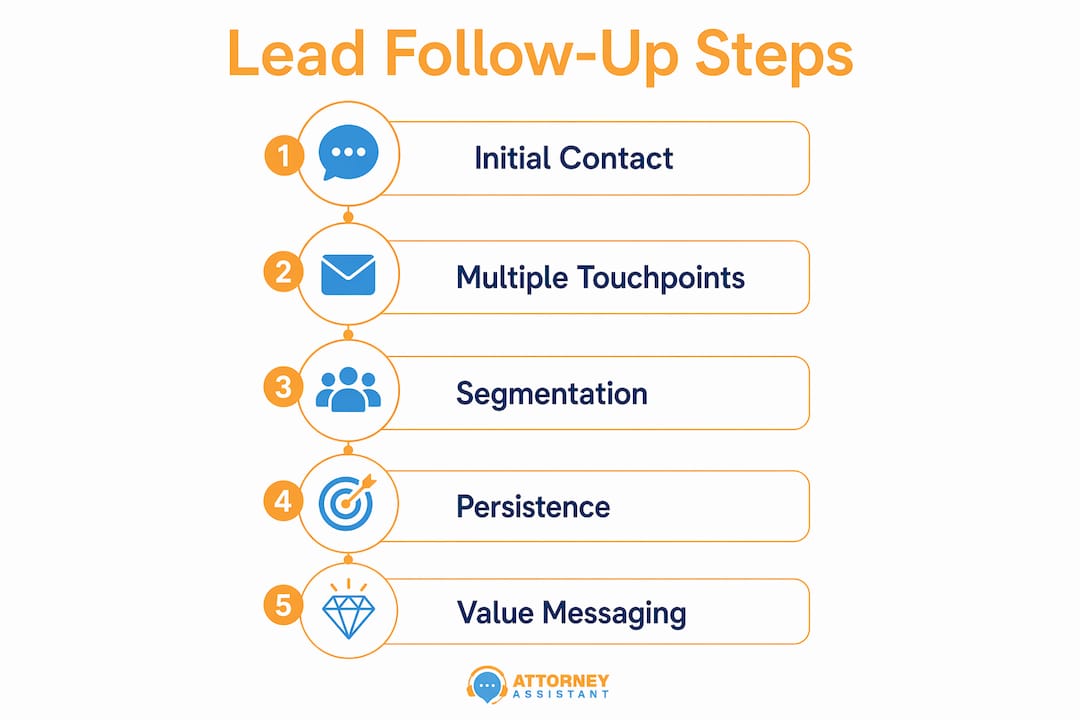
Effective lead follow-up requires speed, persistence, multi-channel outreach, and a value-first messaging approach to convert law firm prospects into retained clients.
| Point | Details |
|---|---|
| Speed determines conversion | Responding within 5 minutes increases conversion likelihood by 391% compared to delayed outreach. |
| Persistence wins cases | 80% of conversions happen between the 5th and 12th touchpoint; most firms quit after one attempt. |
| Multi-channel outreach multiplies results | Combining phone, email, and LinkedIn yields roughly 3x higher conversion than single-channel follow-up. |
| Value-first messaging drives replies | A 3:1 ratio of useful content to direct asks dramatically outperforms generic check-in emails. |
| Structure beats willpower | Consistent follow-up requires a defined cadence with assigned ownership, not individual initiative. |
Why most law firms are solving the wrong follow-up problem
I have worked with enough law firms to see the same pattern repeat. A firm invests in advertising, gets inbound leads, and then assumes the problem is that the leads are low quality. The intake team makes one or two calls, gets no answer, and moves on. The leads are labeled “unresponsive” and the firm goes back to the marketing agency asking for better targeting.
The leads were not the problem. The follow-up was.
What I have found is that law firms treat follow-up as a sales behavior when it is actually an operational system. You cannot fix it by motivating your intake coordinator. You fix it by building a process that does not depend on any one person’s memory or mood. That means a defined cadence, assigned ownership, tracked activity, and a clear escalation path when a lead goes cold.
The firms that convert the most leads are not the ones with the most charismatic intake staff. They are the ones with the most disciplined infrastructure. Speed matters. Persistence matters. But neither works without a system that makes both automatic. If your firm is still relying on sticky notes and mental reminders to manage follow-up, you are not running an intake process. You are running a lottery.
The legal intake tips that actually move the needle are almost always operational, not motivational.
— Nicole
How Attorneyassistant fixes follow-up gaps for law firms
Attorneyassistant was built specifically for firms that are losing revenue not from a lack of leads, but from a lack of follow-through on the leads they already have.
Attorneyassistant handles intake, follow-up, and administrative workflows so your firm responds faster, contacts every lead multiple times across multiple channels, and converts more inquiries into signed cases. The process is structured, tracked, and consistent, regardless of how busy your team gets. If your firm is ready to stop leaking revenue from abandoned leads, explore the lead follow-up services Attorneyassistant offers or book a call to see how a structured cadence would work for your practice.
FAQ
What is lead follow-up in a law firm context?
Lead follow-up is the structured process of contacting a prospective client after their initial inquiry through multiple touchpoints over days or weeks. The goal is to build enough trust and urgency to convert the prospect into a retained client.
How many times should a law firm follow up with a lead?
Research shows 80% of successful conversions happen between the 5th and 12th contact attempt. A standard cadence of 6 to 12 touchpoints over 14 to 21 days is the recommended baseline for most legal practices.
What channels work best for law firm lead follow-up?
Phone calls generate the highest response rates at 15 to 25%, but coordinated multi-channel sequences combining phone, email, and LinkedIn outperform any single channel by approximately three times.
Why do law firms lose leads during follow-up?
The most common cause is structural: no defined cadence, no assigned ownership, and single-attempt abandonment. These are operational gaps, not individual performance issues, and they require process changes to fix.
What is a breakup email in lead follow-up?
A breakup email is a final outreach message that tells the prospect you will close their file unless they respond. It triggers a loss aversion response and can recover 10 to 20% of previously unresponsive leads.
Recommended
Related Articles

Law firm lead management: convert more clients in 2026
Learn how personal injury law firms can improve lead management, speed up intake, and convert more leads into signed cases with proven, practical strategies.

1st Dollar Coverage in Law Firm Retainers: A Practical Guide
Understand 1st dollar coverage in legal and insurance contexts. Learn how it shapes intake, retainer strategy, firm revenue, and risk.
24 7 Phone Answering Service: Law Firm Guide
Discover how a 24 7 phone answering service can help your law firm capture every lead and provide round-the-clock client support. Learn best practices here.