What Is Lead Leakage? A Law Firm Guide

TL;DR:
- Lead leakage occurs when law firms fail to promptly follow up with qualified prospects, causing potential clients to disappear. Eliminating process gaps through automation and regular audits can significantly increase conversion rates and revenue. Most leakage results from operational failures, not marketing issues, and can be fixed with discipline and better workflow management.
Lead leakage is the progressive loss of qualified leads when a law firm fails to track, route, or follow up with them promptly and systematically. The industry term for this problem is pipeline decay, and it costs firms far more than a slow month of new cases. Most firms assume their lead generation is the problem. The real problem is that qualified prospects are already contacting them and then disappearing before anyone signs a retainer. Understanding what causes this loss, and how to stop it, is the most direct path to higher revenue from your existing marketing spend.
What is lead leakage in law firm intake?
Lead leakage is defined as the loss of potential clients as they move through your intake process, caused by slow follow-up, poor routing, or a lack of structured nurturing. It is not a marketing problem. It is an operational one. A prospect who calls your firm, gets no answer, and never hears back is a leaked lead. So is the person who submitted a web form at 6 p.m. and received a reply three days later.
Structured lead management processes reduce leakage by capturing, qualifying, and following up with every lead in a defined sequence. Without that structure, leads fall through the cracks at every handoff point in your intake workflow. The damage compounds quickly because each lost lead represents not just one case, but the lifetime value of a client who may have referred others.
The term “lead leakage” is widely used in sales operations, but in legal practice it maps directly to intake failure. When your intake process has gaps, qualified prospects exit the pipeline silently. They do not send a complaint. They simply hire another firm.
What causes lead leakage in law firm intake processes?
The most common cause of lead leakage is slow follow-up. Responding within 5 minutes can increase conversion rates by up to 21 times compared to slower responses. Most firms respond far outside that window, often because no one owns the responsibility for first contact.
Several other factors drive leads slipping through cracks in legal intake:
- Manual lead routing. When intake staff manually assign leads, bottlenecks form. Automated lead assignment eliminates the “lead black hole” where a prospect sits uncontacted because no one realized they were waiting.
- No defined handoff between marketing and intake. When your marketing team generates a lead and your intake team has no formal process to receive it, the lead often gets lost between the two. Formal service-level agreements (SLAs) clarify ownership and prevent this.
- Inconsistent nurturing. Not every lead is ready to retain a firm immediately. Without a nurturing sequence, leads that need a few more touchpoints before committing simply go cold and hire someone else.
- No lead qualification framework. Treating every inquiry identically wastes intake staff time on low-intent contacts while high-value prospects wait too long for a response.
Pro Tip: Automate your lead routing the moment a new inquiry arrives. Even a basic rule-based assignment in your CRM eliminates the delay caused by manual triage and keeps your 5-minute response window achievable.
How does lead leakage affect law firm revenue and growth?
Lead leakage causes two direct financial problems: lost case revenue and wasted marketing spend. Pipeline decay from leakage impacts firm growth by losing potential clients and inflating acquisition costs. When you pay to generate a lead and then fail to convert it, you have paid twice: once for the lead and once for the replacement lead you will need to generate.
The revenue impact is not limited to individual cases. Leakage also distorts your forecasting. If your intake pipeline is losing leads silently, your conversion data looks artificially low. You may conclude that your marketing channels are underperforming when the real problem is that qualified leads are not being worked properly.
The table below shows how structured lead management changes conversion outcomes.
| Intake scenario | Lead response time | Estimated conversion impact |
|---|---|---|
| No defined process | 24–72 hours | Low; most leads go cold |
| Basic CRM with manual routing | 1–4 hours | Moderate; some leads recovered |
| Automated routing with SLAs | Under 5 minutes | High; consistent first contact |
| Automated routing plus nurturing | Under 5 minutes | Highest; captures delayed decisions |
Average B2B lead response times run approximately 42 hours. That delay alone accounts for a significant share of lost deals. In legal intake, where a prospect may be calling three firms simultaneously, being the last to respond almost always means losing the case.
Leakage also increases your cost per signed case. When conversion rates drop because of intake gaps, you need more leads to hit the same revenue target. That means more marketing spend, not more efficiency.
What are best practices to prevent lead leakage in law firms?
Preventing lead leakage requires process discipline, not just better tools. The following lead management best practices apply directly to legal intake operations.
Centralize all lead data in one CRM. Leads tracked across email inboxes, sticky notes, and spreadsheets are leads waiting to be lost. A centralized CRM gives every intake team member a single source of truth and makes gaps visible.

Enforce the 5-minute response rule. Defining SLA agreements between your marketing and intake teams sets clear expectations for first-contact timing. Without a written SLA, response time defaults to “whenever someone gets to it.”
Use lead scoring to prioritize outreach. Lead scoring focuses your intake team’s attention on high-probability prospects first. A personal injury caller who found you through a paid search ad and described an active case needs a faster response than a general inquiry with no case details.
Build a nurturing sequence for non-immediate leads. Early-stage leads need relationship-building; mature leads need a direct path to retention. A simple email or text sequence keeps your firm visible to prospects who are still deciding.
Audit your intake pipeline regularly. Regular pipeline audits detect leaks before they become revenue losses. A monthly review of lead status, response times, and drop-off points shows exactly where your process is breaking down.
The table below compares intake workflows before and after optimization.
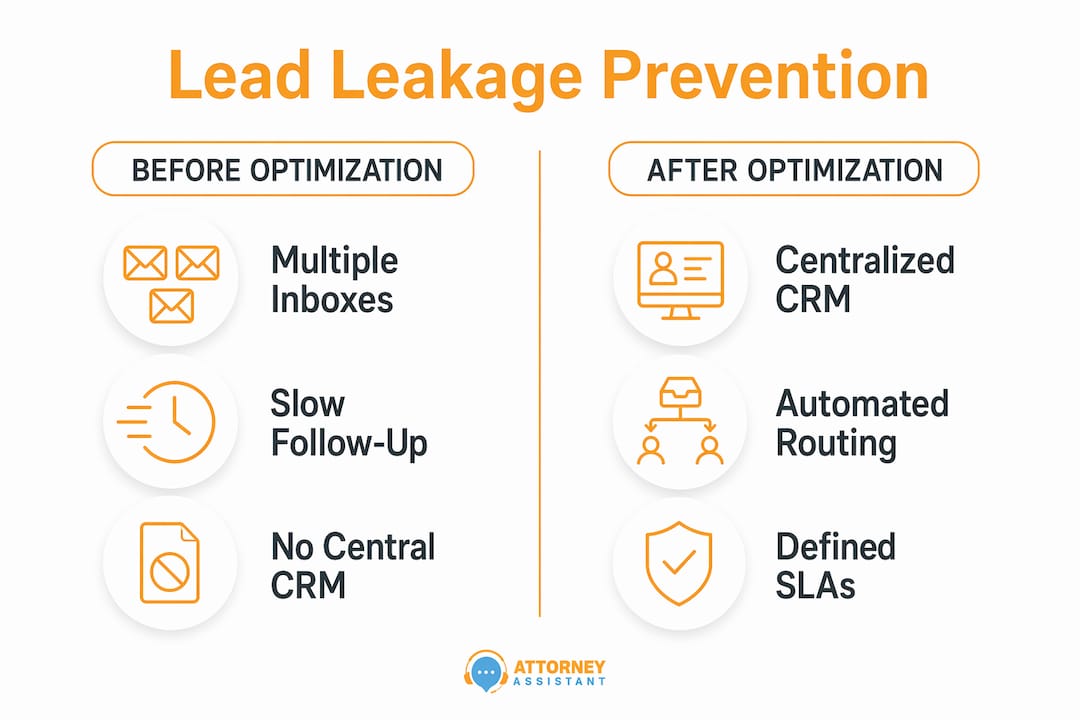
| Workflow element | Before optimization | After optimization |
|---|---|---|
| Lead capture | Multiple inboxes, no central log | Single CRM with auto-capture |
| First response | Manual, 24+ hours average | Automated alert, under 5 minutes |
| Lead routing | Staff assigned manually | Rule-based auto-assignment |
| Nurturing | None or ad hoc emails | Defined sequence by lead stage |
| Pipeline visibility | None | Real-time dashboard |
Pro Tip: Set up a CRM dashboard that flags any lead with no activity after 2 hours. That single alert prevents the majority of leads from going cold unnoticed.
How can law firms measure and monitor lead leakage effectively?
Measurement turns lead leakage from a vague problem into a fixable one. Lack of intake pipeline visibility causes guessing; automated workflows with clear metrics create accountability. The importance of lead tracking cannot be overstated: you cannot fix what you cannot see.
Track these four metrics consistently:
- Lead response time. The average time between a new inquiry and first contact. Anything over 5 minutes warrants a process review.
- Lead-to-consultation conversion rate. The percentage of new inquiries that result in a scheduled consultation. A drop in this number often signals a routing or follow-up gap.
- Pipeline coverage. The total value of active leads in your intake pipeline versus your revenue target. Thin coverage signals that leads are exiting early.
- SLA adherence rate. The percentage of leads contacted within your defined response window. This is the clearest indicator of whether your intake process is working as designed.
CRM dashboards that surface these metrics in real time give intake managers the visibility to catch problems early. A weekly review cadence is sufficient for most firms. The goal is to move from reactive problem-solving to predictable, process-driven intake management.
Key takeaways
Lead leakage is an operational failure, not a marketing one, and fixing it requires process discipline, defined SLAs, and consistent measurement across every intake touchpoint.
| Point | Details |
|---|---|
| Lead leakage defined | Qualified leads exit your pipeline due to slow follow-up, poor routing, or no nurturing. |
| 5-minute response rule | Responding within 5 minutes can increase conversion rates by up to 21 times. |
| Centralize lead data | A single CRM eliminates the gaps created by scattered inboxes and manual tracking. |
| Measure four key metrics | Track response time, conversion rate, pipeline coverage, and SLA adherence consistently. |
| Audit regularly | Monthly pipeline reviews catch leaks before they become significant revenue losses. |
The intake problem most firms refuse to admit
I have worked with enough law firms to say this plainly: most lead leakage is not caused by bad marketing or a weak product. It is caused by a firm that treats intake as an administrative task instead of a revenue function.
The pattern repeats itself. A firm invests heavily in paid search, builds a solid referral network, and then routes new inquiries to a shared inbox that three people monitor inconsistently. A prospect calls on a Friday afternoon, gets voicemail, and signs with a competitor by monday morning. The firm never knows the lead existed.
What makes this particularly costly is that the fix is not expensive. Defining a response SLA, automating lead routing, and reviewing a dashboard once a week costs far less than the cases being lost. The barrier is not budget. It is the belief that intake “basically works” because the firm is still signing cases. That belief survives only because firms rarely track the leads they never converted.
The firms that grow consistently are the ones that treat every inquiry as a revenue event. They measure response time the same way they measure billing hours. They hold intake staff accountable to SLA targets. They know their lead-to-case conversion rate the same way they know their monthly revenue. That discipline is not complicated. It is just uncommon.
— Nicole
How Attorney Assistant helps law firms close intake gaps
Law firms that fix lead leakage do not necessarily hire more staff. They fix the process first.
Attorney Assistant handles intake, follow-up, and administrative workflows so your firm responds faster and converts more leads into signed cases. The service covers first-contact response, lead routing, and follow-up sequences, all built around the operational standards described in this article. Firms that have patched their intake and reception process with Attorney Assistant stop losing cases to slow response times and start converting the leads they are already generating. If your firm is ready to close those gaps, book a call to see exactly where your intake is leaking and what it takes to fix it.
FAQ
What is lead leakage in simple terms?
Lead leakage is when a potential client contacts your firm but never becomes a signed case because of a gap in your intake process, such as a missed call, slow follow-up, or no nurturing sequence.
How does slow follow-up cause lead leakage?
Responding to a new inquiry more than 5 minutes after it arrives dramatically reduces the chance of conversion. Most prospects contact multiple firms simultaneously, and the first to respond wins the case.
What metrics reveal lead leakage in a law firm?
The four most telling metrics are lead response time, lead-to-consultation conversion rate, pipeline coverage, and SLA adherence rate. A drop in any of these signals a leak in your intake process.
Can lead leakage be fixed without hiring more staff?
Yes. Automating lead routing, centralizing data in a CRM, and defining response SLAs fix the majority of leakage without adding headcount. Most leakage comes from process gaps, not staffing shortages.
How often should a law firm audit its intake pipeline?
A monthly pipeline audit is sufficient for most firms. The review should cover lead response times, drop-off points, and SLA adherence to catch problems before they compound into significant revenue loss.
Recommended
Related Articles

Lead Management Best Practices for Law Firms in 2026
Discover effective lead management best practices for law firms in 2026. Improve client conversion and maximize your marketing spend.

Lead leakage in law firms: capture more PI cases
Learn what lead leakage costs PI law firms and get actionable strategies to capture more personal injury cases through faster, smarter intake.

Call Answering Service for Law Firms: What Actually Works
A call answering service for law firms should sign cases, not take messages. Learn pricing models, vendor criteria, and 24/7 intake that converts.