Why Client Onboarding Matters for Law Firm Growth

TL;DR:
- Faster client onboarding, completed within 5-7 days, significantly increases retention rates to over 92%. Structured onboarding reduces scope creep, builds trust, and drives higher referrals, making it essential for firm growth. Technology should support a standardized process, not replace clear ownership and well-defined steps.
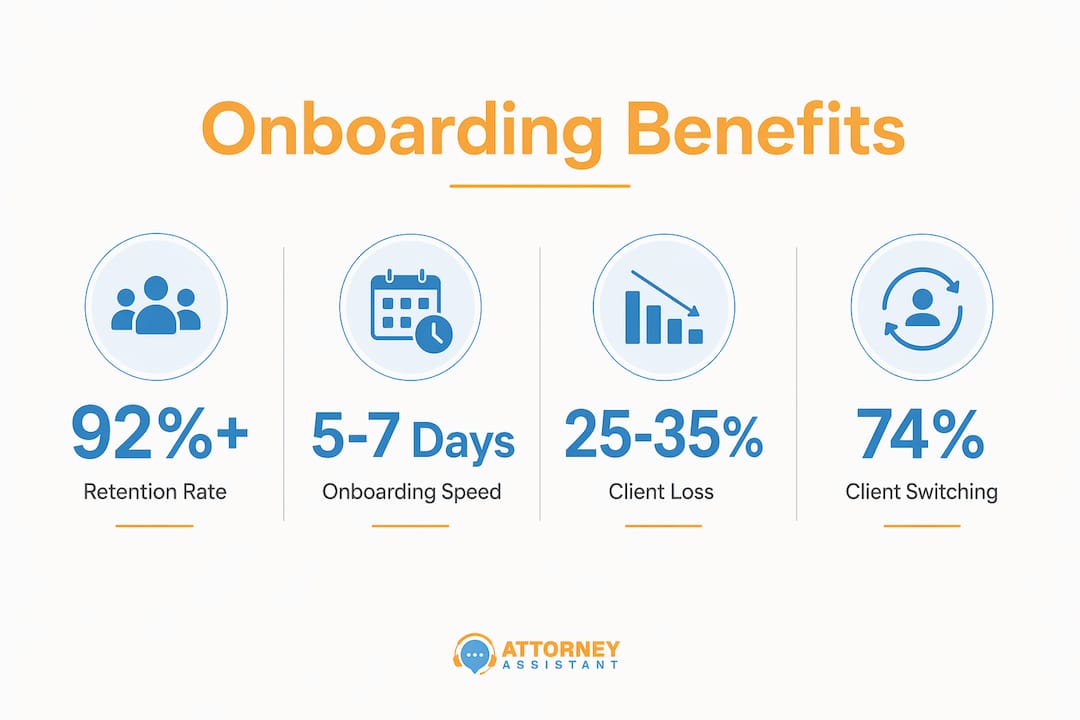
Client onboarding is the structured process that converts a signed engagement letter into an active, trusted client relationship. For law firms, why client onboarding matters comes down to one measurable fact: firms completing onboarding in 5–7 days retain over 92% of new clients at 90 days, while firms taking 14–21 days retain only 70–80%. That gap is not a minor operational detail. It is the difference between a firm that grows on referrals and one that constantly chases new leads to replace clients it quietly loses. Attorneyassistant works with firms that have strong lead volume but weak conversion. The problem is almost always in what happens after the signature.
Why client onboarding matters for retention and revenue
The importance of client onboarding is most visible in its direct effect on revenue. Structured onboarding boosts retention by 50% and delivers 200–400% ROI within 12 months through churn reduction, upsells, and lower delivery costs. That return does not come from doing more legal work. It comes from doing the administrative work correctly at the start.
Speed is the variable most firms underestimate. A client who waits two weeks to receive a welcome packet, a clear scope summary, and a point of contact has already started questioning their decision. That doubt rarely reverses. Firms that move fast signal competence before a single filing is made.
Profitability also depends on what happens during onboarding. Scope creep frequently originates when the engagement letter and scope are never formally reviewed with the client at the outset. When scope is unclear from day one, delivery teams absorb unplanned work, margins erode, and the client still feels underserved. A structured onboarding process closes that gap before it opens.
The table below shows how onboarding speed directly affects retention outcomes:
| Onboarding Completion Time | 90-Day Retention Rate | Key Risk |
|---|---|---|
| 5–7 days | 92%+ | Minimal early churn |
| 14–21 days | 70–80% | Moderate client doubt |
| 21+ days | Below 70% | High churn and scope confusion |
These numbers make the business case clear. Faster onboarding is not just a client service improvement. It is a revenue protection strategy.
What are the biggest risks of poor onboarding?
Most onboarding failures do not come from lack of effort. Onboarding failure almost always stems from informality and undefined ownership, which creates communication chaos and missed steps that surface later as delivery problems. The firm thinks onboarding happened. The client experienced something very different.
The risks break into three categories:
- Scope creep. Without a formal review of the engagement letter during onboarding, clients expand their expectations and firms absorb the cost. This is one of the most common sources of eroded margins in legal practices.
- Trust damage. Clients are psychologically sensitive during the first 14 days. A chaotic or slow onboarding experience signals operational immaturity before any legal work begins. That signal is hard to undo.
- Referral loss. 74% of clients would switch providers due to poor or complex onboarding. Clients who have a rough start do not refer others. They leave quietly and warn their network.
The attorney-client agreement stage is where many of these risks first appear. Firms that treat the signed agreement as the finish line miss the fact that it is actually the starting line.
Pro Tip: Assign a single named person to own every new client’s onboarding. Clients who know exactly who to contact in the first two weeks report significantly higher satisfaction than those who receive generic firm communications.

Informal onboarding also creates internal problems. When no one owns the process, steps get missed. Document requests go out late. Intake notes do not reach the attorney. The client calls to follow up, which signals that your firm is reactive rather than organized. That perception sticks.
How to build an effective client onboarding process
The most effective client onboarding strategies start with process standardization, not software. Best-performing firms standardize hand-off criteria so that delivery teams receive complete client information without any follow-up calls. Software enforces a good process. It cannot create one.
A practical onboarding playbook for a legal practice follows seven phases:
- Welcome communication. Send a personalized welcome message within 24 hours of signing. Confirm the client’s contact, timeline, and next steps.
- Document collection. Use a client portal or intake form to gather all required documents in one request. Avoid back-and-forth emails.
- Scope review. Walk the client through the engagement letter and scope in a brief call or written summary. Confirm mutual understanding in writing.
- Team introduction. Introduce the attorney and any support staff by name. Clients who know who is working their case feel more confident.
- Timeline setting. Provide a realistic case timeline with milestones. Clients who understand the process ask fewer status questions.
- Communication protocol. Define how and when the client will receive updates. Ambiguity here is the source of most “why haven’t I heard anything?” calls.
- 30-day check-in. Schedule a brief check-in at 30 days to confirm satisfaction and address any early concerns. This is where referrals begin.
The law firm onboarding checklist from Attorneyassistant maps these steps into a format your team can use immediately.
Pro Tip: Build your onboarding checklist before selecting any software tool. A checklist forces you to define what “complete onboarding” actually means for your firm. Without that definition, no tool will solve the problem.
The comparison below shows the difference between informal and structured onboarding across key performance areas:
| Onboarding Type | Scope Clarity | Client Trust at Day 14 | 90-Day Retention |
|---|---|---|---|
| Informal | Low | Weak | 70–80% |
| Structured | High | Strong | 92%+ |
Client retention for law firms depends on this structured approach more than most practice owners realize. The firms with the highest referral rates are not necessarily the best litigators. They are the most organized operators.
How does technology support law firm onboarding?
Technology plays a supporting role in onboarding, not a leading one. Automation and enforcement tools reduce manual onboarding hours by 70–75%, cutting the typical 8–12 hours per client down to 2–4 hours. That time savings compounds across every new client your firm signs.
The right tools serve three specific functions:
- Automated reminders. Follow-up messages for unsigned documents, missing information, or upcoming calls remove the manual tracking burden from your staff.
- Gated steps. Enforcement software prevents clients from progressing in the onboarding flow until mandatory steps, such as document uploads or e-signatures, are complete. This eliminates the most common cause of incomplete intake files.
- Client portals. A single location for documents, communications, and status updates reduces inbound calls and gives clients a sense of control over their own case.
The critical warning here is tool overload. Firms that add a CRM, a document portal, an e-signature platform, and an automated email sequence without a defined process end up with more complexity and the same problems. Adding more tools does not solve onboarding issues when the underlying process is undefined. Standardize first. Then automate what you have standardized.
How intake shapes onboarding is a useful starting point for firms evaluating where their current process breaks down. Intake is the first step in onboarding, and it sets the quality of everything that follows.
Key takeaways
Structured client onboarding is the single most reliable driver of 90-day retention, referral volume, and profitability in law firms.
| Point | Details |
|---|---|
| Speed determines retention | Completing onboarding in 5–7 days retains 92%+ of clients; delays past 14 days drop that rate significantly. |
| Scope review prevents margin loss | Formally reviewing the engagement letter during onboarding stops scope creep before it starts. |
| Process before software | Standardize your onboarding steps and hand-off criteria before selecting any automation tool. |
| Ownership eliminates chaos | Assigning one person to own each client’s onboarding removes the communication gaps that damage trust. |
| Referrals start at day one | A professional first 14 days generates 2–3 times more referrals than service quality at month six. |
The part most firms get wrong about onboarding
I have reviewed onboarding processes at dozens of law firms. The pattern is consistent. Practice owners invest heavily in marketing, hire good attorneys, and then lose clients in the first 30 days because no one owns the transition from signed to active.
The uncomfortable truth is that onboarding predicts retention and referrals more reliably than the quality of legal work. A polished first 14 days generates 2–3 times more referrals than strong performance at month six. Clients form their opinion of your firm before you have done anything substantive for them. That opinion is based entirely on how organized and responsive you appear during onboarding.
Most firms treat this as a soft problem. It is not. It is a revenue problem with a measurable solution. Firms that build a formal onboarding operating system, with defined steps, named owners, and clear timelines, retain more clients, generate more referrals, and spend less time managing confusion internally.
The legal client experience is shaped in the first two weeks. Everything after that is maintenance. If you want to grow your firm without increasing your marketing budget, fix what happens after the signature.
— Nicole
How Attorneyassistant helps law firms fix onboarding at the source
Most firms that come to Attorneyassistant are not short on leads. They are losing clients between the first call and the signed engagement, or between the signature and the first substantive update. Both are onboarding failures.
Attorneyassistant handles intake and reception so your firm responds faster, captures more signed cases, and delivers a consistent first impression to every new client. The free tools for law firms include resources to audit and improve your current intake and onboarding workflow. If you want to see exactly where your firm is losing clients, book a call with the Attorneyassistant team and get a direct assessment of your intake process.
FAQ
What is client onboarding in a law firm?
Client onboarding in a law firm is the structured process of transitioning a signed client into an active engagement. It includes document collection, scope review, team introductions, and communication setup.
How does onboarding speed affect client retention?
Firms that complete onboarding in 5–7 days retain over 92% of new clients at 90 days. Firms that take 14–21 days retain only 70–80%, according to data from OnboardMap.
What causes onboarding to fail in legal practices?
Onboarding failure almost always comes from informal processes and undefined ownership, not lack of effort. When no one is accountable for each step, communication gaps and missed tasks follow.
How many clients leave because of poor onboarding?
Poor onboarding causes 25–35% loss of new clients within the first 90 days. Separately, 74% of clients say they would switch providers due to a poor or complex onboarding experience.
Should law firms use software to manage onboarding?
Software supports onboarding but does not replace a defined process. Standardize your steps and hand-off criteria first, then use automation tools to enforce and accelerate what you have already built.
Recommended
Related Articles

Appointment Setting Online: A Law Firm Guide
Master appointment setting online for law firms with proven strategies that turn leads into booked consultations and grow your practice.

Medical Records Request: A Practical Guide for Law Firms
Run a clean medical records request with HIPAA-compliant steps, sample language, timelines, fees, and follow-up tactics built for law firm operations.

Request for Discovery Template: A Practical Guide
Use our request for discovery template with annotated fields, jurisdictional notes, and filing instructions. Customize it for federal or state court cases.