Why Clients Choose Responsive Firms: 2026 Guide

TL;DR:
- Responsiveness is the key factor that influences clients to choose firms over competitors with equal expertise.
- Fast, clear communication increases case signings, builds trust, and prevents client loss during the intake process.
Responsiveness is the single most decisive factor in why clients choose responsive firms over competitors with equal or greater legal expertise. Legal consumers cite responsiveness as their top selection criterion, with data showing that 68% expect a reply within 24 hours and 81% rate regular updates as the most important ongoing service quality. For law firm decision-makers, this is not a soft preference. It is a measurable revenue variable. Firms that respond faster sign more cases. Firms that communicate clearly retain more clients. The operational discipline behind both determines whether your marketing budget converts or bleeds out.
Why clients choose responsive firms over equally qualified competitors
The legal industry uses the term “client responsiveness” to describe a firm’s ability to acknowledge, update, and communicate with clients at the pace and clarity those clients expect. It goes beyond picking up the phone. Speed is a trust factor: when a prospect contacts a firm and receives a fast reply, they interpret that speed as evidence of organization, reliability, and competence. A slow reply signals the opposite, regardless of the firm’s actual track record.
The data on this is direct. 87% of clients expect their contact returned the same business day, and 23% expect a response within four hours. Firms that miss those windows lose cases to whoever responds first. This is not about being the best lawyer. It is about being the first lawyer to demonstrate that you take the client seriously.
One in four clients makes a hiring decision within one to two weeks of their first contact. That window is short, and it closes faster when a competitor reaches them before you do. The firms that win those decisions are not always the most experienced. They are the most present.
The lead response time benchmark that changes everything
Immediate lead response under five minutes dramatically increases contact and qualification rates compared to responses delayed by even thirty minutes. This metric, called lead response time (LRT), is the single most controllable variable in intake conversion. Most firms treat intake as an administrative function. The firms that treat it as a revenue system, with trained staff, CRM tracking, and after-hours coverage, consistently outperform those that do not.
Pro Tip: Track your average LRT weekly. If your team cannot tell you what it is, that gap alone is costing you signed cases.
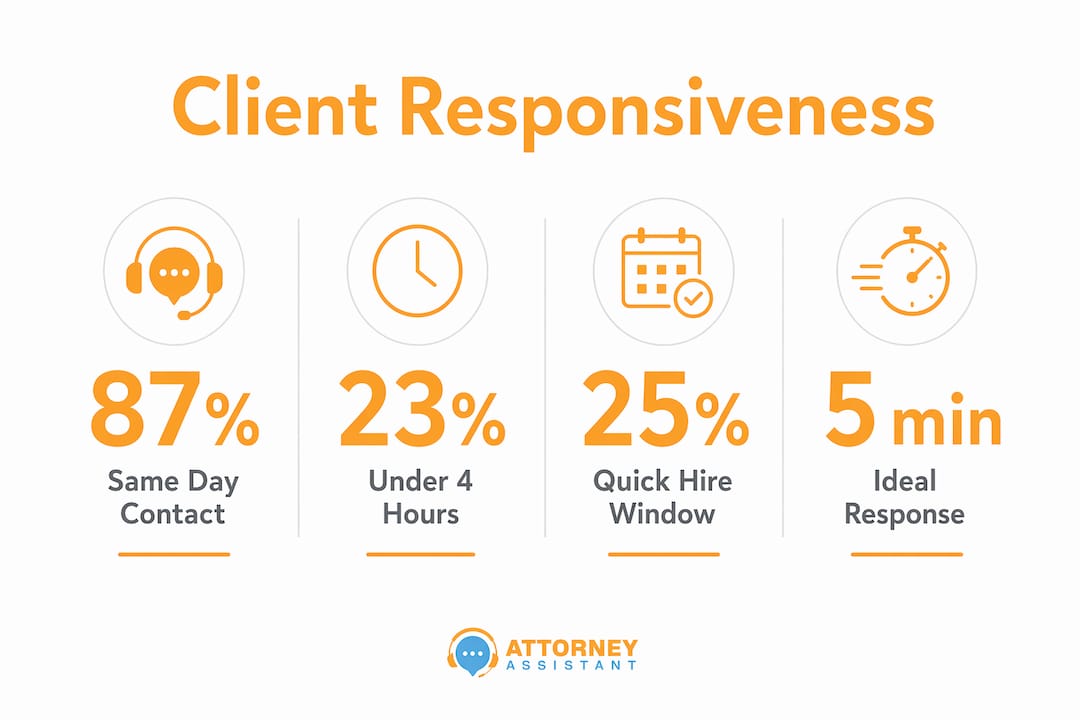
The practical implication is this: your marketing spend generates leads, but your intake speed determines how many of those leads become clients. Firms that improve response time do not need more leads to grow revenue. They need fewer leaks.
What responsiveness actually means beyond picking up the phone
Speed gets clients to the door. Communication quality keeps them there. Clients value knowing what happens next, and they interpret silence as neglect. Fennemore frames responsiveness as a form of respect: clients hear back quickly, understand what is coming, and receive clear guidance rather than legal jargon. That framing matters because it shifts responsiveness from a reaction to a system.

Shamieh Law commits to updates within 72 hours and gives clients direct access via phone, email, text, and a client portal. That multi-channel approach reflects a core truth about modern client expectations: people want to reach you through the channel they prefer, not the one that is most convenient for your staff. Firms that limit contact to a single channel lose clients who would have stayed if given a second option.
Three communication behaviors separate responsive firms from the rest:
- Proactive updates. Clients should not have to ask where their case stands. Scheduled touchpoints, even brief ones, reduce anxiety and build trust.
- Plain language. Translating legal process into clear next steps is a service in itself. Clients who understand what is happening feel more in control and less likely to disengage.
- Channel flexibility. Offering phone, email, text, and portal access is not a luxury. It is a baseline expectation for client satisfaction with responsive services in 2026.
Pro Tip: Set a communication cadence at intake. Tell every new client exactly when and how they will hear from you. That single step eliminates most “why hasn’t anyone called me?” complaints.
Responsiveness expectations also vary by client segment. Corporate clients and business owners expect faster turnaround than individuals navigating personal injury or estate matters. Firms that apply a single communication standard across all practice areas will underserve some clients and over-invest in others.
How responsiveness standards differ by practice area
Not every client expects the same response window, and not every practice area carries the same urgency. The table below reflects realistic benchmarks based on client expectations and competitive norms across common practice areas.
| Practice area | Expected response window | Primary contact channel |
|---|---|---|
| Personal injury | Within 2 to 4 hours | Phone, text |
| Criminal defense | Within 1 to 2 hours | Phone |
| Family law | Same business day | Phone, email |
| Corporate/business law | Within 2 to 4 hours | Email, portal |
| Estate planning | Within 24 hours | Email, phone |
| Immigration | Within 4 to 8 hours | Phone, email |
Criminal defense and personal injury clients are often in crisis when they call. A four-hour delay in those practice areas is not just a missed lead. It is a client who called three other firms while waiting. Corporate clients expect speed because their business problems are time-sensitive, even when the legal matter itself is not urgent. Estate planning clients are more tolerant of a 24-hour window, but they still expect acknowledgment the same day.
Smaller firms can compete directly with larger practices on responsiveness. Large firms often have slower internal routing, more gatekeepers, and less flexible intake processes. A boutique firm with a trained intake specialist and a clear communication protocol can outperform a 50-attorney firm that routes calls through a general receptionist. Size is not the advantage. Systems are.
The rise of digital channels has also shifted expectations across every practice area. Clients who find a firm through Google or a legal directory expect the same speed they get from an e-commerce return. That expectation is not going away.
Operational strategies that make firms genuinely responsive
Responsiveness at scale requires systems, not just good intentions. The firms that consistently meet client expectations build the following into their operations:
- Dedicated intake specialists. A trained intake specialist handles first contact, qualifies the lead, and sets expectations before the attorney is ever involved. This removes the bottleneck of attorney availability from the intake process.
- CRM with automated acknowledgment. When a lead submits a form or calls after hours, an automated reply confirms receipt and sets a callback window. This prevents the lead from feeling ignored while your team prepares to respond.
- Multi-channel intake coverage. Phone, email, live chat, text, and client portals each capture different client segments. Firms that cover all five channels miss fewer leads than those relying on phone alone.
- Closed-loop follow-up workflows. Automated workflows in one documented case achieved an 85% survey distribution rate and a 58% client response rate, with partner acknowledgment delivered within 24 hours. That kind of consistency requires automation, not manual effort.
- Scripted communication cadences. Scripted does not mean robotic. It means every client gets the same quality of update at the same intervals, regardless of which team member handles their case.
- Responsiveness metrics and accountability. Track average response time, follow-up completion rates, and client satisfaction scores. What gets measured gets managed.
The firms that treat legal intake best practices as a revenue function rather than an administrative task see the clearest gains in conversion rates. The operational investment is modest compared to the cost of a missed case.
Key takeaways
Responsive firms win more clients because speed, clarity, and consistent communication directly convert leads into signed cases.
| Point | Details |
|---|---|
| Speed drives selection | 87% of clients expect same-day contact; delays send leads to faster competitors. |
| Communication quality retains clients | Proactive updates and plain language reduce client anxiety and build long-term trust. |
| Practice area benchmarks vary | Criminal and personal injury clients expect responses within hours; estate planning allows up to 24 hours. |
| Small firms can outperform large ones | Dedicated intake systems give smaller firms a real competitive edge over slower, larger practices. |
| Systems create consistent responsiveness | CRM automation, intake specialists, and scripted cadences produce measurable gains in client satisfaction. |
Responsiveness is a culture problem before it is a systems problem
I have worked with enough law firms to know that the intake and communication failures are rarely about technology. They are about culture. Most firms have not decided, at the leadership level, that responsiveness is a non-negotiable standard. It gets treated as a nice-to-have rather than a core operational commitment.
The firms I have seen grow fastest share one trait: their managing partners talk about response time the way they talk about billing rates. It is a number they know, track, and hold people accountable for. When leadership treats responsiveness as a performance metric, the rest of the firm follows.
There is also an empathy dimension that gets overlooked. Clients who contact a law firm are almost always in some form of distress. A fast response does not just convert a lead. It reduces someone’s anxiety at a moment when they feel vulnerable. Firms that internalize that reality build communication cultures that clients feel, not just notice.
The uncomfortable truth is that most firms are losing cases they already paid to attract. Their marketing generates the lead. Their intake process loses it. Fixing that sequence does not require a bigger advertising budget. It requires operational discipline and the decision to treat every first contact as the most important moment in the client relationship.
— Nicole
Stop losing the leads your marketing already paid for
Law firms spend thousands on advertising and SEO to generate leads, then lose a significant portion of those leads to slow follow-up and inconsistent intake. Attorneyassistant fixes that gap directly.
Attorneyassistant handles intake, lead follow-up, and communication workflows so your firm responds faster, converts more leads into signed cases, and stops the revenue leak that most firms do not even know they have. From intake automation to lead recovery services, every solution is built around the operational reality of running a law firm. If your firm is ready to convert more of the leads it already has, book a call with the Attorneyassistant team and find out exactly where your intake is losing cases.
FAQ
Why do clients choose responsive firms over more experienced ones?
Clients interpret fast, clear communication as evidence of competence and organization. Slow replies increase doubt and drive prospects to competitors, regardless of the firm’s actual qualifications.
What is the ideal response time for a law firm?
87% of clients expect contact returned the same business day, and 23% expect a reply within four hours. For high-urgency practice areas like criminal defense, response within one to two hours is the competitive standard.
How does responsiveness affect lead conversion rates?
Responding within five minutes of a lead’s first contact significantly increases the likelihood of qualification and conversion. Delays of even 30 minutes reduce contact rates and give competitors time to reach the same prospect.
Can small firms compete with large firms on responsiveness?
Yes. Smaller firms with dedicated intake specialists and clear communication protocols consistently outperform larger firms with slower internal routing. Systems matter more than firm size when it comes to intake responsiveness.
What communication channels do clients expect from law firms in 2026?
Clients expect access via phone, email, text, and client portals. Shamieh Law’s multi-channel model demonstrates that offering flexible contact options directly improves client satisfaction and reduces drop-off during the intake process.
Recommended
Related Articles

Call Answering Service for Law Firms: What Actually Works
A call answering service for law firms should sign cases, not take messages. Learn pricing models, vendor criteria, and 24/7 intake that converts.

Case Management Notes: A Law Firm's How-To Guide
Learn how to write case management notes that hold up, with a defensible structure, privilege safeguards, handoff tips, and a smarter way to staff the work.

Medical Records Coordinator: What the Role Actually Does
A medical records coordinator manages records retrieval, summaries, billing, and liens for law firms. Learn duties, KPIs, and when to outsource vs hire.