Why responsiveness drives law firm client conversion

TL;DR:
- Responding within 24 hours is crucial for client satisfaction and firm reputation.
- Slow responses can cause significant revenue losses, up to hundreds of thousands annually.
- Improving responsiveness requires clear policies, ownership, automation, and after-hours coverage.
Most personal injury law firms assume their biggest problem is generating more leads. The real problem is closer to home. According to industry benchmarks, the standard for small and mid-sized firms is responding to potential clients within 24 hours, and missing that window directly causes low satisfaction scores and poor online ratings. Responsiveness, not legal skill alone, determines whether a prospective client signs with your firm or moves on to a competitor who picked up the phone first. This guide breaks down what responsiveness really means, what it costs when it fails, and exactly how to fix it.
Table of Contents
- Understanding responsiveness in law firms
- The true cost of slow responses
- Strategies to improve law firm responsiveness
- Measuring responsiveness and tracking success
- Our perspective: Why responsiveness beats legal expertise for growth
- Explore your next steps: Operational support for stronger responsiveness
- Frequently asked questions
Key Takeaways
| Point | Details |
|---|---|
| Responsiveness benchmark | Clients expect a reply within 24 hours for positive satisfaction and reviews. |
| Revenue impact | Poor responsiveness costs the legal industry billions in lost opportunities every year. |
| Action steps matter | Simple operational improvements and systems can dramatically boost client conversion rates. |
| Measure and track | Monitoring response time and conversion metrics helps maintain service quality. |
Understanding responsiveness in law firms
Responsiveness in legal practice is not simply returning calls. It is the total speed and consistency with which your firm communicates across every channel a prospect or client might use to reach you. That includes phone calls, emails, web intake forms, live chat, and even text messages. When a potential client contacts your firm after an accident, they are often scared, confused, and interviewing multiple attorneys at once. The firm that responds first and communicates clearly wins the case.
The 24-hour response standard for small and mid-sized firms is not a suggestion. It is the baseline expectation that prospective clients bring to their search. Miss that window and your ratings take a hit. Miss it consistently and your firm develops a reputation for being hard to reach, which is lethal in a market where Google reviews influence which attorney someone calls in the first place.
Responsiveness has several distinct dimensions you need to track separately:
- Initial contact speed: How fast does someone from your firm reach out after a new lead comes in?
- Follow-up frequency: If a prospect does not answer, how many times and how quickly do you attempt contact again?
- Intake form turnaround: How long does it take for a submitted web form to generate a human response?
- Email reply time: Are client emails handled within business hours, or do they sit for days?
- After-hours coverage: Does your firm have any response capability outside of 9 to 5?
Each of these represents a place where a lead can fall through the cracks. Strengthening your client communication strategies across all of these dimensions builds the kind of client trust that translates directly into signed retainer agreements.
“Slow responsiveness is not just an inconvenience to clients. It is a direct signal that your firm may not be organized or attentive enough to handle their case. Clients draw that conclusion faster than you think.”
A common pitfall is treating responsiveness as a phone-only problem. Many firms invest in call answering but completely ignore email reply times, which can stretch to 48 or 72 hours. Another major gap is web intake forms. A prospect fills out your contact form at 9 p.m. on a Tuesday expecting someone to reach out within hours. If your team only checks form submissions during office hours and processes them in batches, that prospect has already retained someone else by the time you call.
Understanding these gaps is the first step. Fixing them requires a clear picture of what slow responses actually cost your firm financially, which is where most practice owners experience a genuine shock.
The true cost of slow responses
Let’s put a number on this problem. The legal industry loses approximately $109 billion each year from unanswered calls and poor intake processes. Nearly half of all law firms are essentially unreachable by phone during business hours. That is not a marginal issue. That is a structural failure happening at scale across the industry.
For a small personal injury firm with 10 to 20 active leads per month, even losing two or three cases per month to slow follow-up adds up dramatically. If your average case value is $15,000, losing three cases a month means $540,000 in lost annual revenue. These are not hypothetical numbers. These are the leads you are already paying to generate through advertising, referrals, or SEO.

| Scenario | Monthly leads lost | Average case value | Annual revenue lost |
|---|---|---|---|
| Slow intake (2 cases/month) | 2 | $15,000 | $360,000 |
| Missed after-hours calls (3 cases/month) | 3 | $15,000 | $540,000 |
| No follow-up system (5 cases/month) | 5 | $15,000 | $900,000 |
The scenario that catches most attorneys off guard is after-hours missed calls. Personal injury prospects often call right after an accident or right after they leave the emergency room, which frequently happens in the evening or on weekends. If no one is available, they hang up and call the next firm on their list.
The reputation damage from slow responses compounds over time. Clients who feel ignored leave reviews describing your firm as unresponsive, even if the legal work itself is excellent. One two-star review citing poor communication can suppress dozens of five-star reviews in a prospective client’s perception. Understanding the revenue leakage causes inside your intake process is essential before you can stop the bleeding.
Statistic callout: The legal industry loses approximately $109 billion annually from poor intake and missed calls. Your firm is likely contributing to that number right now.
Pro Tip: Assign a dedicated team member or use a third-party answering service specifically for after-hours calls. Even a simple voicemail-to-text system that triggers an immediate email alert allows someone to call back within minutes instead of waiting until morning. The firms that win after-hours leads are rarely the biggest firms. They are the most responsive ones.
Avoiding common intake mistakes is not about spending more on marketing. It is about protecting the investment you have already made by ensuring every lead gets a fast, human response.
Strategies to improve law firm responsiveness
Improving responsiveness is a system problem, not a motivation problem. Your attorneys are busy. Your staff is stretched. The fix is not telling everyone to try harder. The fix is building processes and tools that make fast response the path of least resistance.
Here are five proven strategies personal injury firms can implement immediately:
- Set a response time standard and enforce it. Define what acceptable response time looks like for your firm: 15 minutes for phone calls, one hour for web form submissions, four hours for emails. Write it down, train your team on it, and track it weekly.
- Assign intake ownership explicitly. Every incoming lead should have one named person responsible for the initial contact. When everyone is responsible, no one is. Ambiguity is where leads go to die.
- Use automated lead alerts. When a web form is submitted or a voicemail is left, an automatic alert should reach a human within minutes. This is a simple CRM or intake software setting that takes 30 minutes to configure but saves cases every week.
- Implement a multi-touch follow-up sequence. Most leads require five to eight contact attempts before they convert. Build a follow-up sequence that spans calls, texts, and emails over the first 72 hours. Do not give up after one unanswered call.
- Cover the hours your competitors do not. Evening and weekend coverage is a genuine competitive advantage in personal injury. Even part-time coverage from 5 p.m. to 9 p.m. can capture leads your competitors lose overnight.
Now compare how different intake approaches perform against these goals:
| Intake method | Response speed | After-hours coverage | Follow-up consistency | Cost |
|---|---|---|---|---|
| Manual (in-house only) | Slow | None | Inconsistent | Low direct cost, high opportunity cost |
| Assisted (outsourced intake team) | Fast | Available | Structured | Moderate |
| Automated only | Instant (bot) | Available | Rigid | Low, but impersonal |
| Hybrid (tech plus human) | Fast | Available | Consistent | Moderate to high, best ROI |
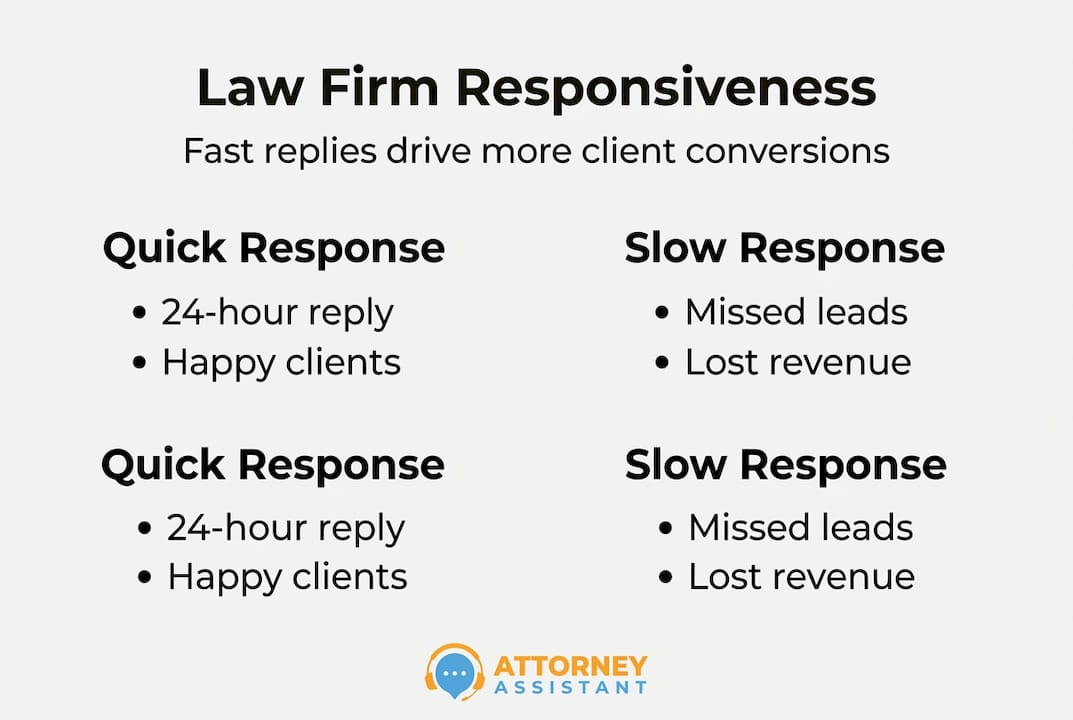
The hybrid model consistently outperforms pure automation or pure manual intake. Clients want a human voice quickly, but technology makes that human response scalable.
When auditing your current responsiveness, run through this checklist:
- Do you know your current average response time to new leads?
- Is there a written policy for how quickly different channels get responses?
- Does every incoming lead route to a named person for follow-up?
- Are you tracking which leads were never contacted a second time?
- Do you have any after-hours phone coverage at all?
Meeting the 24-hour response benchmark starts with knowing where you currently stand. You cannot improve what you are not measuring.
Resources on enhancing response time give you tactical tools to implement these changes, while understanding the root causes of missed calls helps you address the problem at its source rather than applying surface-level fixes.
Measuring responsiveness and tracking success
Strategy without measurement is just hope. If you implement better intake processes but never verify whether they are working, you will drift back to old habits within weeks. Measuring responsiveness is straightforward once you know which numbers to watch.
Here are the key metrics every personal injury firm should track:
- First response time: The average time between a lead coming in and a team member making first contact. Aim for under 15 minutes for phone leads and under 60 minutes for web form submissions.
- Lead contact rate: What percentage of your incoming leads result in at least one live conversation? If this number is below 60%, you have a serious responsiveness gap.
- Lead conversion rate: Of the leads you contact, what percentage sign a retainer? Improvements here reflect better intake quality, not just speed.
- Follow-up attempts per lead: How many touches does your team make before marking a lead as lost? Firms with structured sequences consistently outperform those without.
- Response time by channel: Break this down separately for phone, email, and web forms. You will almost certainly find that one channel is significantly slower than the others.
Once you have these baselines, track them weekly in a simple spreadsheet or your CRM dashboard. Look for trends over 30 to 60 days rather than reacting to individual data points.
Here are simple steps to get your tracking system off the ground:
- Pull a report from your CRM or intake software on all leads from the last 30 days.
- Record the timestamp of when each lead came in and when the first contact attempt was logged.
- Calculate the gap for each lead, then average across all leads for the month.
- Segment the data by channel and by time of day to spot your weakest points.
- Set a target for next month and assign ownership for hitting it.
Linking these data points to business outcomes is where the real insight lives. Firms that consistently meet the 24-hour benchmark see measurably higher client satisfaction scores and retain more clients through the full case lifecycle. Faster intake also reduces the early-case attrition that happens when clients feel ignored in those first critical days after reaching out. Reviewing intake process best practices alongside your data gives you a clear picture of where process improvements will have the biggest impact.
Responsiveness data also protects you from the natural human tendency to overestimate how well things are going. Most attorneys believe their firm responds quickly. The data almost always tells a different story.
Our perspective: Why responsiveness beats legal expertise for growth
Here is the uncomfortable truth most attorneys do not want to hear. A prospective personal injury client cannot evaluate your legal skill. They have no way to compare your case strategy with the firm down the street. What they can evaluate immediately is whether you called them back.
We have seen this pattern repeat across hundreds of client interactions. Firms with genuinely exceptional legal talent lose cases to mediocre competitors because the competitor answered the phone on a Saturday afternoon. The client did not choose the better lawyer. They chose the firm that made them feel like a priority.
Conventional wisdom says that reputation for legal excellence drives growth. Our experience says responsiveness drives initial conversion, and conversion drives everything else. You cannot demonstrate your legal skill to a client you never reached. Think of legal answering service solutions not as a luxury but as the operational foundation that gives your legal skill a chance to matter.
The firms that grow fastest are not always the best. They are the most reachable. Fix that, and everything else follows.
Explore your next steps: Operational support for stronger responsiveness
If this article has clarified one thing, it is that responsiveness is not a soft skill. It is a measurable business function with direct revenue consequences. The good news is that fixing it does not require hiring a dozen new staff members.
Attorney Assistant helps personal injury firms respond faster without burning out their existing teams. Our lead follow-up service ensures no prospect goes dark after their first contact. Our 24/7 intake support covers the hours your competitors ignore, capturing after-hours and weekend leads that would otherwise convert elsewhere. If you want to see how these systems work in practice, join our responsiveness webinar where we walk through real intake scenarios and proven follow-up frameworks. Your next signed case may already be in your lead list.
Frequently asked questions
What is considered acceptable response time for a law firm intake?
Most small and mid-sized firms are expected to respond within 24 hours of contact, with top-performing firms aiming for responses within 15 to 60 minutes.
How much revenue can a law firm lose from slow responses and missed calls?
The legal industry loses approximately $109 billion each year from poor intake and unanswered calls, making responsiveness a direct financial issue for every firm.
Which communication channels should law firms prioritize to improve responsiveness?
Firms should prioritize phone calls first, then web intake forms and email, since slow responsiveness across all channels contributes to poor client satisfaction and lost leads.
How can law firms track and improve response times?
Firms should log first contact timestamps for every lead and calculate average response time by channel monthly, then use those benchmarks and follow-up standards to set measurable improvement targets.
Recommended
- How to enhance law firm response time for client conversion | Attorney Assistant
- Law firm CRM: boost client intake and case conversion | Attorney Assistant
- Optimize law firm intake and convert 80% more leads | Attorney Assistant
- 10 Lead Conversion Strategies Attorneys Need for Higher Revenue | Attorney Assistant
Related Articles

Appointment Setting Online: A Law Firm Guide
Master appointment setting online for law firms with proven strategies that turn leads into booked consultations and grow your practice.

Medical Records Request: A Practical Guide for Law Firms
Run a clean medical records request with HIPAA-compliant steps, sample language, timelines, fees, and follow-up tactics built for law firm operations.

Request for Discovery Template: A Practical Guide
Use our request for discovery template with annotated fields, jurisdictional notes, and filing instructions. Customize it for federal or state court cases.