Boost lead conversion with consistent client intake

TL;DR:
- Most personal injury law firms fail to maintain consistent intake processes, risking lost clients and legal errors. Standardizing intake with scripts, checklists, and automated follow-up improves client experience, legal defense, and revenue capture. Regular audits, dedicated ownership, and basic tools establish lasting intake discipline, preventing costly inconsistencies.
Every personal injury firm knows the frustration of a promising lead that goes cold. What most firms don’t realize is that the problem rarely lives in their marketing budget or their case quality. It lives in their intake process. Standardizing intake with checklists, scripts, and structured forms prevents staff from skipping critical facts, reduces operational errors, protects against malpractice risk, and improves how quickly new clients feel confident they made the right call. If your team improvises intake conversations, you are losing cases you never knew you had.
Table of Contents
- Why consistency is critical in client intake
- What a consistent intake process looks like
- Common pitfalls of inconsistent intake (and how to fix them)
- Implementing consistency: Practical steps for PI law firms
- Why most PI firms underestimate intake consistency: Our take
- Ready to make your intake process consistent?
- Frequently asked questions
Key Takeaways
| Point | Details |
|---|---|
| Consistency drives conversions | PI firms with standardized intake capture and convert more leads reliably. |
| Reduces risk of malpractice | A documented, repeatable intake process protects against costly errors and legal exposure. |
| Faster, better onboarding | Structured intake ensures every new client gets the right attention without delay or lost facts. |
| Start simple | Even basic templates and team training can create immediate improvements in consistency. |
Why consistency is critical in client intake
The phrase “client intake” sounds routine. Fill out a form, collect some details, send a retainer. But for a personal injury law firm, intake is the moment a potential client decides whether to trust you with one of the most stressful events of their life. Get it wrong once and you lose that client. Get it wrong repeatedly and you develop a reputation for being disorganized, slow, or dismissive.
Consistent intake matters for three distinct reasons: legal risk, client experience, and revenue capture.
On the legal risk side, the most common malpractice claims in PI law stem from missing information at intake. A missed statute of limitations date, an undisclosed prior injury, or a forgotten insurance policy detail can derail an otherwise solid case. The American Bar Association recommends standardizing the intake process with scripts and forms so that no critical fact goes uncaptured, regardless of who handles the call. This is not about being bureaucratic. It is about building a defensible record from the very first interaction.
On the client experience side, consider what a prospective client goes through before they call your firm. They have likely been injured, are worried about money, and may have already spoken to two or three other firms. They are comparing experiences in real time. If one firm’s intake is smooth, professional, and thorough while another feels improvised or rushed, the choice becomes obvious.

On the revenue side, intake’s impact on onboarding is direct and measurable. Firms that use consistent intake processes sign more cases because clients feel confident earlier. Poor intake creates hesitation. Hesitation creates drop-off.
Here are the core reasons inconsistent intake hurts PI firms specifically:
- Missed critical facts lead to case errors or client disputes later
- Slow or uneven responses cause prospects to sign with a competitor instead
- Inconsistent communication styles make the firm seem disorganized
- No documentation trail exposes firms to malpractice claims
- Varying staff approaches create unpredictable quality across client touchpoints
“The intake process is your firm’s first impression and your legal protection. Treating it as optional or improvised is one of the most expensive decisions a firm can make.”
Reviewing client intake best practices regularly, especially as your team grows, keeps everyone aligned and prevents the drift that erodes consistency over time.
What a consistent intake process looks like
Many PI firms believe they have a consistent intake process because they use the same intake form. But a form is only one piece of the picture. True consistency means every prospect, regardless of which staff member they speak with or what time they call, receives the same structured experience.
Here is the difference between an ad hoc approach and a standardized one:
| Element | Ad hoc intake | Standardized intake |
|---|---|---|
| Initial contact | Staff improvises greeting and questions | Scripted opening with defined qualifying questions |
| Data capture | Varies by staff member | Required fields on a structured form |
| Response time | Depends on who is available | Defined speed-to-lead target (within 24 hours) |
| Follow-up | If someone remembers | Automated reminders with set intervals |
| Case qualification | Gut feeling | Documented checklist with clear criteria |
| Documentation | Inconsistent notes | Standardized record stored in case management software |
The distinction is obvious when you see it side by side. Ad hoc intake relies entirely on individual judgment and memory. Standardized intake creates a repeatable, auditable experience.
Here is how to build out a consistent PI intake framework step by step:
- Define your qualifying criteria. Know in advance what facts you need to assess viability: type of injury, date of incident, liability factors, insurance coverage, and jurisdiction.
- Write a scripted intake conversation. This is not a rigid robot script. It is a guide that ensures no staff member forgets to ask the critical questions. Review intake script examples for language that works in real PI conversations.
- Build a structured intake form. Capture every required field digitally so data is searchable, transferable, and reviewable.
- Set a speed-to-lead standard. Research cited by Miami-Dade Bar makes clear that structured triage ensures every inbound inquiry receives the same minimum next steps and data capture, dramatically improving conversion rates.
- Automate follow-up. Use your case management software or a dedicated intake tool to trigger follow-up messages at set intervals after first contact.
- Create a staff training cadence. Intake consistency erodes quickly when training is a one-time event. Schedule quarterly refreshers.
Using an onboarding checklist tied directly to your intake data ensures the transition from prospect to signed client is seamless, not another opportunity for information to fall through the cracks.
Pro Tip: Run a “mystery caller” test on your own firm. Have someone call in as a potential PI client and score the experience against your intake checklist. Most firms discover gaps they had no idea existed.
Common pitfalls of inconsistent intake (and how to fix them)
Knowing what good intake looks like is one thing. Understanding where firms actually fail is where the real learning happens. The most common intake pitfalls are predictable, and every single one of them is fixable.
Pitfall 1: Improvised conversations. When staff do not have a script or checklist to rely on, they improvise. That sounds flexible, but in practice it means some callers get asked about insurance while others never do. Some get a warm, professional greeting while others get a rushed, distracted one. As noted by the Miami-Dade Bar Association, lack of a defined intake process and inconsistent staffing create improvised, inconsistent experiences that hurt conversion and expose firms to risk.
Pitfall 2: Slow response times. Speed matters more than most PI firms realize. A prospect who calls three firms will often sign with the first firm that responds with professionalism and clarity. If your team takes 48 hours to return a call or sends a generic email acknowledgment, you have already lost ground.
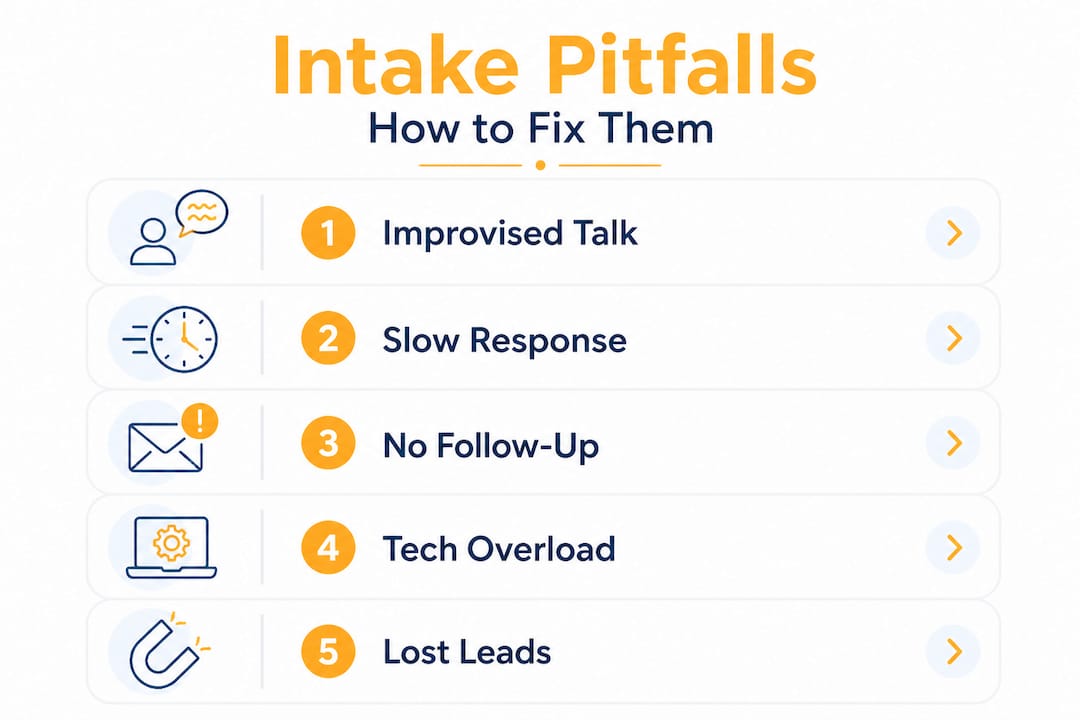
Pitfall 3: No follow-up system. One of the most costly intake mistakes is failing to follow up with a prospect who expressed interest but did not sign immediately. Many PI clients are dealing with medical appointments, insurance adjusters, and family stress. They do not always sign on day one. Without a structured follow-up sequence, these leads evaporate.
Pitfall 4: Staff turnover disrupting consistency. In firms where intake lives in the heads of a few experienced staff members, every departure is a consistency crisis. Documented processes and automated systems reduce this vulnerability significantly.
Here is the fix for each pitfall:
- Replace improvisation with a standardized script and mandatory intake form fields
- Fix slow responses by setting a firm-wide speed-to-lead rule and using automated acknowledgment messages
- Build a follow-up system using intake software or CRM tools, with at least three touchpoints over the first week
- Reduce turnover risk by documenting everything so any trained staff member can run intake without institutional knowledge
Firms that focus on automating intake for consistency find that technology does not replace the human element of intake. It protects it, by ensuring the structured framework runs even when individual staff members are unavailable or overwhelmed.
The hidden cost of dropped leads is significant. Even if you only lose two signed cases per month due to intake inconsistency, and each case has an average value of $25,000 to $50,000, the annual revenue leak is $600,000 to $1.2 million. Most firms treat intake as an administrative function. It is actually a revenue function.
Implementing consistency: Practical steps for PI law firms
You do not need to overhaul everything at once. The most sustainable improvements come from systematic, incremental changes that build momentum over time. Here is a practical roadmap.
-
Audit your current process. Before building anything new, document what actually happens today. Shadow your intake staff for a week. Record calls where permitted. Map every touchpoint from first contact to signed retainer. Identify where information gets lost, delayed, or handled differently by different people.
-
Build or adopt a standard intake script. Write a conversational guide that covers opening, qualifying questions, empathy checkpoints, and next steps. Pilot it with one staff member before rolling it out firm-wide. Adjust based on real feedback.
-
Create or upgrade your intake form. The form should capture every fact your attorneys need to make a qualification decision. Work backward from case requirements to form fields.
-
Set response time standards. Data shows 79% of clients expect a response within 24 hours, and faster is almost always better in PI intake. Build this into your staff expectations and automate where possible.
-
Assign a process owner. This is the single most underrated step. Consistency requires someone who is accountable for it. Give one person ownership of intake quality, including training, audits, and process updates.
-
Schedule regular intake reviews. Monthly or quarterly check-ins help you catch inconsistencies before they compound. Review call recordings, form completion rates, and signed case data together.
-
Explore dedicated intake tools. Review available intake tools to find options that integrate with your current case management software and reduce manual steps for your team.
Pro Tip: When organizing your intake team, clearly separate intake roles from case management roles. Staff who juggle both often deprioritize intake during busy periods, which is exactly when consistent intake matters most.
Why most PI firms underestimate intake consistency: Our take
Here is the uncomfortable truth we have seen play out repeatedly: most PI law firms believe their intake is better than it is. Not because they are careless, but because inconsistency is invisible until something goes wrong. A malpractice claim surfaces. A high-value lead quietly signs with a competitor. Reviews mention that the office felt disorganized. By then, the pattern has been running for months.
The conventional wisdom is that intake problems come from not having the right forms or software. Our experience tells us the deeper issue is cultural. Intake is treated as administrative work rather than strategic work. It gets delegated to the least experienced person on the team and updated only when something breaks. That attitude makes it nearly impossible to achieve real, lasting consistency.
True intake consistency requires a mindset shift. It means treating every inbound call as if your best attorney were on the line, not because you are overstating the administrative task, but because the client on the other end does not distinguish between intake and representation. They are already evaluating your firm.
Firms that invest in hiring an intake specialist dedicated to this function, rather than adding it as a secondary duty, consistently outperform peers in conversion rates. The return is not marginal. It is structural.
Inconsistency also quietly damages your referral pipeline. Clients who experience a smooth, professional intake are more likely to refer family and friends. Clients who feel like they fell through the cracks, even if their case settled successfully, rarely send referrals. That lost referral revenue rarely gets attributed to intake, but it belongs there.
Ready to make your intake process consistent?
Intake consistency is not a one-time project. It is an ongoing operational discipline, and it is genuinely hard to maintain without the right systems in place.
Attorney Assistant was built specifically to solve this problem for personal injury law firms. Our 24/7 intake services ensure every inbound lead is captured, qualified, and followed up with the same professional process, regardless of time or staffing. Our lead follow-up solutions keep prospects engaged through the signing process so you stop losing leads to slow response times. And our library of law firm intake tools gives your team the frameworks to build and maintain consistency at scale. If your firm is ready to stop leaking revenue from leads you have already earned, we are ready to help.
Frequently asked questions
How does intake consistency reduce malpractice risk?
A standardized intake process prevents staff from omitting critical facts and documents every step, creating a defensible record against claims of negligence in the event of a dispute.
What’s the typical response time clients expect from PI law firms?
79% of clients expect a response within 24 hours, making speed-to-lead one of the most measurable drivers of intake conversion for personal injury firms.
Do standardized intake scripts slow down new client onboarding?
No. Using structured scripts and forms actually accelerates onboarding by ensuring consistent data collection upfront, which reduces back-and-forth and rework later in the case lifecycle.
How can smaller PI firms adopt standardized intake without expensive software?
Even basic checklists, printed intake forms, and a simple training guide create meaningful consistency without software. Technology amplifies consistency but is not a prerequisite for building the foundation.
Recommended
- Optimize law firm intake and convert 80% more leads | Attorney Assistant
- 10 Lead Conversion Strategies Attorneys Need for Higher Revenue | Attorney Assistant
- 24/7 Intake Services | Attorney Assistant
- Legal intake tips to boost case conversion in 2026 | Attorney Assistant
- Predictable Pipeline for a Managed IT Services Firm – AI Management Agency
- Industrial Lead Generation: Systems for Pipeline
Related Articles

Call Flow Customer Service for Law Firms: A Practical Guide
Design a call flow customer service system for your law firm that captures leads, qualifies matters, and signs cases. Practical guide

Fear of Talking on Phone: 7 Practical Confidence Tips
Overcome fear of talking on phone with practical scripts, role-play, exposure exercises, and intake tools built for legal teams.

Appointment Setting Online: A Law Firm Guide
Master appointment setting online for law firms with proven strategies that turn leads into booked consultations and grow your practice.