How to Convert Leads into Cases for Law Firms

TL;DR:
- Law firms often lose leads due to slow responses and inefficient intake processes rather than insufficient inquiries. Improving response speed, automating workflows, and clearly defining each funnel stage can significantly increase conversion rates without additional marketing costs. Operational discipline and consistent follow-up are more effective than increased ad spend in maximizing existing lead volume.
Most law firms have a lead problem they don’t recognize. It’s not that they need more inquiries coming in. The real issue is that they’re losing the leads they already have because of slow response times, inconsistent follow-up, and intake processes that create friction at every step. Understanding how to convert leads into cases is an operational challenge, not a marketing one. Fix the gaps in your intake funnel and your existing lead volume starts generating more revenue without spending another dollar on ads.
Table of Contents
- Key takeaways
- How to convert leads into cases: laying the foundation
- The intake funnel from first contact to signed retainer
- Operational pitfalls that kill conversion rates
- Tracking performance and improving over time
- My take: operational discipline beats ad spend every time
- How Attorneyassistant helps firms close more cases
- FAQ
Key takeaways
| Point | Details |
|---|---|
| Speed determines conversion | Responding within 5 minutes makes you 21x more likely to connect and convert a lead than waiting 30 minutes. |
| Biggest drop-off is post-consultation | The highest-risk period for losing a lead is the gap between consultation agreement and signed retainer. |
| Top firms convert far more | Top-performing firms convert 45% or more of inquiries to signed clients; the average firm converts around 14%. |
| Automate non-human steps | Routing, scheduling, and SLA alerts should run without human input to eliminate processing delays. |
| One-step signing closes faster | Collapsing signing, payment, and intake into a single flow dramatically reduces drop-off after consultation. |
How to convert leads into cases: laying the foundation
Before you optimize anything, you need clarity on what your intake funnel actually looks like. Most firms assume they have a process. What they often have is a collection of habits, some documented and some not.
Lead conversion follows a structured path from inquiry through qualification, consultation, and finally retention. Each stage requires different actions, different owners, and different tools. When any stage lacks definition, leads fall through without anyone noticing.
Defining your lead stages
The four stages every firm needs clearly mapped are: Inquiry, Qualification, Consultation, and Retention. The intake funnel stages correspond directly to where you’re losing revenue. If you can’t answer “who owns this lead at each stage and what action must be taken within what timeframe,” your process has gaps.
The tools your firm needs
Here is what a functioning intake and conversion stack looks like:
- CRM with lead tracking: Every inquiry must be logged, time-stamped, and assigned. No exceptions.
- Intake forms: Short, mobile-friendly, and limited to what you need for qualification. Not everything you want to know.
- Lead routing rules: Automatic assignment based on practice area, geography, or intake team availability.
- Automated follow-up sequences: Email and SMS touchpoints that go out without a staff member manually triggering them.
- Scheduling tool: One-click booking that eliminates phone tag and reduces time to consultation.
Alignment between teams
Shared rules on lead quality and ownership across marketing, intake, and attorneys reduce the friction that causes leads to go cold. The most common breakdown Attorneyassistant sees in law firms is that marketing counts a lead as a win the moment an inquiry comes in, while intake staff are already overwhelmed and attorneys don’t follow up after consultations. Everyone needs a defined role and a defined handoff criteria.

Pro Tip: Set a weekly number to track: how many inquiries became consultations, and how many consultations became signed retainers. If you don’t track those two numbers, you cannot improve them.
The intake funnel from first contact to signed retainer
This is where converting leads effectively either happens or falls apart. The steps below are not theoretical. They reflect what separates high-converting firms from firms stuck at average numbers.
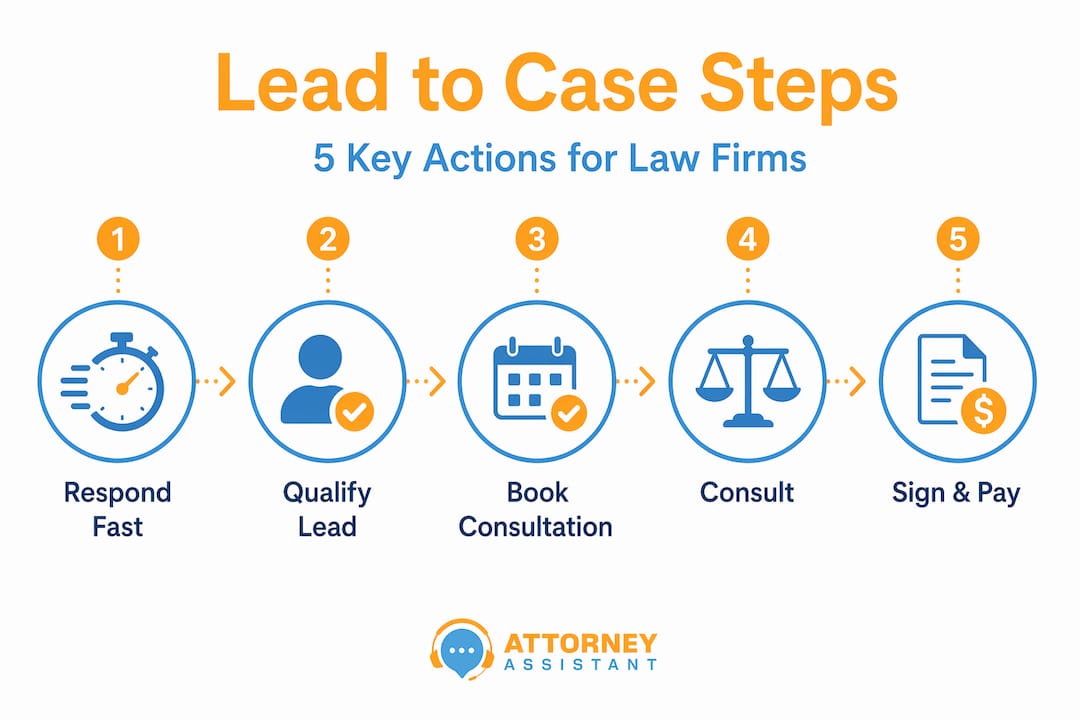
Step 1: Respond within 5 minutes
This is non-negotiable. Responding within 5 minutes makes your firm 21 times more likely to connect and qualify a lead than waiting 30 minutes. Most firms respond in hours, not minutes. That delay is your competition’s advantage.
Automated acknowledgment messages do not replace a live conversation, but they buy you time and signal responsiveness. The goal is a real person making contact within 5 minutes during business hours, with an automated touchpoint handling after-hours inquiries immediately.
Step 2: Qualify with a short form
Keep your intake form to 5 to 7 fields. Anything longer increases abandonment. The goal at this stage is to determine whether the inquiry meets your basic case criteria, not to gather every detail for the file. You can build a richer profile after they are qualified and scheduled.
Step 3: Schedule the consultation fast
Offer multiple options and let the prospective client choose without back-and-forth. A scheduling tool integrated with your calendar removes the friction that causes people to abandon the process. The faster you get them into a consultation slot, the less time they have to call your competitor.
Step 4: Run a focused consultation with a clear next step
Every consultation must end with a specific call to action. Not “we’ll be in touch” or “think it over.” The attorney or intake specialist should close the loop before the call ends: “Here is what happens next, and we’ll send you the agreement in the next hour.”
Step 5: Collapse signing and payment into one step
The one-step retainer process combines signing, payment, and intake details into a single mobile-friendly flow. This is one of the highest-leverage changes a firm can make. Every additional step between “yes” and “signed” is a chance for a lead to hesitate, get busy, or call someone else.
Pro Tip: Send the retainer agreement within 30 minutes of a successful consultation. Do not wait until the next business day. The window of commitment closes fast.
Operational pitfalls that kill conversion rates
You can have the right process on paper and still lose leads due to execution gaps. These are the most common breakdowns that reduce your case conversion rate.
- Delayed retainer delivery. The highest-risk drop-off point is the gap between verbal agreement and signed retainer. The biggest conversion danger is letting that window stretch past a few hours. A lead who says “yes” on a Tuesday afternoon and hasn’t signed by Wednesday morning is at serious risk of going cold.
- Manual routing bottlenecks. When a staff member has to manually assign and forward leads, delays compound. Automating routing and SLA alerts cuts processing time from hours to seconds.
- Undefined handoff criteria. Without explicit qualification checklists and ownership assignments, leads get passed around or ignored. If no one owns the lead at a specific stage, no one follows up.
- Inconsistent follow-up after consultation. Many firms do one follow-up and stop. The data on ways to increase case conversions consistently shows that multiple structured touchpoints after consultation are required to close leads who didn’t sign immediately.
- Multi-step signing and payment. Separate DocuSign links, separate payment portals, and separate intake forms create enough friction to lose clients who were genuinely interested. Consolidate these into one flow.
Speed-to-lead is a process design problem, not a people problem. You cannot coach your way to a 5-minute response across every channel during every hour. You solve it by building a system that responds automatically and alerts the right person immediately.
Tracking performance and improving over time
Getting the process right is step one. Knowing whether it’s working, and where it still isn’t, is how you improve your case conversion rate over time.
The two metrics that matter most
Track inquiry-to-consultation rate and consultation-to-retainer rate separately. Most firms only look at total signed cases and miss the stage where they’re losing the most opportunity.
Here is how typical firms compare to top performers:
| Metric | Average firm | Top-performing firm |
|---|---|---|
| Inquiry-to-consultation rate | 30–40% | 60–70% |
| Consultation-to-retainer rate | 35–45% | 70–80% |
| Overall inquiry-to-signed rate | ~14% | 45% or higher |
| Average response time | 2–4 hours | Under 5 minutes |
Using CRM data to find leaks
Your CRM should tell you where leads are stalling. If you have a large number of leads stuck at “consultation scheduled” with no movement, your post-consultation follow-up is the problem. If leads are dropping off before a consultation is scheduled, your response speed or qualification form is creating friction.
Set SLA alerts that fire when a lead has been sitting in a stage without action for longer than your defined threshold. An optimized intake follow-up process includes these automated alerts so nothing slips through quietly.
Refine your qualification criteria
If your consultation-to-retainer rate is high but your inquiry-to-consultation rate is low, your qualification filter may be too aggressive. If your inquiry-to-consultation rate is high but retainer rate is low, you’re spending consultation time on leads that don’t fit your practice. Adjust the criteria at the qualification stage and test for 30 days before drawing conclusions.
Pro Tip: Run a monthly review of your intake funnel data with whoever manages your CRM and your intake team. The goal is to identify one specific change to test each month, not to overhaul everything at once.
My take: operational discipline beats ad spend every time
I’ve worked with enough law firms to see the same pattern repeatedly. A firm is frustrated with its case volume and the instinct is to increase ad spend or try a new marketing channel. Then you look at their intake data and see that 40% of inquiries never got a response within the same business day. Another 25% of consultations had no documented follow-up afterward.
In my experience, the best practices for lead conversion are not complicated. They require discipline and accountability, not new technology or bigger budgets. What I’ve found is that firms who treat the handoff between each funnel stage like a contract, with defined criteria, assigned ownership, and a documented timeline, outperform firms spending twice as much on lead generation.
The uncomfortable truth is that most lead conversion problems are internal. They are caused by unclear roles, manual processes that create delays, and a lack of SLA enforcement. Speed-to-lead is rarely a rep behavior problem. It is almost always a process design problem.
I have seen firms increase signed cases by 30% or more simply by cutting response time from two hours to under ten minutes and automating retainer delivery after consultation. No new ad budget. No new practice areas. Just fixing what was already broken.
— Nicole
How Attorneyassistant helps firms close more cases
If your firm is generating leads but not seeing the case volume to match, the issue is almost certainly in your intake and follow-up operations. Attorneyassistant works directly with law firms to fix the gaps that cause signed cases to leak out of the funnel. From handling intake operations and live response to managing lead follow-up sequences that keep warm leads from going cold, Attorneyassistant provides the systems and the people to close those gaps. Firms that work with Attorneyassistant respond faster, follow up consistently, and sign more cases from the same lead volume they already have. If you want to see where your firm is leaking revenue, book a call to walk through your intake process.
FAQ
What is the most important factor in converting leads to cases?
Response speed is the single most powerful lever. Responding within 5 minutes makes a firm 21 times more likely to connect with and convert a lead compared to waiting 30 minutes.
Where do most law firms lose leads in the intake funnel?
The highest-risk drop-off point is the gap between a completed consultation and a signed retainer. Collapsing signing, payment, and intake into one step significantly reduces this loss.
What conversion rate should law firms aim for?
Top-performing firms convert 45% or more of inquiries into signed clients. The average firm converts around 14%, which means most firms have significant room to improve through operational changes.
How do you close more leads without increasing ad spend?
Fix the operational gaps in your intake funnel first. Automating lead routing, reducing response time, and standardizing post-consultation follow-up will increase your case volume from existing lead flow before you need to spend more on marketing.
How often should law firms review their lead conversion metrics?
Review inquiry-to-consultation and consultation-to-retainer rates monthly. Use CRM data to identify which stage is underperforming and test one specific change at a time to accurately measure impact.
Recommended
- Convert more leads into signed cases for injury firms | Attorney Assistant
- Law firm lead management: convert more clients in 2026 | Attorney Assistant
- Optimize law firm intake and convert 80% more leads | Attorney Assistant
- Lead qualification in law: boost case conversion and efficiency | Attorney Assistant
Related Articles

Lead Conversion Strategies for Law Firms: 2026 Guide
Discover effective examples of lead conversion strategies for law firms. Learn actionable tactics to boost client intake and drive revenue.

10 Business Finance Course Options for Law Firms
Compare 10 business finance course options by level, format, workload, and law-firm relevance, then choose the right fit for your role and goals.

10 Good VoIP App Options for Law Firms in 2026
Compare 10 good VoIP app options for small and mid-sized law firms, including security, integrations, pricing, mobile use, and desk-phone readiness.