Lead Conversion Workflow for Law Firms: 2026 Guide

TL;DR:
- Improving lead conversion workflows is crucial for law firms to maximize revenue from existing inquiries. Most firms lose clients due to slow response times and inconsistent follow-up, not a lack of leads. Implementing structured processes, using CRM tools, and ensuring rapid, multi-touch follow-up can significantly boost signed client rates.
A lead conversion workflow is a structured, repeatable process law firms use to turn inquiries into signed retainers efficiently and reliably. Most firms treat intake as an administrative task. That framing costs them money. The average firm converts roughly 14% of inquiries into signed clients, while optimized firms reach 40–50%. That gap represents more than $200,000 in lost annual revenue for a mid-size practice. The firms closing that gap are not generating more leads. They are fixing the process that handles the leads they already have.
What are the essential stages of a law firm lead conversion workflow?
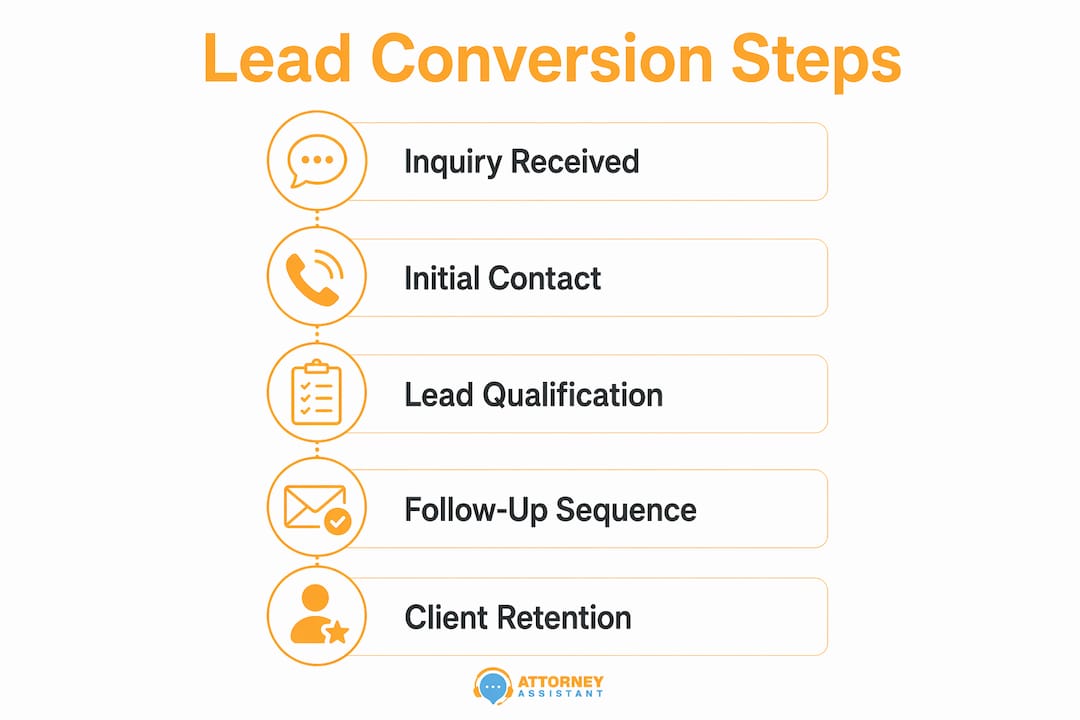
A law firm’s intake pipeline has five distinct stages. Each stage has a clear job. When any stage is undefined, leads fall through.
-
Lead capture. Every inquiry channel, whether phone, web form, live chat, or referral, must feed into a single system. The intake record must capture the prospect’s name, contact information, case type, jurisdiction, and how they found the firm. Missing fields at this stage create downstream confusion.
-
Qualification. A scripted intake call determines whether the lead fits the firm’s practice areas, jurisdiction, and case criteria. Structured intake scripts capture critical case information in the first two minutes, which improves scheduling speed and reduces time spent on unqualified prospects. The goal is a clear yes or no, not a vague “maybe follow up later.”
-
Conflict check and scheduling. Qualified leads move immediately to a conflict check. If the check clears, the next step is booking a consultation, not sending a general email. Delays at this stage are where warm leads go cold.
-
Follow-up sequences. Leads who do not convert after the first contact need a structured, multi-touch follow-up plan. Without a defined sequence, follow-up becomes inconsistent and dependent on individual staff memory.
-
Signed retainer. The final stage is the conversion event. Tracking which leads reach this stage, and which ones drop out before it, reveals exactly where the workflow breaks down.
Measuring conversion rates at each stage is the only way to identify bottlenecks. A firm that loses 60% of leads between qualification and scheduling has a scheduling problem, not a lead quality problem.
How can law firms optimize response time and follow-up to increase conversion?
Speed is the single largest variable in legal lead conversion. Leads contacted within five minutes convert 21 times more than leads contacted after 30 minutes. That is not a marginal difference. It reflects how quickly a prospective client’s urgency fades or redirects to another firm.
The practical implication is that every intake process needs two layers: an immediate automated acknowledgment and a live follow-up within minutes.
What a high-performing follow-up sequence looks like:
- Day 1, within 5 minutes: Automated text or email confirming receipt of the inquiry and setting expectations for a callback.
- Day 1, within 30 minutes: Live phone call from an intake specialist using a structured script.
- Day 2: Second call attempt plus a personalized email referencing the case type.
- Day 3–5: Additional call attempts and a value-added email, such as a relevant FAQ or resource.
- Day 7–14: Final outreach touches before moving the lead to a long-term nurture sequence.
Effective follow-up sequences involve 5–7 multi-channel touchpoints over 7–14 days. Firms that stop after one or two attempts leave qualified leads unconverted.
After-hours coverage is a separate problem that most firms underestimate. 46% of potential clients contact firms outside standard business hours. Firms without after-hours intake tools lose roughly half of those leads before the next business day begins. Answering services, callback scheduling, and after-hours intake coverage directly reduce that loss.
Pro Tip: Train intake staff to own their stage of the pipeline. An intake specialist who knows their job ends at a booked consultation, not a vague “I’ll try to reach them,” performs measurably better.
The first interaction with a lead is the start of the client relationship, not a clerical task. Firms that treat it that way convert at a higher rate.
What tools and technologies support an effective lead conversion workflow?
A CRM system is the operational backbone of any intake workflow. CRM usage increases lead conversion by 47% through consistent pipeline tracking. That number reflects what happens when every lead has a defined stage, an owner, and a next action, rather than sitting in a spreadsheet or an email inbox.

The table below outlines the core technology categories and their role in a law firm’s intake process.
| Technology | Primary function | Key benefit |
|---|---|---|
| CRM system | Pipeline tracking and stage management | Prevents leads from falling through the cracks |
| Automated acknowledgment tools | Immediate response to new inquiries | Reduces first-response time to under five minutes |
| Scheduling software | Consultation booking without back-and-forth | Removes friction between qualification and consultation |
| Analytics dashboard | Daily KPI reporting on response times and stage conversion | Identifies bottlenecks with real data, not guesswork |
| After-hours intake tools | Answering services or callback scheduling | Captures leads that arrive outside business hours |
Automation must be designed with compliance in mind. ABA Model Rule 5.5 and the TCPA govern how law firms communicate with prospective clients. Automated texts and emails must include proper disclosures, honor opt-out requests, and avoid creating an implied attorney-client relationship before a conflict check clears. Firms that skip this step expose themselves to regulatory risk.
Pro Tip: Build SLA reporting into your CRM from day one. If your system cannot tell you the average response time for the last 30 days, you are managing intake by feel, not by fact.
Firms that measure response time daily improve it. Firms that guess at their response time consistently underestimate it and underperform. A dashboard that surfaces response time, stage conversion rates, and follow-up completion rates turns intake management from reactive to predictable.
Understanding the full lead nurturing process across phone, email, and text channels helps firms design automation sequences that feel personal rather than mechanical.
How to implement and troubleshoot your lead conversion workflow
Building a new intake workflow while running an active firm requires a phased approach. Trying to change everything at once breaks existing processes and creates staff confusion.
-
Phase 1: Stabilize response. Define who owns first contact and set a response time target. Measure actual response times, not perceived ones. Most firms discover their real average is two to four times longer than they assumed.
-
Phase 2: Standardize qualification. Introduce scripted intake calls with clear qualification criteria. Define what a qualified lead looks like for each practice area. Implement changes in waves to avoid process breakage and allow the team to adapt before the next layer is added.
-
Phase 3: Add automation and QA. Once response and qualification are consistent, layer in automated acknowledgments, scheduling tools, and follow-up sequences. Add a weekly QA review of intake calls and CRM entries.
“Conversion improves most when intake becomes a disciplined operating system with KPIs, stage ownership, and SLA reporting, not just better scripts.” — Law Firm Intake Process Playbook
The most common implementation mistakes are predictable. Firms assume that “contacted” means “qualified.” These are different pipeline stages, and mixing them inflates CRM data and makes conversion metrics meaningless. A lead that received a voicemail is not a qualified lead.
Clear exit criteria for each pipeline stage keep the database accurate. A stage should only advance when specific conditions are met: a live conversation occurred, case type was confirmed, jurisdiction was verified. Mandatory fields in the CRM enforce this discipline without relying on staff memory.
Missed calls are a separate failure mode. A firm that misses a call and does not call back within the hour has effectively rejected that lead. Tracking missed call rates alongside response times gives a complete picture of intake performance.
Pro Tip: Run a one-week audit before implementing any new tools. Log every inbound inquiry, the time it was received, the time of first contact, and the outcome. The results will show you exactly where to start.
Key takeaways
A law firm’s lead conversion workflow directly determines how much revenue it captures from its existing marketing spend. Fixing intake operations, not increasing lead volume, is the fastest path to higher signed client rates.
| Point | Details |
|---|---|
| Speed determines conversion | Leads contacted within five minutes convert 21 times more than those reached after 30 minutes. |
| Follow-up requires structure | A 5–7 touch sequence over 7–14 days across phone, email, and text is the standard for high-converting firms. |
| CRM tracking is non-negotiable | CRM usage increases conversion by 47%; every lead needs a stage, an owner, and a next action. |
| Implement in phases | Stabilize response first, then standardize qualification, then add automation to avoid process failures. |
| Measure what actually happens | Firms that track daily response time KPIs improve faster than firms that estimate their performance. |
Why intake discipline beats ad hoc effort every time
Law firm owners often tell me they need more leads. After reviewing their intake data, the real problem is almost always the same: they are not converting the leads they already have. A firm spending $10,000 a month on marketing and converting at 14% is leaving a significant portion of that investment on the table. Fixing the intake process to reach even 25% conversion doubles the return on that same spend, without adding a single new lead source.
The firms I have seen make the biggest gains are not the ones with the most sophisticated technology. They are the ones that treat intake as a revenue function with defined ownership, measurable KPIs, and a real accountability structure. Scripts help. Automation helps. But neither works without someone responsible for the outcome.
Automation also requires more care in legal than in most industries. The TCPA and ABA rules are not obstacles. They are guardrails that, when built into the workflow from the start, prevent expensive compliance problems later. Firms that design compliant automation upfront spend less time fixing it afterward.
The client follow-up workflow is where most firms have the most room to improve. A disciplined, multi-touch sequence that runs consistently, regardless of which staff member is on duty, is more valuable than any single heroic effort by one motivated employee. Systems beat individuals at scale. That is true in manufacturing, and it is true in legal intake.
— Nicole
How Attorney Assistant supports your intake workflow
Attorney Assistant handles the intake and follow-up operations that law firms consistently struggle to run in-house.
Our team manages lead follow-up workflows so firms respond faster, qualify leads consistently, and convert more inquiries into signed retainers. We integrate with existing CRM systems and build follow-up sequences that comply with ABA and TCPA requirements. Firms working with Attorney Assistant stop losing revenue to slow response times and missed calls without rebuilding their entire operation from scratch. If you want to see how this works for your practice, book a call with our team or explore our free firm tools to assess where your intake stands today.
FAQ
What is a lead conversion workflow for law firms?
A lead conversion workflow is a defined, repeatable process that moves a prospective client from first inquiry through qualification, consultation scheduling, and signed retainer. It replaces ad hoc follow-up with a structured system that produces consistent results.
What is a good lead conversion rate for a law firm?
The average law firm converts roughly 14% of inquiries into signed clients. Firms with optimized intake workflows reach 40–50%, which represents a significant revenue difference on the same lead volume.
How quickly should a law firm respond to a new lead?
Firms should aim to make first contact within five minutes of receiving an inquiry. Leads reached within five minutes convert 21 times more than those contacted after 30 minutes.
How many follow-up attempts should a law firm make?
A high-performing follow-up sequence includes 5–7 touchpoints across phone, email, and text over a 7–14 day period. Stopping after one or two attempts leaves a large portion of qualified leads unconverted.
How does Attorney Assistant help with lead conversion?
Attorney Assistant manages intake follow-up, qualification workflows, and after-hours coverage so law firms respond faster and convert more leads into signed clients. Firms can learn more about intake optimization or book a call to discuss their specific intake gaps.
Recommended
- Law firm lead management: convert more clients in 2026 | Attorney Assistant
- Optimize law firm intake and convert 80% more leads | Attorney Assistant
- How to Convert Leads into Cases for Law Firms | Attorney Assistant
- 10 Lead Conversion Strategies Attorneys Need for Higher Revenue | Attorney Assistant
Related Articles

Why Leads Go Unconverted at Law Firms: Fix It Now
Discover why leads go unconverted at law firms and learn proven strategies to boost your conversion rates. Don't leave money on the table!

Types of Lead Nurturing Strategies for Law Firms in 2026
Discover the best types of lead nurturing strategies for law firms in 2026. Improve client engagement and boost conversion rates today!

Keep the Conversation Going: 8 Intake Follow-Up Tactics
Learn how to keep the conversation going with law prospects using eight practical intake and follow-up tactics, from speed-to-lead to attorney handoffs.