At 9:15 on a Tuesday, someone in your office says a sentence that ends with "pull the recording," and the receptionist who took that call realizes she has no idea whether the caller was ever told.
Maybe the recording feature came switched on with the phone system. Maybe it got turned on during a slow week two years ago and nobody updated the intake script. Either way, the firm is now holding audio of a conversation with a prospective client who never knew it existed, and the questions arrive all at once. Can we keep this. Can we use it for training. Who else has access, and how long does it sit there.
Monitoring phone calls gets sold as a feature. In a law firm, it's a governance decision. That's true for the obvious reason, which is that consent rules carry real penalties, and for a less obvious one: the way you monitor determines what you can learn. A firm that records everything and never looks at missed calls has solved the wrong problem at considerable expense.
Two questions need separating. Whether the monitoring is lawful, and whether it tells you anything worth knowing.
Table of Contents
- Why Firms Monitor Phone Calls in the First Place
- Five Ways to Monitor Calls and What Each One Captures
- Which States Require All-Party Consent
- Getting Consent Right Before the First Word
- Why Transcripts and AI Scores Need Human Checks
- What Monitoring Data Reveals About Missed Calls
- Confirm Your Monitoring Policy Before the Next Call
Why Firms Monitor Phone Calls in the First Place
The receptionist usually finds out second. Someone from management asks for a specific call, she goes looking for it, and discovers the phone system has been capturing audio since the day it was installed. Nobody told her. More to the point, nobody told the caller.
Monitoring phone calls means watching how calls are handled. Listening live, recording the audio, transcribing it, scoring it, or logging the number, time, duration, and destination all count. The word covers a wide range of practices, and most firms inherit whatever version their phone system shipped with rather than choosing one deliberately.
The reasons firms do it are consistent across practice areas. Coaching a new intake specialist through her first month. Catching the inquiries that were handled badly or not at all. Proving what was said when a client later disputes the advice or the fee. Checking whether the script that sounded fine in a conference room produces signed retainers in real life.
The practice has been institutionalized for a long time. In the 2005 Electronic Monitoring and Surveillance Survey, 51% of employers monitored how much time employees spent on the phone and tracked the numbers they called, up from 9% in 2001. The same survey found 19% recorded calls made by employees in selected job categories, another 3% recorded and reviewed all employee calls, and 57% blocked access to 900-number services and other unauthorized numbers.
Tracking versus reviewing
Those are different activities with different legal weight. Logging duration and destination is a capacity question. Reviewing what a caller said is a privacy question, and it drags transcription, storage, vendor access, and retention along with it.
The people affected are not abstract. They are the intake specialist reading a script, the receptionist covering the front desk, the attorney taking the after-hours call, and the caller who agreed to none of it.
Five Ways to Monitor Calls and What Each One Captures
Most firms run two or three of these at once without noticing the overlap. That's how a firm ends up with a written policy saying "we don't record calls" and fourteen months of audio in a vendor portal.
| Method | What it captures | Typical purpose | Notice or consent check |
|---|---|---|---|
| Live listening | Live audio as the call happens | Coaching, spot checks, supervising new staff | Disclose before listening, and follow state consent rules |
| Call recording | Full audio saved as a file | Quality review, dispute evidence, intake review | Disclose before recording and confirm consent for every connected state |
| Transcription | Searchable text generated from audio | Search, QA sampling, workflow triggers | Same as recording, plus vendor access and retention terms |
| AI analysis | Sentiment, quality scores, tags, summaries | Scaling review and flagging risk calls | Disclose the analysis, and confirm the vendor cannot reuse recordings |
| Metadata logging | Number, time, duration, outcome, no audio | Answer rates, missed calls, speed to lead | Generally content-free, but document the policy anyway |
Live listening is the one callers can feel even though they can't hear it, so it needs the same disclosure as recording and often gets none because there's no file at the end of it. Recording creates evidence and, with it, a retention duty: audio you keep "just in case" becomes material you have to manage, produce, and eventually delete. Transcription makes a call searchable and inherits every recognition error on the way. AI scoring is how a firm reviews 400 calls a week without hiring four reviewers, which is exactly why the vendor's data reuse terms deserve a careful read. Metadata stays content-free, which is why it answers capacity questions without touching privacy law.
A firm can use call metadata freely for staffing and capacity planning. The moment audio or text exists, consent duties attach and someone has to own them.
Match the method to the question you're trying to answer, and collect no more content than that question needs. If the question is "why did we miss 60 calls last month," you need metadata. If the question is "why do callers hang up at the fee discussion," you need recordings, and you need the consent workflow that goes with them. A call screening service is a useful reference point here, because screening by definition decides what gets captured and what doesn't.
Which States Require All-Party Consent
A single national recording policy fails at the first out-of-state caller.
A widely used state-by-state recording comparison compiled by Matthiesen, Wickert & Lehrer identifies 11 states that generally require consent from everyone involved before a conversation or telephone call is recorded: California, Delaware, Florida, Illinois, Maryland, Massachusetts, Montana, Nevada, New Hampshire, Pennsylvania, and Washington.
"Two-party consent" is the shorthand everyone uses. It's imprecise, and it gets less precise as a call grows. Once a warm transfer or a three-way conversation adds a third participant, all-party is the only description that fits.
What California actually requires
Penal Code section 632 prohibits intentionally recording a confidential communication without the consent of all parties, telephone calls included. A violation can carry a fine of up to $2,500 per offense, up to one year in county jail, or both. That's a criminal statute, not a courtesy disclosure.
The participant exemption firms assume exists does not. The California Supreme Court has held that section 632.7 reaches a person who is participating in the call, not just an outside interceptor: recording a communication transmitted between a cellular or cordless phone and another telephone without all-party consent is prohibited even when the person pressing record is on the line. Your intake specialist is a participant. So is your receptionist and so is the attorney who took the call at 7pm from the parking lot. None of them is exempt.
If you take calls from anywhere in the country, run one uniform disclosure-and-consent workflow on every call instead of trying to determine the caller's location in real time. Guessing wrong is expensive, and the guess has to happen in the first two seconds of the call. Dograh's guide to call recording is a readable orientation on how these rules play out in ordinary business calls. Use it to understand how these rules apply in practice, not as a substitute for checking your own state's current statute, since these laws change and any published comparison can lag.
Treat the state list as a starting point for your own review, not as a compliance certificate.
Getting Consent Right Before the First Word
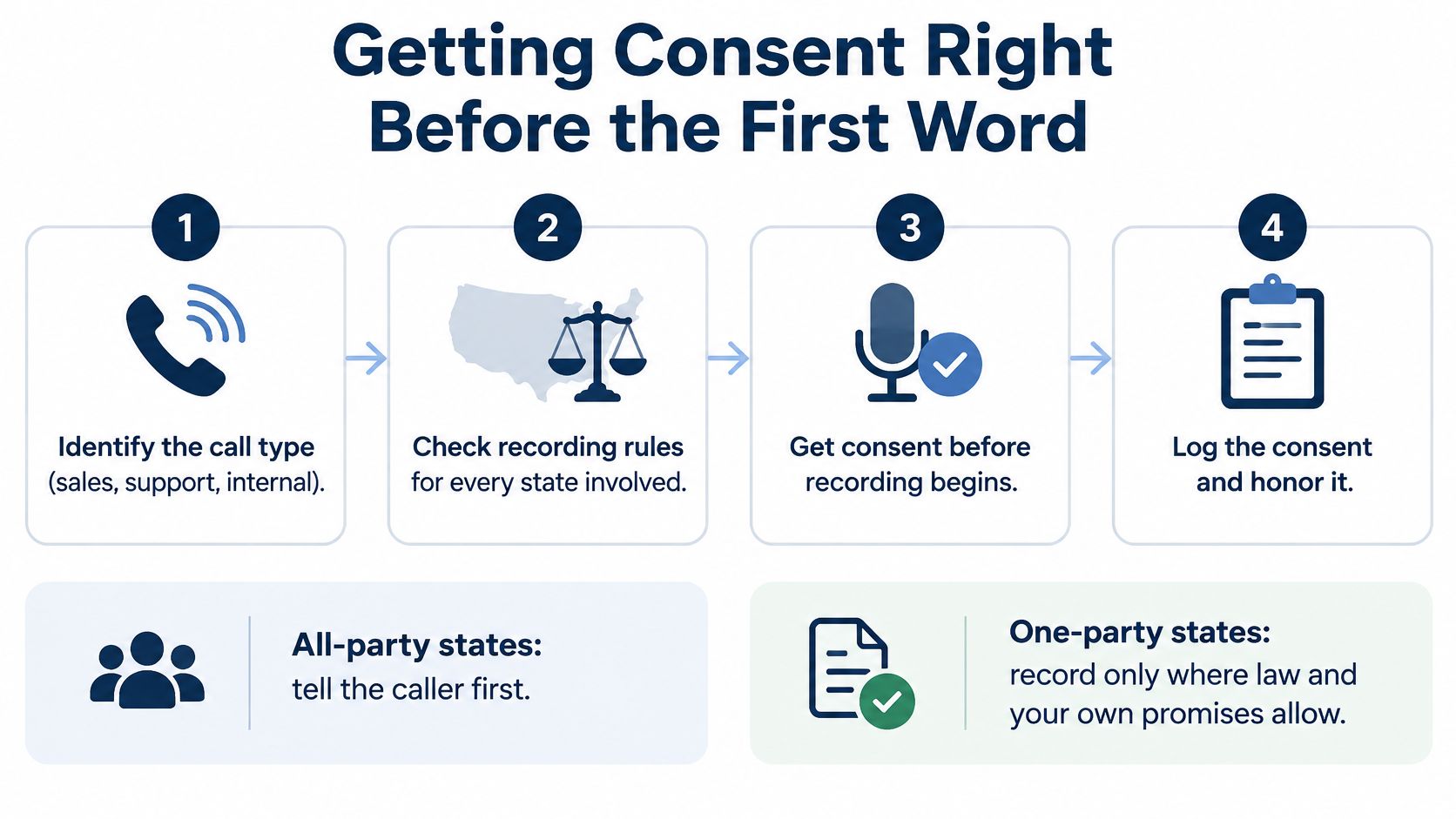
The direct answer: a firm can record a call without telling the caller only where the law allows it and where the firm's own public statements allow it. In an all-party state, that set is close to empty.
The disclosure itself, said out loud before recording starts:
Working script: "This call may be recorded and transcribed so we can review intake quality and train our team. If you'd prefer, I can transfer you to a line we don't record."
Notice what the sentence does. It names recording and transcription, states the purpose, and offers the alternative before the caller has to ask for it. A notice that says "this call may be monitored" and then runs live listening, transcription, and AI scoring is technically true and practically useless.
FCC guidance states the commission has no general rule governing individuals' recording of telephone conversations, while warning that state laws may prohibit recording and that illegal wiretapping can carry criminal sanctions. "The FCC allows it" is not a defense in a state that doesn't.
The professional-responsibility layer
Separate from legality, an ethics opinion in the University of Houston legal ethics collection notes that a lawyer may record a conversation without telling the other participants only where the recording doesn't violate applicable law and doesn't contradict a representation that the conversation isn't being recorded. If your website says calls aren't recorded and your system is capturing audio, the recording is the smaller problem.
The seven-step workflow
- Identify the parties and jurisdictions. Note who is on the line and where the firm believes they are. A transfer that adds a California caller mid-call changes the analysis for the rest of the conversation.
- Play the disclosure before recording starts. Announcements placed after the greeting are often too late, because the opening seconds were already captured.
- Capture consent or refusal explicitly. Train the specialist to log the answer. Silence is not consent, and neither is a caller who keeps talking.
- Set the recording status. If consent isn't given, recording stops or never begins. Configure the pause as a button the intake team can press, not a workaround involving a supervisor.
- Log the outcome with time and proof. The record of notice is the evidence you'd want if a call is later disputed.
- Route refusals to the unrecorded path. Decide in advance who takes those calls or which line handles them, because improvising at 9pm rarely ends well.
- Apply retention and access limits. Role-based access, deletion dates, export restrictions, incident response, and a rule about whether recordings containing medical, financial, or privileged detail may be used for coaching.
Ask the vendor two questions
Can you use our recordings to improve your models, and who inside your company can hear them? Get both answers in writing, and treat model training as a separate permission from storage. The gap between capture and disclosure is not theoretical. Reporting on AI notetaker adoption found that only 34.7% of workers whose meetings included an AI notetaker said they were always asked for permission, while 18.8% said they discovered after the fact that a meeting or call had been recorded or transcribed without their knowledge, per Stacker's reporting on AI notetakers in U.S. workplaces.
Why Transcripts and AI Scores Need Human Checks
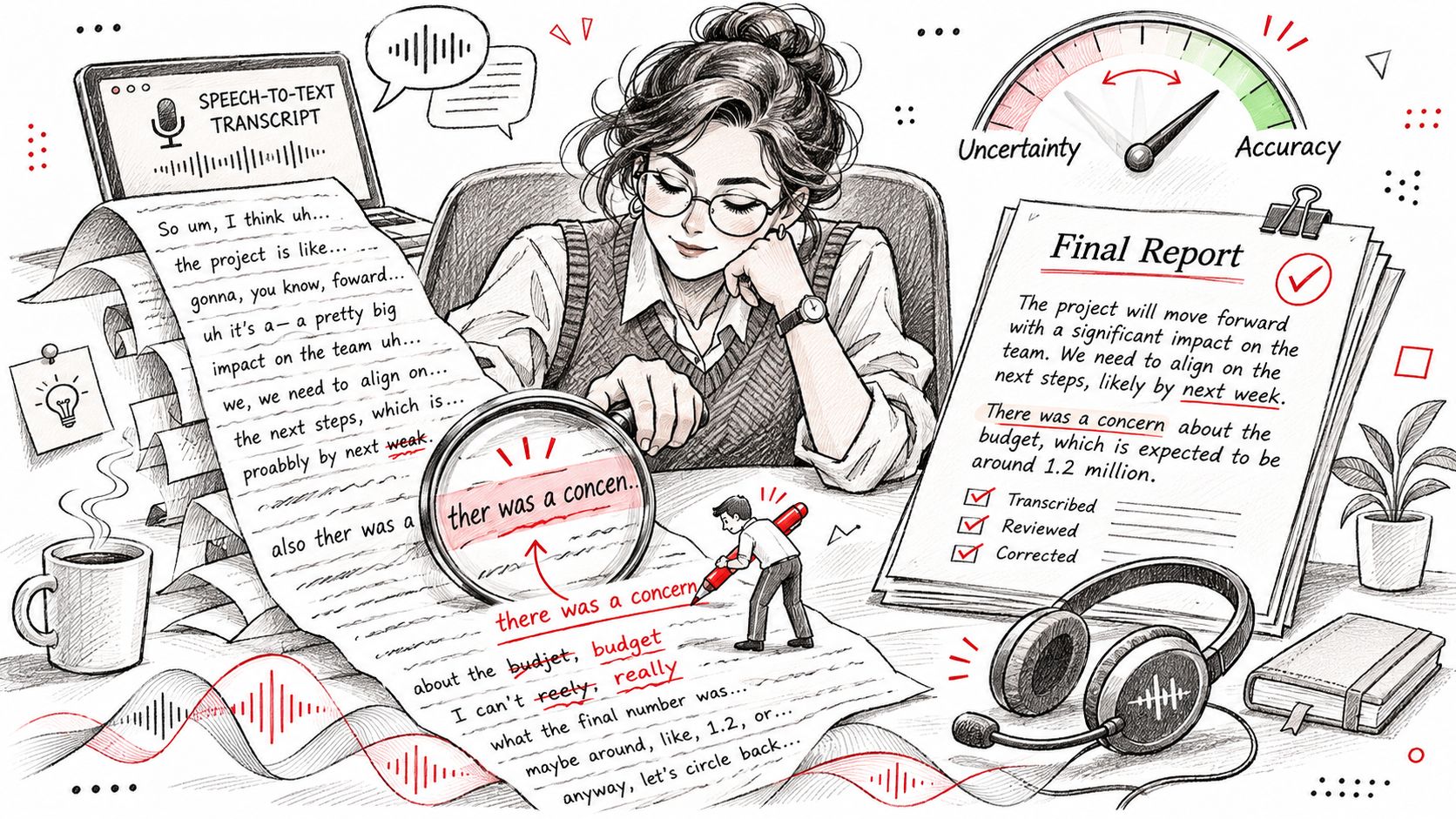
The transcript will confidently call your claimant "Mango." Her name is Margo, she said it twice, and the software heard a fruit both times.
Speech-to-text output is probabilistic, not authoritative. How far off it runs depends on the audio. NIST's OpenASR20 evaluation, which used conversational telephone speech, reported word error rates of approximately 40% to 65% for the best systems under severely constrained, low-resource-language training conditions. A well-resourced language on clean audio performs far better. Your intake line is neither.
Telephone audio is the hard case regardless. Narrow bandwidth strips out the frequencies that distinguish similar consonants, and background noise, accents, interruptions, overlapping speakers, and legal vocabulary the model has never encountered all take their toll.
Where transcripts earn their keep
Searchable indexing, QA sampling, and workflow triggers are all fair uses. A supervisor can search for "rear-ended" across 200 calls and find the twelve that need a closer listen.
Where firms get caught out is letting the transcript settle something on its own. Rejecting a lead. Assigning liability facts. Summarizing a client's legal theory for the demand letter. If you want the mechanics explained without jargon, what automatic speech recognition does covers acoustic and language modeling in plain terms, which helps explain why a confidence score exists at all.
Require human verification for names, dates, injuries, insurance limits, statutes, conflicts information, and anything else where one wrong word changes the outcome. Set confidence thresholds so low-scoring fields get flagged for review rather than accepted. That is a governance decision, not a recording feature: the firm is choosing which outputs a machine may settle and which ones a person must confirm.
The speaker label problem
Attribution deserves the same skepticism. Speaker-recognition benchmarks report challenge results rather than guaranteed identity accuracy. A label saying the speaker is the caller is a hypothesis, and in a household where two people sound alike, it is a bad one.
A defensible design stores four things together: the original recording, the transcript version, confidence metadata, and reviewer corrections. A supervisor can then audit whether an alert came from something the caller said or from a recognition error. That is the same discipline that keeps customer service calls reviewable months later, without relying on anyone's memory of the conversation.
The practical test is a single question. Can a supervisor trace a flag back to the audio and confirm it? If the answer is no, the system is generating confident guesses and calling them quality assurance.
What Monitoring Data Reveals About Missed Calls
The American Bar Association's secret-shopper study reported in Law Practice Magazine found that only 40% of law firms answered phone calls, down from 56% in 2019, meaning 60% failed to answer during the test. The same 2025 analysis reported that 28% of law-firm calls were missed.
That reframes the whole exercise. The most valuable question a monitoring program can answer isn't whether someone followed the script. It's what happened after a call was missed or handled poorly.
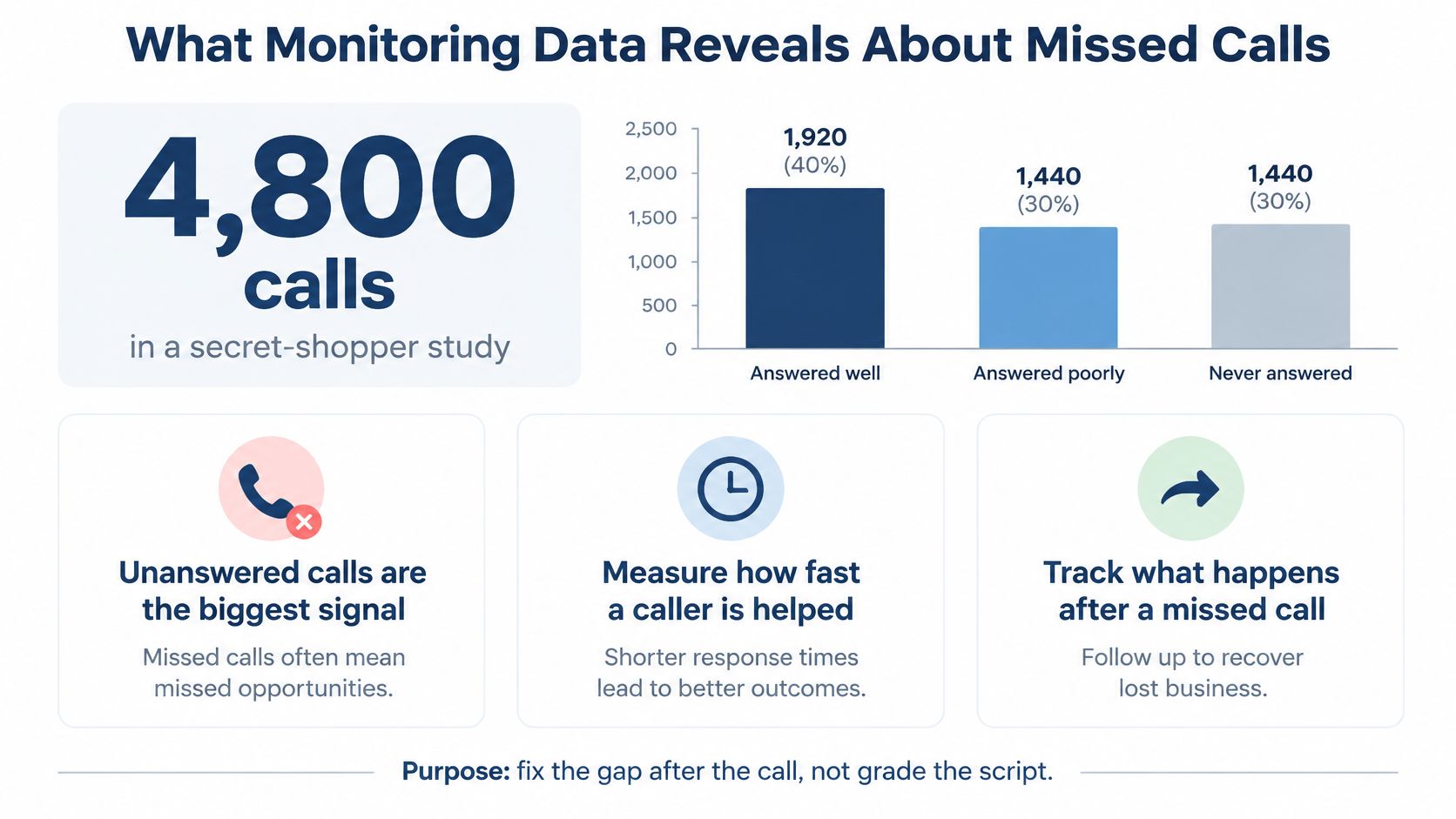
Recordings can expose a systemic availability problem. They cannot fix one. A firm can score every call a perfect ten and still lose the matters that rang through to voicemail at 6:40 on a Friday.
The metrics that separate the problems
Unanswered calls. Abandoned callers who hung up during the hold message. Delayed callbacks, meaning the gap between the inquiry and the first real attempt to reach them. Unqualified inquiries, which are a marketing targeting issue rather than an intake failure. Duplicate leads from a prospect who called three times. Warm transfers that died mid-route. Appointments set. Retainers signed.
Each one points somewhere different. Staffing, follow-up discipline, ad spend, phone routing, or training. A dashboard that shows only "calls handled" hides all of it.
Practical rule: sample by risk, not at random. Calls involving conflicts information, distressed or injured callers, fee discussions, and anything a client later disputes deserve review more often than a scheduling call does.
The ethics guardrail
Conversion metrics can reward the wrong behavior. Pressuring a distressed caller toward a retainer, skipping a conflicts check to keep momentum, letting an intake specialist give something that sounds like legal advice, or accepting an AI summary that softened a fact all raise conversion and create exposure. Score legal-process compliance alongside service quality, and treat a high-conversion call with a botched conflicts check as a failure.
A dashboard small firms can actually run
Large contact centers have analysts. A twelve-person firm has a practice manager with forty other things to do. Keep it to three questions. Which missed-call patterns represent lost matters. Which need faster follow-up. Which point to a training gap or a conflicts-screening failure.
None of that works if the underlying capture is patchy. In lead recovery, every call, form, and chat inquiry is captured in real time, which is the baseline any of these numbers depend on. If you're setting this up from scratch, call tracking for law firms covers the logging layer that makes the rest measurable.
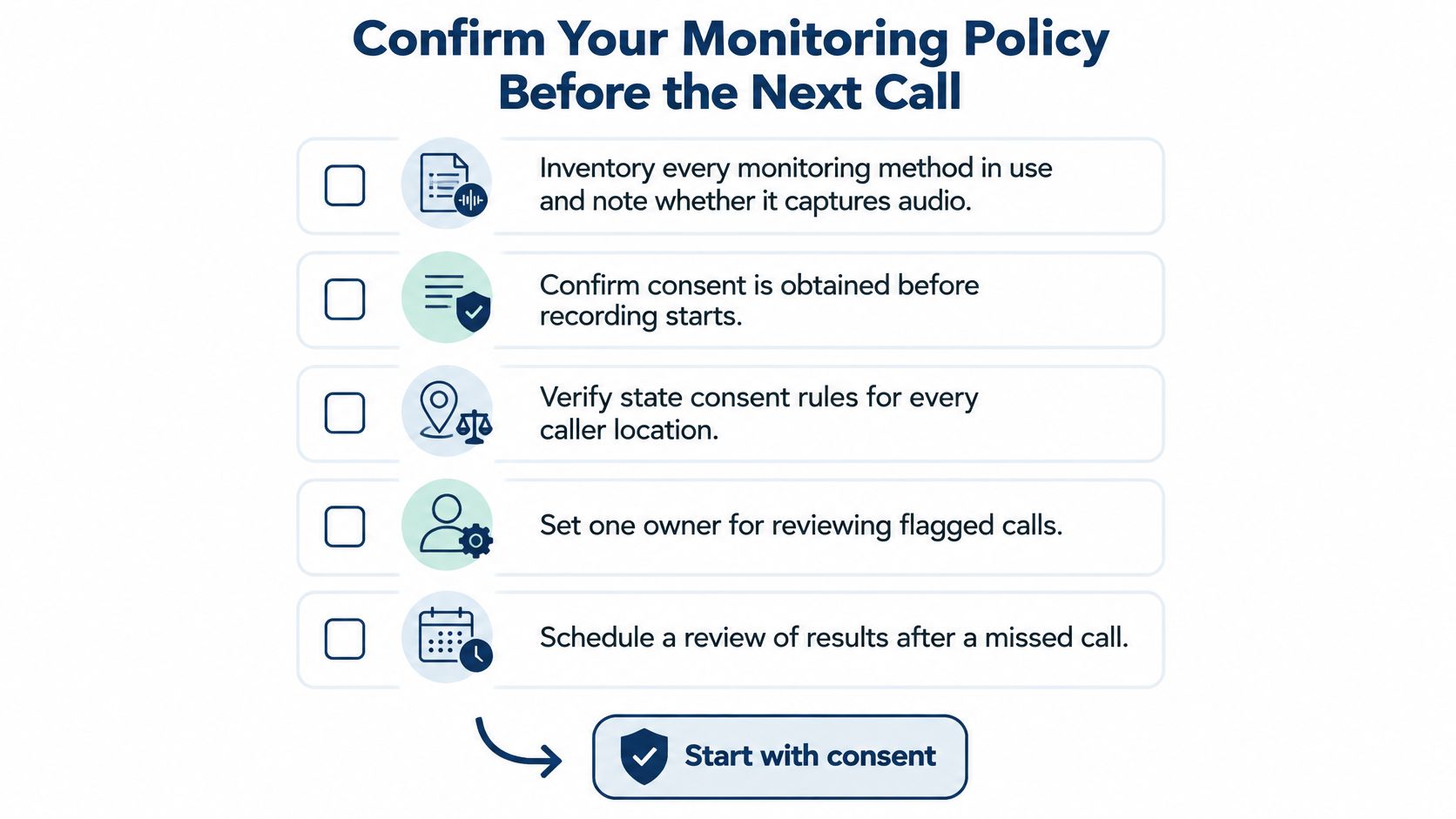
Confirm Your Monitoring Policy Before the Next Call
A checklist you can finish this week, without buying anything:
- Inventory every method in use. Include the ones nobody chose, like the recording default on the desk phone and the voicemail-to-email transcript. Note which ones capture audio or text and which capture only metadata.
- Test the notice and the refusal path. Call your own firm from a cell phone. Listen to what plays, in what order, and whether a caller who declines has an actual place to go.
- Confirm the state analysis. Match the notice to the states your callers and transferred parties are in. Recheck the statute rather than a saved PDF from three years ago.
- Set the controls. Access roles, retention and deletion periods, vendor reuse limits, and who may export audio.
- Name one owner. One person reviews flagged calls, corrections to transcripts, and the monthly metric review. A policy with no owner is a document.
The cheapest fix on this list is usually step five. Assigning the work to a named person costs nothing and surfaces the problems the other four steps are designed to prevent.
Coverage versus review
Before anyone rewrites a script, count the calls that went unanswered by hour and by day of week. If the pattern is a wall of calls between noon and 2pm, or everything after 5pm, the gap is coverage. Coaching a receptionist who isn't there to answer the phone is an expensive way to feel productive. Fixing the schedule, or adding live coverage for the hours nobody works, is the actual fix.
This is the part we handle directly. Frontline is Attorney Assistant's 24/7 live intake team, built to answer, qualify, follow up with, and sign cases, including nights and weekends. Staffline provides dedicated full-time legal support professionals who work inside your systems on case management, records, and intake administration. Pairing the two covers a firm from first call through case resolution, and the right mix gets scoped on a discovery call. You can read more about Attorney Assistant's intake and staffing services if that's where your gaps turn out to be.
Our own intake operation records and reviews every lead call for quality and refines the scripts from those reviews, which is what turns a monitoring policy from paperwork into a feedback loop. The audit that matters is not whether you own the tool. It's whether anyone reads what it produces and changes something as a result.
Attorney Assistant gives law firms the intake and staffing capacity that makes a monitoring policy worth having: 24/7 live intake through Frontline and dedicated full-time legal support through Staffline, both working inside your existing systems with call quality reviewed as a routine part of the job. If you'd like to see where your own calls are going unanswered, and what it would take to catch them, visit Attorney Assistant and start with the hours you already know are costing you matters.
Related Articles

Client Experience Coordinator for Law Firms
See what a client experience coordinator owns in a law firm, from intake and status updates to the skills that keep matters moving.
Answering Service for Business: A Practical Guide for 2026
Learn how an answering service for business works, which options exist, and how fast, consistent call handling protects leads, intake and client trust.
Law Firm Lead Generation: 7 Intake and Follow-Up Tools
Law firm lead generation fails without fast intake and steady follow-up. Compare seven tools and what each one actually delivers for your firm.