Personal Injury Case Intake Tips for Law Firms

TL;DR:
- Most personal injury firms lose clients due to broken intake processes, not bad attorneys. Responding within five minutes and using specific, well-trained intake procedures significantly increase case conversions. Prioritizing proper qualification, HIPAA compliance, and smooth handoffs ensures faster retainers and better client experiences.
Most personal injury firms are not losing clients because of bad attorneys. They are losing clients because of broken intake. A potential client calls, waits too long for a callback, or gets transferred three times and hangs up. That case goes to the firm that picked up first. The personal injury case intake tips in this article are built for firms that want to stop that leak and convert more of the leads they already have into signed cases.
Table of Contents
- Key takeaways
- 1. Apply these personal injury case intake tips before anything else: set your criteria
- 2. Respond to new inquiries within five minutes
- 3. Use a personal injury-specific intake form
- 4. Train intake specialists on qualifying criteria, not just scripts
- 5. Prioritize HIPAA compliance from the first medical question
- 6. Build a documented handoff process to case managers
- What I have actually seen change outcomes
- How Attorneyassistant helps firms fix intake from the ground up
- FAQ
Key takeaways
| Point | Details |
|---|---|
| Speed wins cases | Responding within five minutes of an inquiry dramatically increases your chance of signing the client. |
| Screening saves attorney time | Standardized qualifying questions filter out weak cases before they reach your attorneys. |
| Intake forms reduce follow-up | Collecting complete accident and injury data at first contact cuts redundant calls and errors. |
| HIPAA compliance is non-negotiable | Generic release forms are not enough. Each medical authorization must be specific and tailored. |
| Handoff quality determines conversion | A verified, complete handoff packet from intake to case manager prevents delays and client frustration. |
1. Apply these personal injury case intake tips before anything else: set your criteria
Before your team answers a single call, they need to know what a qualified case looks like. Without written criteria, intake specialists make judgment calls that vary by person, shift, and mood. That inconsistency costs you cases you should sign and wastes attorney time on cases you should not.
The three qualifying filters that matter most:
- Statute of limitations. If the filing window has passed or is about to close with no time to act, that case needs to be flagged immediately.
- Liability. Can fault be established? Was there another party, a property owner, an employer, or a manufacturer?
- Injury severity. Is there documented medical treatment or a clear physical injury? Cases without medical evidence are difficult to value and harder to settle.
Alongside these filters, standardized screening questions that cover injury type, insurance involvement, and incident date keep every intake call consistent. Write the questions so they sound conversational, not clinical. “Were you seen by a doctor after the accident?” lands better than “Please describe your medical treatment history.”
Pro Tip: Build your screening criteria into a decision tree your intake team can follow in real time. If the answer to any single disqualifying question is “yes,” the specialist knows exactly what to do next without escalating to an attorney.
2. Respond to new inquiries within five minutes
This is the single most impactful change most firms can make. Rapid response rates mean the first firm that calls wins the case. A person who was just in a car accident is scared, in pain, and searching for help. They will call three or four firms. The one that calls back first almost always gets the retainer.
A five-minute response window is not a goal. It is a threshold. Beyond that, connection rates drop sharply. The lead is not cold. The lead is gone.
Here is what a practical fast-response system looks like:
- Route web form submissions directly to an on-call intake specialist, not a general inbox.
- Set up automated text acknowledgments for after-hours inquiries so the client knows someone will call.
- Use a single intake queue that pulls phone calls, chat leads, and web forms into one place.
- Assign clear coverage windows so there is no ambiguity about who handles overflow.
Pro Tip: Track the average time from first contact to first callback each week. Once you see it in writing, the urgency to fix it becomes real for everyone on the team.
The first firm to respond to a personal injury inquiry typically secures the case. That is not a soft suggestion. It is the single operational reality that should shape how you staff and schedule your intake team.
3. Use a personal injury-specific intake form
Generic intake forms waste everyone’s time. A form that asks for name, phone, and “description of incident” gives you almost nothing usable. A well-structured injury-specific form captures everything the attorney needs to make a preliminary liability and damages assessment before the first real meeting.
The fields that matter most:
| Form section | What to capture |
|---|---|
| Incident details | Date, location, type of accident, parties involved |
| Injury information | Body parts affected, current symptoms, treatment status |
| Fault and liability | Description of how the accident occurred, any police report number |
| Medical treatment | Treating physicians, hospitals visited, ongoing care |
| Insurance information | Client’s carrier, adverse party’s insurer, policy numbers if known |
A complete intake form reduces follow-up calls and speeds up case assessment considerably. When the attorney reviews the file and already has the accident date, treating physician, and insurance carrier, they can start working in minutes instead of waiting for a second round of questions.

The form does not have to be long. It has to be specific. Clients filling out a form online are often still shaken up. Keep field labels clear. Add short placeholder text that explains what you are asking for. That small investment in clarity pays off in data quality.
Pro Tip: Include a conditional field that asks whether the client has received any settlement offers. Clients often do not realize this is a critical fact, but it tells you immediately whether the adverse insurer is already in play.
4. Train intake specialists on qualifying criteria, not just scripts
Scripts without criteria produce polite conversations that go nowhere. Properly trained intake specialists do not just read questions. They listen for the answers that matter and know how to route the call based on what they hear.
Training should cover three core areas. First, the firm’s specific case acceptance criteria, including case types the firm handles and types it does not. Second, how to recognize emotional distress in a caller and respond with empathy without losing sight of the qualifying conversation. Third, what to do when a case falls outside the criteria, including warm transfers, referral partners, or respectful declinations.
The payoff from trained intake specialists is measurable. Attorneys spend time on cases worth their attention. Clients feel heard from the first call. And the firm stops burning hours on inquiries that were never going to sign.
5. Prioritize HIPAA compliance from the first medical question
The moment your intake team asks about medical treatment, HIPAA applies. Most firms know this in theory but underestimate how specific the requirements are in practice.
Here is what a compliant medical authorization process requires:
- Each authorization must name the specific healthcare provider releasing the records.
- It must identify the specific recipient who will receive the records.
- It must state the purpose for which the information is being used.
- It must include an expiration date or event.
- It must be signed by the client, not just acknowledged.
General release forms are insufficient for personal injury practice. Blanket authorizations that do not specify providers or purposes create compliance exposure. That exposure is not theoretical. It results in records being withheld, cases stalling, and potential sanctions.
On the data security side, secure digital portals are the correct method for transferring protected health information. Email is not. Unsecured file sharing is not. The risk of a breach is real, and PHI security practices including role-based access control, encryption, and audit logs are what HIPAA’s Security Rule requires.
Build this into intake from the start. Waiting until a case is in litigation to establish proper authorization habits creates gaps that are hard to close.
6. Build a documented handoff process to case managers
Intake does not end when a client agrees to sign. It ends when the case manager receives a complete, verified file and knows exactly what the next step is. Without that structure, signed clients fall through the cracks, retainers go unsigned for days, and attorneys start cases without the information they need.
A solid handoff packet should include:
- Completed intake form with all accident, injury, and insurance fields verified
- A summary note from the intake specialist flagging any urgent items or inconsistencies
- Status of signed retainer agreement or confirmation of pending e-signature
- Any documents already received, such as photos, police reports, or prior correspondence
- Scheduled follow-up date if the client is still deciding
Complete, documented handoffs to case managers prevent redundant client calls and miscommunication. When the case manager picks up the file and already has everything they need, the client experience is smooth. When they have to call back and ask the same questions the intake team already asked, the client wonders why they hired this firm.
Measuring drop-off points in your intake funnel is the only way to know where you are losing signed cases after first contact. Track how many inquiries become consultations, how many consultations become signed retainers, and where the gaps are largest. That data tells you exactly where to focus.
What I have actually seen change outcomes
In my experience, the firms that struggle most with intake are not struggling because they lack empathy or legal skill. They are struggling because they treat intake like a receptionist task instead of a revenue-critical function.
I have seen firms invest heavily in advertising and then route those leads to a general voicemail. The phone rings, no one answers, and the lead calls the next firm on the list. The money spent on marketing is gone. The case is gone. Nothing about that outcome required bad lawyering. It just required a gap in the process.
What I have found actually works is treating intake as a specialized role with its own training, metrics, and accountability. The firms that see the most improvement are the ones who separate intake from general reception, measure response time weekly, and build a personal injury case checklist that every specialist uses on every call without exception.
The empathy piece matters too. Injured clients are not shopping for a product. They are frightened and often in pain. The intake call is your first chance to show them they made the right choice. That tone is trainable, and it converts.
— Nicole
How Attorneyassistant helps firms fix intake from the ground up
If reading this article surfaced a few uncomfortable recognitions about how your firm currently handles intake, you are not alone. Most firms have at least two of these gaps. Some have all of them.
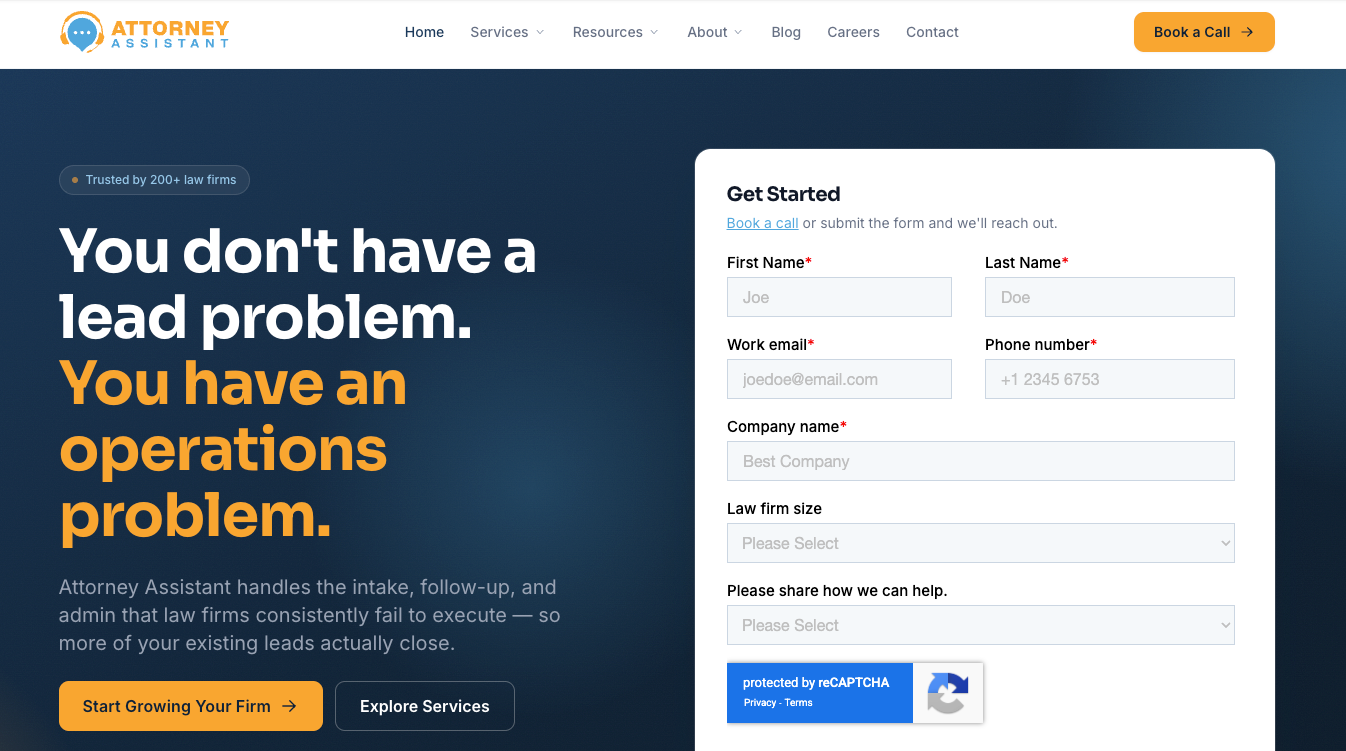
Attorneyassistant works directly with personal injury firms to fix the operational problems that cost signed cases. From response time to retainer signing, the focus is on the gaps between marketing and revenue. The virtual webinar is a direct way to get your intake team trained on the methods that actually move conversion numbers. If you want to see what your firm’s intake is missing, the free tools are a low-friction starting point. And if follow-up is where your leads are going quiet, the lead follow-up service is built exactly for that problem. Book a call to talk through what applies to your firm.
FAQ
What is the most important step in the personal injury intake process?
Speed is the most critical factor. Responding within five minutes of a new inquiry dramatically increases your chance of connecting with the client before they contact another firm.
What should a personal injury intake form include?
A strong intake form captures the accident date and location, injury details, treating physicians, fault information, and insurance carrier data. Collecting this at first contact reduces follow-up calls and accelerates case assessment.
What are the most common intake mistakes in personal injury firms?
The most frequent mistakes are slow follow-up, inconsistent screening criteria, and poor handoff documentation. Each of these creates a specific point where clients disengage or cases stall before a retainer is signed.
How does HIPAA apply during personal injury intake?
HIPAA applies as soon as your team collects or requests protected health information. Valid medical authorizations must name specific providers, recipients, and purposes. Generic release forms do not meet the standard.
How do you measure intake performance in a law firm?
Track inquiry-to-consultation rate, consultation-to-retainer rate, and average response time. Identifying drop-off points in the funnel shows you exactly where clients are being lost so you can target improvements with precision.
Recommended
- Law firm client intake best practices: boost conversions | Attorney Assistant
- Effective law firm intake process: boost client conversion | Attorney Assistant
- Master legal intake to boost PI case conversions by 40% | Attorney Assistant
- Client Communication Guide: Boost Law Firm Intake | Attorney Assistant
Related Articles

Common Intake Challenges That Cost Law Firms Clients
Discover common intake challenges law firms face that cost them clients. Learn how to improve your process and boost client conversion rates.

Tips for Improving Case Intake at Your Law Firm
Discover essential tips for improving case intake at your law firm. Boost conversion rates and secure more clients with effective strategies.

How to Enhance Intake Efficiency at Your Law Firm
Learn how to enhance intake efficiency at your law firm. Boost client conversions with actionable strategies and streamlined processes.