Role of intake call tracking: the personal injury firm's guide

TL;DR:
- Without proper call tracking, personal injury firms remain blind to which marketing efforts generate signed cases. Call tracking provides valuable data for attribution, optimizing response times, and identifying intake process gaps, leading to increased conversions. Implementing continuous review and integration of call data transforms static infrastructure into an active management system that minimizes lead leakage.
Without call tracking, you are essentially flying blind on which marketing dollars actually bring in signed cases. 55% of signed personal injury cases remain untraceable to their marketing source when firms lack proper tracking in place. That single blind spot creates a cascade of problems: wasted ad budgets, missed follow-up windows, and intake failures that bleed revenue quietly every week. This guide explains the role of intake call tracking in fixing those exact problems, with specific frameworks for attribution, response speed, after-hours coverage, and continuous improvement that PI firms can act on immediately.
Table of Contents
- Why intake call tracking matters in personal injury law
- How call tracking reveals hidden gaps in your intake process
- Measuring marketing ROI and intake quality with call tracking
- Optimizing intake speed and after-hours coverage with call tracking
- Implementing and sustaining effective intake call tracking
- Why most law firms fail to maximize call tracking’s full potential
- Streamline your intake and never miss a lead again
- Frequently asked questions
Key Takeaways
| Point | Details |
|---|---|
| Call tracking attribution | Call tracking reveals which marketing channels generate signed cases, improving budget decisions. |
| Intake speed impact | Contacting leads within one minute increases conversion rates dramatically. |
| After-hours importance | 40-60% of personal injury calls come after hours and require live intake to prevent losses. |
| Call quality scoring | Not all calls are equal; scoring calls by quality sharpens marketing ROI analysis. |
| Continuous review | Weekly audits of call recordings and conversion metrics help optimize intake performance. |
Why intake call tracking matters in personal injury law
Call tracking is not a marketing luxury. For personal injury firms competing in high-cost advertising markets, it is a foundational tool that connects your spend to your results.
Here is how it works at its core. Call tracking assigns a unique phone number to each marketing channel you run, whether that is Google Ads, a billboard, an organic search result, or a Facebook campaign. When a potential client calls that number, the system records which source triggered the call, how long the conversation lasted, whether it was answered, and what happened next. That data flows into your dashboard and, ideally, into your CRM.
Without that layer, you are guessing. And guessing in PI marketing, where cost per click on paid search can run into hundreds of dollars, costs firms real money.
The benefits of intake tracking go well beyond marketing attribution. Consider what the data actually enables:
- Budget reallocation: Law firms using call tracking typically see 25 to 30% increases in conversions by moving budget from underperforming channels to ones that actually produce signed cases.
- Campaign comparison: You can see, side by side, whether your local SEO or your Google Ads campaign converts more callers into consultations.
- Intake bottleneck detection: Patterns in unanswered calls, short calls, or calls that never lead to a signed retainer point directly to intake process failures.
- Staff performance visibility: Call duration and outcome data reveals which intake staff members close well and which ones lose leads.
Understanding the importance of call tracking starts with accepting that marketing data without call attribution is incomplete. Most PI firms invest heavily in lead generation and almost nothing in tracking what happens to those leads once they call. Fixing that gap is where real conversion improvement begins. Hiring a dedicated intake specialist is a natural complement to that tracking layer.
How call tracking reveals hidden gaps in your intake process
Most managing partners assume their intake process is reasonably solid. Call tracking almost always proves otherwise.
The most common discovery is missed calls. 85% of missed PI intake callers never call back, and 40 to 60% of inquiries come after business hours. That means a significant portion of your leads are calling when no one picks up, hitting voicemail, and then calling a competitor who does answer. You may never know this is happening without tracking data that shows exactly when calls arrive versus when they get answered.

Voicemail is a particularly costly fallback. Replacing voicemails with live intake reduces the one-in-three hang-up rate that firms relying on recorded messages consistently experience. When a potential client in physical or emotional distress after an accident reaches a voicemail, most of them hang up. The call is logged nowhere, followed up on by no one, and the lead is gone.
Call tracking exposes several other hidden intake failures:
- Slow response patterns: If tracking shows a 45-minute average time between missed call and callback, that alone explains conversion drops.
- After-hours dead zones: If 40% of your calls come in after 6 PM but you have zero after-hours coverage, tracking makes that revenue loss visible and quantifiable.
- Short call rates: Calls under 60 seconds usually indicate the caller hung up before getting help. A high rate of these signals a routing or staffing problem.
- Repeat callers who never converted: These are warm leads who tried more than once and still did not get through. Tracking surfaces them.
Pro Tip: Pull your call tracking report and filter specifically for calls received between 6 PM and 8 AM. If that volume surprises you, your after-hours coverage gap is costing you cases right now. Read more about the root causes of missed calls to understand what is actually driving the leak.
Measuring marketing ROI and intake quality with call tracking
One of the most powerful benefits of intake tracking is its ability to tell you the true cost of acquiring a signed case, broken down by channel and practice area.
Most firms look at cost per lead. That is the wrong metric. A lead who calls but never signs is a marketing cost with zero return. Call tracking lets you connect the full journey from ad impression to signed retainer, giving you a real cost per acquisition (CPA) that reflects actual revenue.
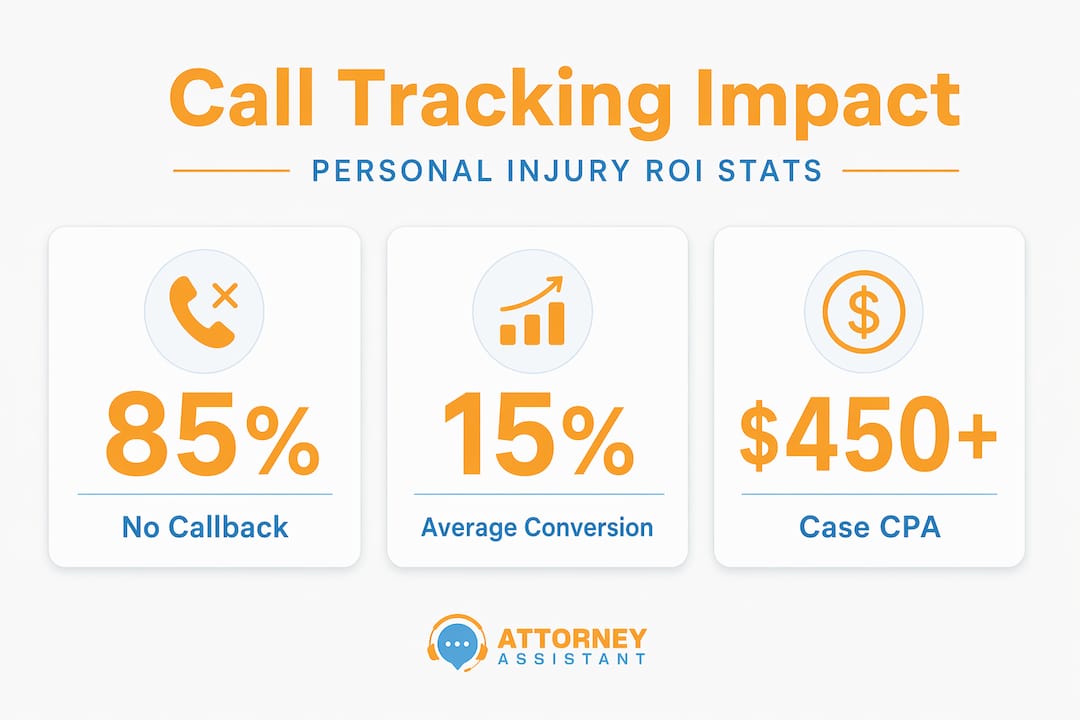
The difference in CPA by channel can be dramatic. Real CPA by practice area varies widely, for example running around $400 for personal injury paid search versus $150 for local SEO. That $250 gap, multiplied across dozens of cases annually, is a meaningful budget decision. Without call tracking, most firms never see it.
Call quality scoring adds another layer of precision. Not all incoming calls represent qualified leads. Tracking systems let you score calls based on duration, intent signals, and outcome, so you separate genuine prospects from wrong numbers, existing clients, and calls from vendors. Here is a useful comparison to consider:
| Call type | Average duration | Typical conversion rate | Action |
|---|---|---|---|
| Qualified new inquiry | 3 to 7 minutes | 25 to 45% | Prioritize and fast-track |
| Short hang-up | Under 60 seconds | Near 0% | Review routing/staffing |
| After-hours voicemail | Variable | 5 to 10% | Replace with live coverage |
| Repeat caller | 2 to 5 minutes | 30 to 50% | Trigger immediate callback |
Personal injury intake calls convert at 15% on average, compared to 45% for estate planning. That gap is not accidental. It reflects call urgency, emotional state, and intake responsiveness. Knowing that number gives you a realistic baseline to improve from, and call tracking is what makes it measurable.
Pro Tip: Score every call with at least three categories: qualified lead, existing client, and non-lead. That simple filter cleans your conversion data and gives you real numbers to optimize against. You can find specific strategies for reducing marketing budget leaks that tracking data reveals.
Optimizing intake speed and after-hours coverage with call tracking
Speed is not a soft metric in PI intake. It is the single biggest variable in whether a lead signs with you or your competitor.
PI leads contacted within one minute convert 391% better than those contacted after five minutes, based on Velocify research. That is not a small edge. That is the difference between a firm that grows and one that wonders why its close rate is low despite solid lead volume.
Call tracking makes speed measurable and improvable. Here are four steps to use it effectively for intake speed:
- Benchmark your current response time. Pull the average time between an inbound call and a live pickup or callback. This is your baseline.
- Identify the slowest points in the chain. Is it after-hours? Lunchtime? Mondays? Call data pinpoints these with specificity.
- Set a response time target. Under 60 seconds for live calls and under five minutes for callbacks is the standard worth aiming for.
- Track improvement weekly. Response time should appear in your intake dashboard alongside conversion rates so staff see the direct relationship.
After-hours coverage deserves its own attention. Tracking after-hours call conversion rates often reveals that they justify the cost of 24/7 live intake, especially for PI firms where accidents do not follow business hours.
“The calls coming in at 10 PM are not less valuable than the ones at 10 AM. They are often more motivated callers who have just been through a traumatic event and are ready to talk to someone right now.”
Live intake instead of voicemail directly reduces that 33% hang-up rate. A caller who reaches a live person at 11 PM and gets empathy, clear next steps, and a scheduled consultation is far more likely to become a signed case than one who leaves a message and wonders if anyone will call back. Explore specific legal intake tips for putting this into practice.
Implementing and sustaining effective intake call tracking
Setting up call tracking is straightforward. The challenge most firms face is sustaining it well enough to actually improve intake over time.
Here is a practical implementation sequence:
- Audit your current setup. Identify which campaigns, if any, have tracking numbers. Note gaps where calls are coming in unattributed.
- Implement Dynamic Number Insertion (DNI). DNI automatically swaps the phone number displayed on your website based on how a visitor arrived, giving you source-level attribution for every call.
- Integrate call data with your CRM. Without this integration, call tracking data lives in a silo. Connected to your CRM, every call becomes part of the client record and the conversion funnel.
- Train intake staff on call scoring. Every person handling intake calls should understand how calls are categorized, what the firm tracks, and why their handling of each call affects the numbers.
- Review recordings weekly. Recording and transcribing calls improves coaching and script refinement, with firms reporting up to 40% increases in booked appointments after systematic review.
Beyond the initial setup, a regular tracking audit keeps your system current as your marketing mix changes. Add a new campaign? Add a new tracking number. Drop a channel? Review what happened to those calls before removing it.
Useful ongoing tracking habits include:
- Weekly dashboard review of response times, missed call rates, and conversion by channel
- Monthly call recording review sessions with intake staff focused on language, empathy, and objection handling
- Quarterly CPA analysis by marketing channel to shift budget toward what actually signs cases
Pro Tip: The highest-leverage call recordings to review are the ones that lasted three or more minutes but did not convert. These near-miss conversations reveal exactly where your intake is losing qualified leads. Read more about how to master legal intake through continuous process refinement. You can also explore how Frontline solutions bring these components together for PI firms.
Why most law firms fail to maximize call tracking’s full potential
Here is the hard truth about how most PI firms use call tracking: they treat it like a light switch. They turn it on, confirm the data is flowing, and then almost never look at it again.
This is one of the most expensive passive mistakes a firm can make. The role of intake call tracking is not to run in the background and generate reports no one reads. It is to function as an active feedback system that shapes how you staff, budget, train, and respond. When firms treat it as static infrastructure rather than a living operational tool, they capture maybe 20% of its actual value.
The after-hours data problem is particularly glaring. Most firms know, abstractly, that after-hours calls exist. But when tracking shows that 47% of your calls came in outside staffed hours last month and your after-hours coverage is a voicemail box, that is not an abstract problem. It is a calculable number of missed cases. Firms that refuse to look at that data can tell themselves their coverage is fine. Firms that do look at it have to make a decision.
Call recordings are the second most underused feature in call tracking. Most firms do not listen to them regularly. The ones that do build a genuine competitive advantage. You learn exactly which phrases make callers relax and book. You learn what objections come up and which responses actually work. A single hour of call recording review with your intake team each month produces compounding improvements in how every future call goes.
Lack of CRM integration is the third common failure. When call data and case management data live in different systems, you cannot see the full picture. You cannot answer the question “which calls actually became signed retainers and what did those callers have in common?” Without that answer, you are optimizing in the dark.
The firms that win at intake treat call tracking as a core management tool, not an IT setup task. Pairing it with a skilled intake specialist and a structured review cadence turns raw data into better conversations, faster responses, and more signed cases. The firms that get this right consistently outperform competitors spending twice as much on ads, because they stop leaking leads at the intake stage.
Streamline your intake and never miss a lead again
The data is clear. Missed calls, slow responses, and untracked after-hours inquiries are costing your firm cases it already paid to attract. The role of intake call tracking is to make all of that visible so you can fix it.
Attorney Assistant specializes in exactly these problems. We provide dedicated intake specialists who handle calls live, including after hours, so your leads reach a person instead of a voicemail. Our lead follow-up services close the gap between first contact and signed retainer, and our 24/7 intake coverage integrates with your existing systems so no call goes untracked or unanswered. If your firm is ready to stop leaking leads it already paid for, book a call with our team and we will show you exactly where your intake is losing cases.
Frequently asked questions
What is intake call tracking and why is it important for personal injury firms?
Call tracking assigns unique phone numbers to marketing channels, allowing firms to see which ads generate calls and signed cases, which enables smarter budget allocation and measurably improved conversion rates.
How does call tracking improve lead conversion rates?
By revealing which marketing efforts deliver qualified leads and enabling faster, more informed intake responses, call tracking helps firms increase signed cases by 25 to 30% through budget reallocation and intake process improvements.
Can after-hours calls really impact conversion?
Yes. Since 40 to 60% of inquiries come after business hours, tracking those calls and providing live intake at those times significantly reduces missed opportunities and captures cases competitors are losing to voicemail.
What role do call recordings play in improving intake?
Reviewing recordings helps firms identify effective language and missed opportunities in real conversations. Mentioning a free case evaluation in the first 30 seconds, for example, has been shown to boost bookings by 40% when identified through systematic call review.
How should firms start implementing call tracking?
Begin with an audit of existing setups, then implement dynamic number insertion across campaigns, integrate call data with your CRM, train staff on call scoring, and establish a weekly review cadence to refine intake processes based on what the data shows.
Recommended
- Effective law firm intake process: boost client conversion | Attorney Assistant
- Master legal intake to boost PI case conversions by 40% | Attorney Assistant
- Law firm client intake best practices: boost conversions | Attorney Assistant
- Client Communication Guide: Boost Law Firm Intake | Attorney Assistant
Related Articles

Macs for Lawyers: The Hardware and Compatibility Guide
A practical guide to Macs for lawyers covering hardware choices, software compatibility, security tradeoffs, and recommendations by firm size and workflow.

Business Telephone Answering Service for Law Firms
How a business telephone answering service works for law firms, including 24/7 intake, qualification, warm transfers, pricing models, and what

Call Flow Customer Service for Law Firms: A Practical Guide
Design a call flow customer service system for your law firm that captures leads, qualifies matters, and signs cases. Practical guide