Stop Revenue Leakage in Your Law Firm: Key Causes

TL;DR:
- Most revenue loss in PI firms occurs before a case is signed due to intake delays.
- Responding to inquiries within five minutes and automating follow-up can recover significant revenue.
- Improving intake processes prevents operational leaks and boosts case conversions significantly.
Most personal injury law firms are not losing money because of bad billing. They are losing it before a single retainer is signed. When a potential client calls after hours and no one answers, that case is almost certainly gone. When your intake team takes 20 minutes to respond to a web form, the lead has already called your competitor. Slow intake response over 5 minutes drops conversion by 400%, and 40 to 60 percent of inquiries arrive after business hours. This guide breaks down what revenue leakage actually means for PI firms, exactly where it happens, and the proven fixes that can recover five or six figures annually.
Table of Contents
- What is law firm revenue leakage?
- Where revenue slips through the cracks: Intake, follow-up, and beyond
- The cost of inaction: Revenue lost, cases missed
- How to plug the leaks: Proven fixes for law firm revenue leakage
- A perspective you won’t hear from consultants: Fix intake first, not last
- Stop the leaks — Unlock hidden revenue with Attorney Assistant
- Frequently asked questions
Key Takeaways
| Point | Details |
|---|---|
| Intake is the main leak | Missed calls and slow follow-up cost PI firms the most revenue each year. |
| Small changes, big gains | Quick intake and automation can recover up to 40% more signed cases. |
| Audit to uncover leaks | Tracking the right KPIs reveals preventable lost income that most firms overlook. |
| Simple fixes matter | After-hours coverage and prompt follow-up deliver outsize financial impact. |
What is law firm revenue leakage?
Revenue leakage is not a billing problem. It is not about invoicing the wrong hourly rate or forgetting to charge for a phone call. In the context of a law firm, revenue leakage means preventable loss of income you should have earned but did not, because of a flaw somewhere in your processes.
For a personal injury firm, the most damaging leaks happen before a case even opens. A prospect fills out your contact form at 9 p.m. No one responds until 10 a.m. the next day. That lead is cold, and probably signed with someone else. That is revenue leakage. It was earned in the sense that your marketing spend generated the inquiry. It was lost because your intake process could not capture it.
It helps to separate leakage from two related but different concepts:
- Churn: Clients who leave your firm by choice, often due to service dissatisfaction. This is a retention problem.
- Traditional profit leaks: Billing write-offs, administrative inefficiency, or time that goes unbilled. These matter, but they are secondary in a contingency model.
- Revenue leakage: Preventable income loss tied to operational gaps, primarily in intake and lead management.
As one analysis of common law firm revenue issues notes, general business sources often frame leakage around contracts and billing errors, while PI-focused practices experience it most sharply at the lead conversion stage. Because you work on contingency, you do not bill by the hour. Every case you fail to sign is a direct hit to your revenue, with no fallback.
“In a contingency model, the intake process is the revenue engine. Fix it first, or all other optimization is noise.”
For a broader overview of revenue leakage in law firms, the pattern is consistent: the leak is operational, and it is fixable.
Where revenue slips through the cracks: Intake, follow-up, and beyond
Knowing what leakage is matters. Knowing exactly where it happens is what lets you stop it.
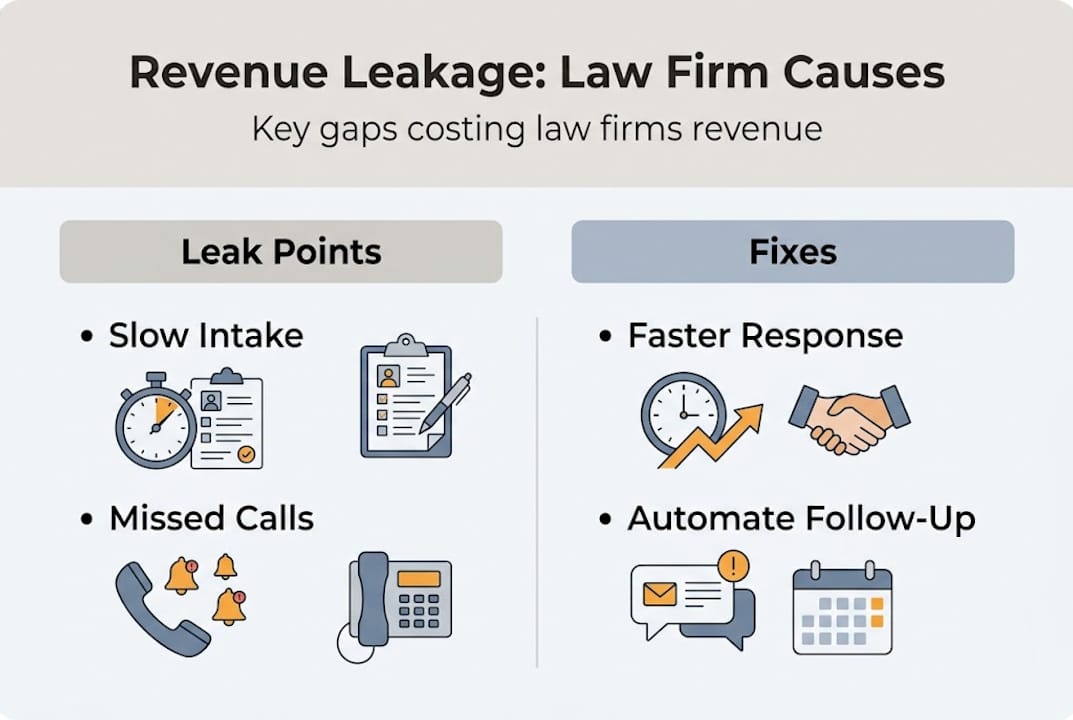
The most common operational weak spots in PI law firms fall into a predictable pattern. Here is where money walks out the door:
- Slow response to new inquiries: Any delay beyond five minutes sharply reduces the chance of converting that lead.
- Missed after-hours calls: Nearly half of all inbound inquiries arrive outside your office hours, and most firms have no reliable system to handle them.
- Inconsistent follow-up: Leads who do not sign immediately rarely get a second or third contact attempt.
- Manual data entry errors: Intake information entered by hand gets lost, misfiled, or duplicated, creating gaps in follow-up.
| Leak point | Estimated lead loss rate | Annual revenue impact (avg. case value $10k) |
|---|---|---|
| Response time over 5 min | 8 to 15% of inquiries | $480k to $900k |
| After-hours misses | 40 to 60% of those calls | $200k to $400k+ |
| No follow-up after first contact | 5 to 10% of warm leads | $100k to $300k |
| Manual intake errors | 2 to 5% of cases | $50k to $150k |
The numbers become jarring when you run the math. Eight lost cases per month at $10,000 each equals $960,000 per year in lost revenue. That is not a billing issue. That is a systems issue.
And firms that address it see real results. Improving intake processes can increase signed PI cases by 15 to 40% according to 2026 benchmarking data. That kind of lift is not coming from a new billing software. It comes from answering faster and following up consistently.

If you want to boost PI case conversions, the starting point is always intake speed and coverage. Reviewing your intake process best practices is the fastest way to identify which of these leak points is costing you the most right now.
The cost of inaction: Revenue lost, cases missed
Understanding where leaks happen is only half the story. The other half is what those leaks cost you in compounding ways, not just this month, but over the next three years.
Start with the direct math. If your firm receives 50 inbound inquiries per month and your intake process loses just 16 percent of them to slow response or missed calls, that is 8 cases gone. At a $10,000 average case value, that adds up to $960,000 annually. Most firms reading that number assume it does not apply to them. It usually does.
“The biggest mistake is assuming the revenue you never saw was never really there.”
Beyond the direct loss, consider the compounding effects:
- Lost referrals: Every unsigned potential client is also a missed source of future referrals. One signed case can generate two or three more over time through word of mouth.
- Higher marketing spend to compensate: Firms that leak leads tend to throw more budget at advertising to replace what they lose, instead of fixing the root problem.
- Slowed firm growth: Without a reliable intake system, scaling becomes almost impossible. You cannot grow a firm built on a leaky foundation.
- Staff burnout: When intake is chaotic, staff spend more time chasing and re-entering information, which creates errors and high turnover.
Even large firms are not immune. 89% of BigLaw firms report rising write-offs even as billing volumes increase. Revenue leakage is industry-wide, but for PI firms on contingency, the consequences are more immediate.
Pro Tip: Audit your intake leakage quarterly by tracking three KPIs: your average response time to new inquiries, your after-hours call capture rate, and your lead-to-signed-case conversion rate. A drop in any one of these is your early warning signal. Review client intake best practices and check your improving follow-up protocols to set baseline benchmarks.
How to plug the leaks: Proven fixes for law firm revenue leakage
Now for the part that actually moves the needle. Here is a step-by-step approach to auditing and fixing your firm’s revenue leakage, starting today.
Step 1: Run a leakage audit. Pull your last 90 days of inbound inquiries and compare them to signed cases. The gap is your leakage rate. Identify whether the loss is heaviest in response speed, after-hours coverage, or follow-up consistency.
Step 2: Set baseline KPIs. Tracking realization rate, capture rate, and response time gives you a real number to improve. Firms that monitor these consistently recover 10 to 20 percent of previously lost revenue within six months.
Step 3: Fix after-hours coverage first. This is usually the fastest win. Whether you use a legal intake specialist or a 24/7 answering service, covering the hours between 5 p.m. and 9 a.m. alone can recapture 30 to 50 percent of missed calls.
Step 4: Automate follow-up. A lead that does not sign on the first call needs a second and third touch. Automated follow-up sequences ensure that no warm lead goes cold without at least three contact attempts.
Step 5: Review and repeat monthly. Leakage is not a one-time fix. It creeps back in as your team grows or processes drift.
| Approach | Response time | After-hours coverage | Follow-up consistency | Cost |
|---|---|---|---|---|
| Manual (staff only) | 20 to 60 min | Rarely covered | Inconsistent | Low upfront, high loss |
| Automated intake tools | Under 2 min | 24/7 capable | Systematic | Moderate |
| Hybrid (staff + automation) | Under 1 min | Fully covered | High | Best ROI |
Pro Tip: Start with intake automation tools that integrate with your existing CRM. You do not need to rebuild your entire workflow. A targeted fix at the intake stage delivers faster returns than a firm-wide tech overhaul.
A perspective you won’t hear from consultants: Fix intake first, not last
Most law firm consultants walk in and head straight for billing software, collections reports, or practice management upgrades. They build dashboards that track billable hours and write-off rates. For PI firms, that is largely the wrong starting point.
The evidence backs this up. PI-focused firms lose revenue primarily through lead conversion failures, not billing inefficiencies. Because there are no billable hours to optimize on contingency cases, the entire revenue engine runs on how many leads you sign, and how fast.
What we have seen across hundreds of firms is a consistent pattern: the ones that boost PI case conversions at scale are not the ones with the fanciest tech stacks. They are the firms that built an intake-first culture, where every team member understands that a missed call is not an administrative inconvenience. It is a direct revenue event.
Billing optimization on a leaky intake process is like patching a roof while the foundation is crumbling. Fix intake first. Every other operational improvement multiplies in value once your lead capture rate is solid.
Stop the leaks — Unlock hidden revenue with Attorney Assistant
If any of the numbers in this article felt uncomfortably familiar, you are not alone. Most PI firms are sitting on recoverable revenue right now, buried inside their intake gaps and follow-up failures.
Attorney Assistant was built specifically to solve this problem. We handle intake coverage, lead follow-up, and administrative workflows so your firm responds faster, signs more cases, and stops bleeding money through operational cracks. Our intake optimization solutions are designed to show results within the first 30 days. You can also explore our lead follow-up service or get a clear picture of marketing waste your firm may already be generating. The next step is simple: book a free intake audit and find out exactly where your firm is leaking.
Frequently asked questions
What causes the most revenue leakage in personal injury law firms?
The biggest sources are slow intake response times, missed after-hours calls, and poor follow-up. 8 to 25% of leads are lost through these gaps alone.
How much money do law firms lose to revenue leakage annually?
Personal injury firms can lose up to $960,000 per year from intake and lead leakage, based on just eight missed cases per month at an average value of $10,000 each.
How can law firms recover lost revenue?
Firms can recover 10 to 20% or more by speeding up intake responses, covering after-hours calls, and automating their follow-up sequences.
What is the difference between revenue leakage and churn?
Revenue leakage is preventable income loss caused by operational failures, while churn happens when clients voluntarily leave your firm after they have already engaged. Leakage audits reveal hidden losses that churn metrics never capture.
Which KPIs should law firms track to detect revenue leakage?
Track realization rate, capture rate, and average inquiry response time. Monitoring these KPIs consistently is the fastest way to spot where your firm is losing money before it becomes a structural problem.
Recommended
- Lead leakage in law firms: capture more PI cases | Attorney Assistant
- Your Marketing Budget Is Leaking Revenue | Attorney Assistant | Attorney Assistant
- Client retention for law firms: Boost loyalty and profits | Attorney Assistant
- Why Law Firms Miss Calls: Root Causes and Solutions | Attorney Assistant
Related Articles

Call Answering Service for Law Firms: What Actually Works
A call answering service for law firms should sign cases, not take messages. Learn pricing models, vendor criteria, and 24/7 intake that converts.

Case Management Notes: A Law Firm's How-To Guide
Learn how to write case management notes that hold up, with a defensible structure, privilege safeguards, handoff tips, and a smarter way to staff the work.

Medical Records Coordinator: What the Role Actually Does
A medical records coordinator manages records retrieval, summaries, billing, and liens for law firms. Learn duties, KPIs, and when to outsource vs hire.