What Is Intake Optimization for Law Firms in 2026

TL;DR:
- Most law firms lose many leads before signing a retainer, often due to inefficient intake processes. Intake optimization leverages technology, workflows, and ownership to streamline client onboarding, increase conversions, and reduce administrative time. Continuous measurement and incremental improvements are essential for sustaining successful intake systems.
Most law firms spend thousands of dollars generating leads, then lose a significant portion of them before a retainer is ever signed. The culprit is rarely marketing. What is intake optimization? It’s the structured, data-driven process of improving every step between a prospect’s first contact and their first signed agreement. Intake optimization combines technology, defined workflows, and clear ownership to reduce friction, speed up response, and increase the percentage of leads that convert into paying clients. If your firm struggles with slow follow-up, incomplete intake forms, or inconsistent client experiences, this guide will show you exactly where the problem starts and how to fix it.
Table of Contents
- Key Takeaways
- What is intake optimization and why it matters
- Core elements of successful intake optimization
- Manual vs. optimized intake: the real difference
- Steps to optimize intake in your law firm
- Common pitfalls that derail intake improvements
- My honest take on intake optimization
- How Attorneyassistant helps you fix intake now
- FAQ
Key Takeaways
| Point | Details |
|---|---|
| Intake optimization is a revenue lever | Fixing how leads move through intake directly increases signed cases without spending more on marketing. |
| Speed determines conversion | Responding to leads within minutes yields significantly higher retained client rates than waiting hours. |
| Automation reduces admin time sharply | Firms using structured intake portals report up to 80% less admin time per new file. |
| Start small before scaling | A single conditional intake form connected to your CRM eliminates most manual intake work before you add complexity. |
| Measure outcome metrics, not vanity metrics | Track signed cases and qualified consultations, not search rankings or form submission volume. |
What is intake optimization and why it matters
Intake optimization is the practice of designing, automating, and continuously improving the client onboarding process so that the right information is collected, the right people are notified, and the right next steps happen without manual chasing. For law firms, that means intake performance becomes a measurable product rather than a loose administrative function.
The core components of a well-optimized intake process include:
- Dynamic workflows that adjust questions and document requests based on practice area and case type
- Conditional logic that personalizes the intake form experience so clients only see what’s relevant
- Automated document collection with status tracking so nothing falls through the cracks
- Routing rules that send leads to the right attorney or intake coordinator the moment a form is submitted
Without these, intake is just email and hope. The consequences are real. Firms relying on manual intake report significantly lower client satisfaction scores compared to firms that have automated the process. Specifically, automating client intake is tied to 35% higher client satisfaction than manual approaches.
Intake is the foundation of the case lifecycle. Treat it as a measurable product, and you gain the ability to track exactly where friction occurs and eliminate it.
Manual intake fails not because people are careless, but because the process has no enforcement mechanism. An email can be missed. A spreadsheet has no reminder system. When the intake process depends entirely on individual memory and discipline, errors compound and leads disappear quietly.
Core elements of successful intake optimization
The technology behind effective intake optimization is less complicated than most administrators expect. The real challenge is choosing the right components and connecting them properly.
-
Dynamic intake forms with conditional logic. A form that adapts to the prospect’s answers collects more complete information faster. A personal injury intake should not ask the same questions as an estate planning intake. Practice-area-specific checklists enforce data completeness and significantly reduce incorrect submissions compared to generic forms.
-
CRM and practice management integration. When intake data flows directly into your case management system, you eliminate duplicate data entry and reduce the risk of a lead getting lost between systems. Every contact creates a record. Every record triggers a workflow.
-
Automated reminders and status tracking. One of the biggest time drains in manual intake is chasing clients for missing documents or signatures. Dynamic intake workflows produce two times faster onboarding and 90% fewer manual chaser emails compared to static form-based processes.
-
E-signature integration early in the process. Retainer signing is a major delay point for most firms. When e-signature is embedded into the intake flow rather than sent separately after consultation, clients complete retainer signing in hours rather than days.
-
Document storage with automatic organization. Files uploaded during intake should be tagged, sorted, and stored without anyone touching them manually. This removes a category of administrative work entirely.
Pro Tip: Before building any automation, start with a single conditional intake form connected to your CRM. According to intake workflow research, one conditional form eliminates 60 to 70 percent of manual intake work. Prove the concept before adding layers.
Trying to automate everything at once produces systems that break quietly and often. Start with the one form your team uses most, get it working correctly, then expand.
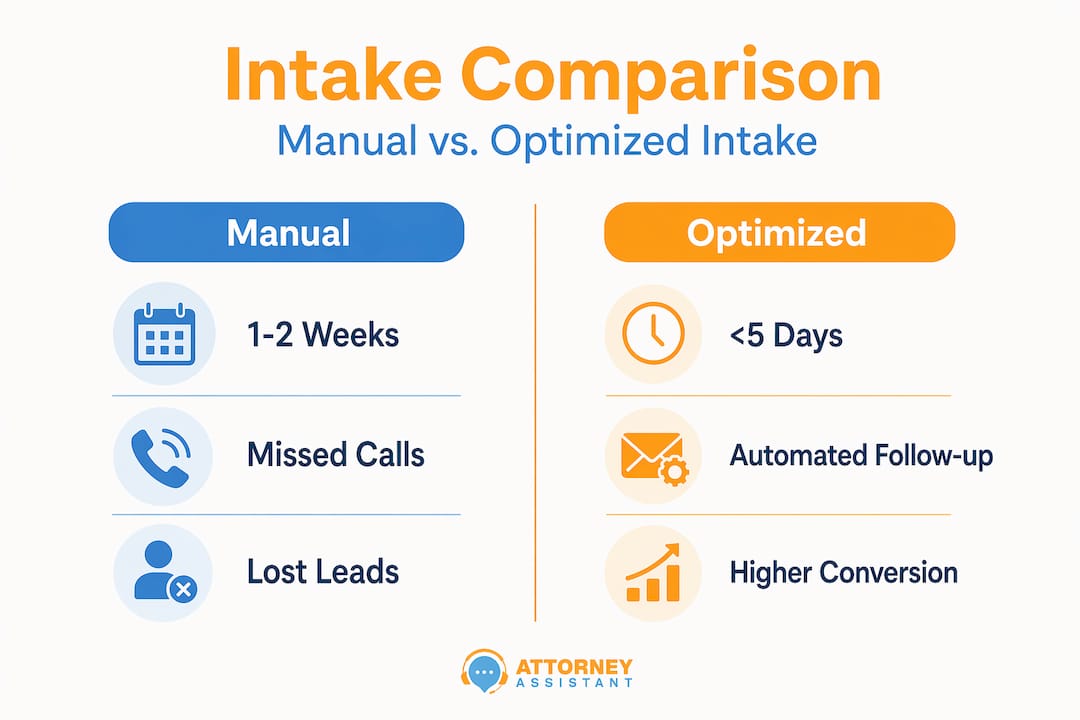
Manual vs. optimized intake: the real difference
The gap between a firm running manual intake and one running an optimized process is not cosmetic. It shows up in your conversion rate, your staff hours, and the experience clients describe to their friends.
| Metric | Manual intake | Optimized intake |
|---|---|---|
| Matter-opening time | 1 to 2 weeks | Under 5 days |
| Admin time per new file | High, often 3 to 5 hours | Reduced by up to 80% |
| Follow-up chaser emails | Frequent, manual | 90% fewer with automation |
| Retainer signing speed | Days after consultation | Hours, via embedded e-signature |
| Client satisfaction | Baseline | Up to 35% higher |
| Onboarding completion speed | Standard | 2x faster with dynamic workflows |
A 4-attorney boutique firm documented exactly this shift. After moving from manual email intake to a structured portal, they saw matter-opening time drop from 1 to 2 weeks to under 5 days, with administrative time per new file falling by 80%.

That is not a marginal improvement. For a firm handling 20 new matters per month, reducing admin time by 80% per file frees up dozens of hours that can go toward client work or business development. And automating admin intake tasks means attorneys spend that reclaimed time on substantive client conversations instead of chasing paperwork.
From the client’s perspective, a firm with optimized intake looks more professional from day one. The onboarding experience is the first real impression of how the firm operates. A disorganized intake process signals a disorganized firm, regardless of how good the attorneys actually are.
Steps to optimize intake in your law firm
Knowing what intake optimization is matters. Knowing how to start is what actually changes your numbers. Here is a practical sequence that works for firms at any size.
-
Map your current process. Write down every step from first contact to signed retainer. Note who is responsible, what system handles each step, and how long each step takes. You cannot fix what you have not documented.
-
Define ownership and follow-up timelines. Every inbound inquiry needs a named owner and a response deadline. Speed in intake response is the key variable in lead conversion. Responding within minutes, not hours, produces meaningfully higher retained client rates.
-
Build your intake form with conditional logic. Replace generic intake forms with forms that branch based on case type and practice area. Connect the form to your CRM so every submission creates a contact record automatically.
-
Embed e-signature into the intake flow. Do not wait until after a consultation to send retainer documents. Build the signing step into the intake sequence so clients can complete it while their interest is highest.
-
Implement practice-area checklists. Give each practice area its own list of required documents and information. Clients who receive clear, specific instructions submit complete files faster.
-
Track your intake KPIs. Monitoring lead volume, consultation rate, conversion rate, and drop-off points gives you the data to identify exactly where prospects are falling out of the process.
-
Iterate based on data. Run your improved process for 30 days, review the KPIs, identify the next friction point, and fix that. Intake optimization is not a one-time project. It is an ongoing improvement cycle.
Pro Tip: The handoff between marketing and operations is where most leads are lost silently. Documenting the intake handoff and assigning a clear owner to that moment prevents the quiet attrition that inflates your cost per signed case.
Common pitfalls that derail intake improvements
Understanding the benefits of intake optimization is one thing. Sustaining those improvements requires avoiding a predictable set of mistakes.
-
Over-automating too fast. Firms that try to automate every step before the basics are working create brittle systems that break in ways that are hard to diagnose. Start incrementally and eliminate the bulk of manual work before adding complexity.
-
Tracking the wrong metrics. Ranking positions and form submission volume are not intake success metrics. Signed cases and qualified consultations are the outcomes that tell you whether your intake process is working.
-
Removing the human element entirely. Automation handles data collection and follow-up reminders well. It does not replace a warm phone call for high-value or emotionally complex cases. Clients in difficult legal situations need to feel heard. Losing that connection at intake loses the client.
-
Skipping intake contract design. Every automated intake workflow needs explicit statuses and rejection reasons built into it. Without them, incomplete submissions stall silently and no one knows where the problem is.
-
Assuming technology solves adoption. A new intake system that your staff does not use consistently is worse than the manual process it replaced. Firm-wide adoption requires training, clear expectations, and leadership buy-in.
The firms that see lasting results from intake process improvement are the ones that treat it as an operational discipline, not a technology deployment.
My honest take on intake optimization
I’ve watched firms invest in marketing budgets, hire new associates, and rebrand entirely while ignoring the fact that their intake process was hemorrhaging leads every week. Intake gets overlooked because it sits between marketing and operations. Nobody fully owns it, so nobody fully fixes it.
What I’ve learned from working with firms on this is that the ones who start small and build structure first see results faster than the ones who buy expensive software and expect it to solve the problem on its own. Moving intake earlier in the client journey, so that consultations become strategy conversations rather than information-gathering sessions, changes the entire client relationship from the first interaction.
The uncomfortable truth is that some intake improvements require culture change, not just technology change. If attorneys treat intake as administrative noise below their attention, the process will always be inconsistent. Leadership has to signal that intake is a revenue function, not a clerical one.
My advice: start with the client experience and work backward. What does a prospect need to feel confident enough to sign? Build your intake process around that answer, then figure out which tools and automations support it.
— Nicole
How Attorneyassistant helps you fix intake now
If reading this made you mentally catalog the gaps in your own intake process, you are not alone. Most firms can name three or four places where leads fall out before they ever become clients.
Attorneyassistant specializes in exactly the operational problems this article covers: missed calls, slow follow-up, and inconsistent intake that costs firms signed cases every month. Our intake and reception support services put a structured, reliable process in place so your firm responds faster and captures more of the leads you are already generating. For firms with follow-up gaps, our lead follow-up services keep prospects moving toward a signed retainer instead of going cold. You can also explore our free tools for law firms or join a virtual webinar to see how intake optimization works in practice. When you are ready to talk through your firm’s specific situation, book a call and we will show you where your intake process is costing you cases.
FAQ
What is intake optimization in a law firm?
Intake optimization is the process of structuring, automating, and improving every step between a prospect’s first contact and a signed retainer agreement. The goal is to reduce friction, speed up response times, and increase the percentage of leads that convert into retained clients.
How does intake optimization improve lead conversion?
Faster response times and clearer intake workflows increase conversion because prospects are more likely to hire the first firm that contacts them professionally. Firms that respond within minutes and use structured intake processes consistently retain more clients from the same lead volume.
What technologies are used in intake optimization?
The core tools include dynamic intake forms with conditional logic, CRM integration, automated follow-up reminders, e-signature software, and practice management platforms. The most effective intake systems connect these tools so data flows between them without manual transfer.
How long does it take to see results from intake optimization?
Most firms see measurable improvements within 30 to 60 days of implementing a structured intake process. The quickest wins come from defining ownership of inbound leads and deploying a single conditional intake form connected to a CRM.
What metrics should I track to measure intake success?
Track lead volume, consultation rate, conversion rate from consultation to signed retainer, and drop-off points within the intake sequence. These outcome metrics tell you more about intake health than traffic or form submission counts.
Recommended
Related Articles

Tips for Improving Case Intake at Your Law Firm
Discover essential tips for improving case intake at your law firm. Boost conversion rates and secure more clients with effective strategies.

What Is Streamlined Intake for Law Firms in 2026
Discover what is streamlined intake for law firms in 2026. Learn how a centralized system can improve client engagement and case success!

Intake Process Best Practices for Personal Injury Firms
Discover essential intake process best practices for personal injury firms. Boost your case wins by optimizing every step from call to closure!