
Most advice about white glove support starts with “answer the phone faster.” That's useful, but incomplete. A caller can reach a pleasant receptionist immediately, repeat the same facts to three people, wait days for a conflict review, and never receive the promised callback. The firm technically answered. The prospect still disappeared.
For a law firm, premium service is an operational standard. It means every inquiry is acknowledged, qualified, documented, assigned, advanced, and followed through, whether it arrives during business hours, on a Sunday evening, or while the attorney who should review it is in court. The pleasant phone voice is welcome. It just can't be the entire strategy.
Table of Contents
- Redefining Premium Legal Service
- The Metrics That Actually Matter
- Engineering a Closed Loop Intake System
- Co-Managed Staffing Versus Traditional Hiring
- Balancing Personalization With Privacy Rules
- Operational Scenarios for Growing Practices
- Auditing Your Current Intake and Operations
Redefining Premium Legal Service
The phrase white glove began as a literal handling standard associated with English household staff and butlers who wore white gloves while handling silver, valuables, and delicate possessions. By the mid-20th century, the idea had expanded into specialized delivery for affluent customers and high-value goods. Modern white-glove service can include appointment coordination, in-home placement, assembly, installation, instruction, packaging removal, maintenance, and post-service support, as DHL's history of white-glove services describes.
The useful lesson for legal operations is simple. White glove support isn't a synonym for courtesy, and it isn't a nicer label for outsourcing a task. It's ownership of the workflow from first contact through completion. In a law firm, that may begin with an after-hours inquiry and continue through qualification, conflict-check preparation, appointment booking, retainer execution, records acquisition, client updates, and lien resolution.
Practical rule: If the client has to explain the matter again because the firm lost the context, the service wasn't white glove. It was merely available.
Commercial evidence supports treating responsiveness and experience as part of the service itself. FreightWaves, cited by Averitt, estimated that furniture and appliance e-commerce requiring white-glove delivery represented approximately $199 billion, or about 17% of the existing e-commerce market. The same source reported that consumers may pay up to 16% more for a better customer experience, while 75% of online customers expect an inquiry response within five minutes, as detailed in Averitt's discussion of white-glove service.
Legal inquiries carry their own version of complexity. A potential client may be discussing an injury, family crisis, employment dispute, immigration matter, or financial loss. The firm's first interaction establishes whether the organization appears capable of handling that complexity. A message left in a generic inbox does not establish much besides the existence of a generic inbox.
The most useful definition is therefore continuity and care at every handoff. Before contact, the firm makes access easy. During intake, the team captures the right facts and explains the next step. After transfer or booking, someone owns the follow-up. White glove support is the operating discipline that makes those promises reliable.
The Metrics That Actually Matter
Call volume is a workload measure, not a service-quality measure. A firm can celebrate a busy month while losing viable matters because nobody followed up, qualification was incomplete, or the attorney never received the information needed to make a decision.
The dashboard should distinguish availability from continuity. Availability asks whether someone answered. Continuity asks whether the inquiry moved forward without the prospect repeating information or chasing the firm.
A 2025 study of 1,333 law firms found a median online-lead response time of 13 minutes. Only 25% responded within five minutes, while 39% took more than two hours or didn't respond at all, according to the 2025 lead response time study. Those figures make response time worth tracking, but speed alone won't prove that the intake process worked.
Build a closed-loop scorecard
| Metric | Definition | Target outcome |
|---|---|---|
| Time to first human response | Elapsed time from inquiry to meaningful human contact | The prospect receives prompt acknowledgment and a useful next step |
| Qualification accuracy | Percentage of required matter facts correctly captured and classified | Attorneys receive enough reliable context to evaluate fit |
| Warm-transfer completion | Percentage of intended live transfers that connect successfully | Qualified prospects reach the appropriate attorney or owner |
| Appointment-booking rate | Qualified inquiries that receive and retain a scheduled next step | The inquiry has a documented path forward |
| Follow-up completion | Assigned follow-up actions completed by their deadline | No lead depends on someone remembering |
| Missed-lead recovery | Previously missed or stalled inquiries re-engaged and advanced | Lost opportunities receive structured recovery attempts |
| Handoff integrity | Records containing owner, disposition, next action, and deadline | Every transfer has accountability |
A 2022 peer-reviewed study found that response speed had a statistically significant direct effect on relationship quality, with β = 0.27, p < 0.001, and customer loyalty, with β = 0.23, p < 0.001, as reported in the Frontiers in Psychology service-recovery study. The practical implication is not “answer quickly and stop.” It's “answer quickly, then complete the recovery or resolution.”
For firms building a broader operations dashboard, this guide to build an actionable email dashboard can help structure response and follow-up reporting across channels. The same discipline belongs in intake: define the event, assign an owner, record the outcome, and review exceptions rather than relying on attractive totals.
A firm should also score contextual quality. Research on email service recovery found that complete answers, personalization, and an explicit expression of thanks were positively associated with satisfaction, positive word-of-mouth, and repurchase intent. It also cautioned that response time by itself may matter less than the completeness and quality of the response, as discussed in the QUT service-recovery research.
Engineering a Closed Loop Intake System
Taking a message is not intake. Intake is the controlled movement of an inquiry from arrival to a documented outcome.
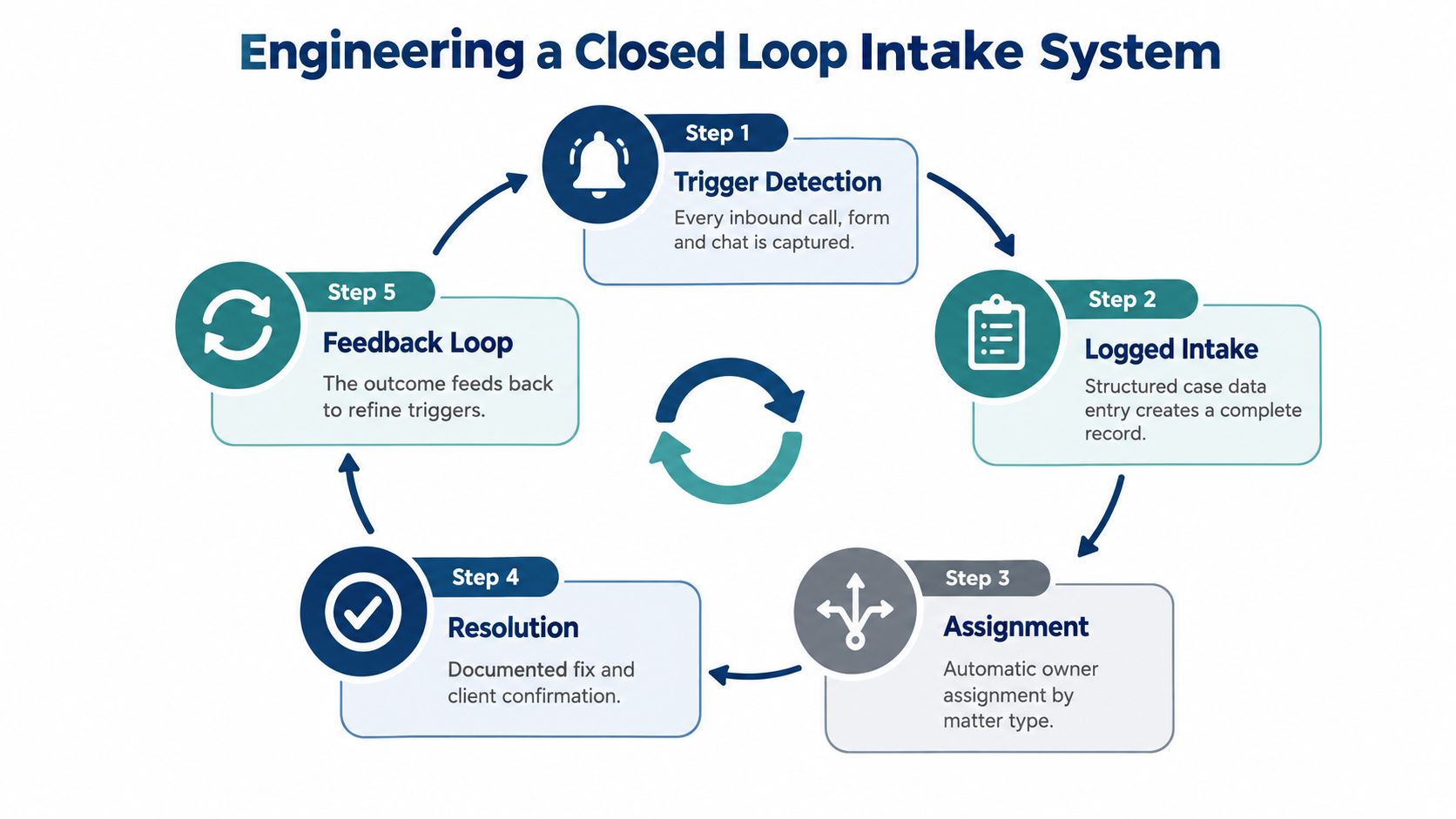
A workable system has five stages. Each stage needs a trigger, an owner, a deadline, and an auditable record. Without those four elements, the process eventually becomes “someone was supposed to call them,” which is not a control system. It's a sentence people say shortly before opening a spreadsheet.
Start with the trigger
Trigger detection captures every inbound call, web form, chat, text, and referral notification. Don't allow after-hours calls to live only in voicemail, and don't treat a failed warm transfer as a completed interaction.
Logged intake creates a structured record containing the matter type, jurisdiction, incident date, opposing-party information, prior contacts, qualification status, consent or conflict-check flags, and agreed next step. The fields should be adjusted to the practice area, but the principle is consistent: capture what the next authorized person needs, not every fact that might someday be interesting.
Assignment routes the inquiry by matter type and availability. A personal injury inquiry, a family-law issue, and a boutique commercial dispute may require different qualification questions and different escalation paths.
Define resolution and recovery
Resolution means the next action is complete or clearly documented. That could be a successful attorney transfer, a booked consultation, a retainer sent for signature, or a documented decline with the reason recorded.
Feedback loop reviews outcomes. If a warm transfer fails repeatedly after hours, change the routing rule. If a source sends inquiries outside the firm's practice area, adjust qualification or marketing. A closed loop improves because the firm studies where the loop breaks.
For multilingual coverage, firms can use best practices for global support teams to think through language access, consistency, escalation, and cultural clarity. Frontline coverage can support English and Español, but language availability still needs documented scripts, qualification boundaries, and attorney escalation rules.
A virtual receptionist model can help when the firm needs a structured front door, as explained in live virtual receptionist services. The critical distinction is whether that front door records, routes, follows up, and confirms resolution. A receptionist who merely forwards a message has moved the problem, not solved it.
Co-Managed Staffing Versus Traditional Hiring
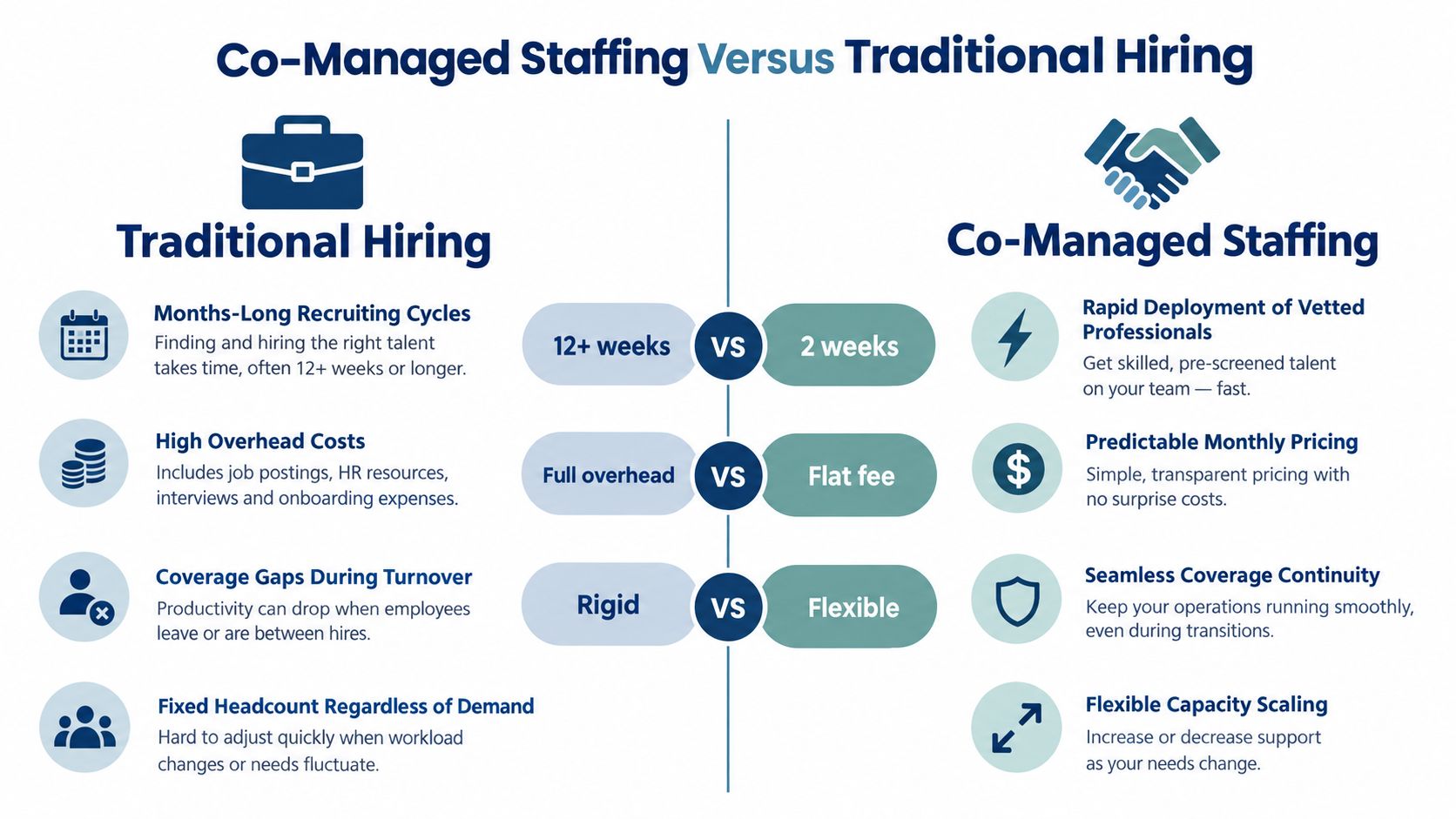
Traditional hiring gives the firm direct control, but it also gives the firm the full burden of recruiting, training, supervision, coverage, and replacement. When a capable employee leaves, the workflow doesn't pause politely until the job posting performs.
A co-managed model treats staffing as shared operational infrastructure. A dedicated professional works inside the firm's systems, learns its processes, and handles defined responsibilities while the firm retains control over legal judgment, client strategy, and matter decisions.
Compare the operating burden
| Traditional hiring | Co-managed dedicated staffing |
|---|---|
| The firm sources and screens candidates | Attorney Assistant sources, vets, and trains staff on legal support fundamentals |
| The firm carries the full recruiting and replacement burden | The staffing partner supports continuity and performance management |
| Coverage depends on one employee's schedule and availability | The role is designed around dedicated capacity and defined workflows |
| Training often competes with active casework | The firm trains the professional on its systems, preferences, and procedures |
| Management responsibility sits entirely with the firm | Oversight is shared through co-managed performance support |
The word dedicated matters. Staffline professionals work with one firm, 40 hours per week, rather than being divided among several clients. They can support case management, records and bill retrieval, lien reduction, file opening, calendar and inbox management, CRM hygiene, intake, and administrative work. This isn't generic labor wearing a legal-themed name tag.
The firm still owns the substantive work. A dedicated support professional can organize medical records, update a case-management system, prepare a retrieval request, or maintain a follow-up queue. The attorney decides legal strategy, evaluates the matter, advises the client, and approves substantive conclusions.
Technical operations also deserve attention. Firms evaluating a managed technology relationship can review how to choose a managed IT provider for law, particularly around access controls, reliability, support ownership, and legal-workflow fit. Staffing and technology should reinforce each other. A perfectly organized workflow inside inaccessible systems remains perfectly unhelpful.
The broader model is capacity, not task disposal. Frontline signs the case. Staffline carries it. That division lets the firm connect intake with the case-support work that follows instead of creating a new bottleneck immediately after the retainer.
Firms considering this approach can also review virtual staffing solutions for law firms to assess which responsibilities belong in a dedicated support role and which should remain with attorneys or internal leadership.
Balancing Personalization With Privacy Rules
Personalization creates trust only when the client understands what the firm is collecting and why. An intake specialist who asks for every available medical detail before confirming whether the firm handles the matter may sound thorough. The client may instead hear, “I'm not sure who has access to this information.”
Recent global research captures the tension. 64% of consumers prefer companies that tailor experiences to their needs, while 53% are highly or extremely concerned about personal-data privacy, and only 33% trust companies to use that information responsibly, according to the Qualtrics Institute consumer privacy and personalization research. PwC's 2025 U.S. survey found that 53% considered data sharing worthwhile when it improved the experience, but 93% said mishandling data would cause a loss of trust, as reported in the same research source.
Collect only what advances the next step
Before a conflict review, a nonlawyer intake specialist generally needs enough information to identify the caller, understand the broad matter category, identify relevant parties, establish jurisdictional and timing basics, and determine whether the inquiry fits the firm's stated criteria. The specialist shouldn't provide legal advice, predict an outcome, or imply that the firm has accepted representation.
A practical intake script should explain the role and limits plainly. It should state that collecting information doesn't create an attorney-client relationship, that an attorney must evaluate the matter, and that the firm may need additional information before deciding whether it can help. Exact language should be approved by the firm's attorneys and adapted to its jurisdiction and practice areas.
Use a minimum-necessary information rule:
- Before screening: Capture contact details, broad matter type, location, relevant dates, and names needed for a preliminary conflict check.
- Before attorney review: Add the facts required by the practice-area qualification protocol, without soliciting unnecessary narrative or sensitive documents.
- After authorization: Collect records through approved channels, with documented consent and clear access controls.
- At escalation: Route questions involving legal advice, urgent safety concerns, conflicts, representation status, or unusual sensitivity to an attorney or designated supervisor.
Medical records, financial documents, immigration materials, call recordings, texts, and uploaded files need defined retention and deletion rules. Access should follow role-based permissions, and the firm should know who can view, export, or delete each category. Document management for law firms offers a useful framework for organizing ownership and access rather than letting sensitive material accumulate in personal inboxes.
Consent-based personalization is less theatrical and more credible. Let clients choose preferred channels and contact windows, record those preferences, and use prior context only for the next authorized step. The best experience isn't the one that collects the most. It's the one that makes the client feel known without making the firm look careless.
Operational Scenarios for Growing Practices
A personal injury firm can lose capacity in two places at once. Marketing produces a weekend inquiry, while the existing caseload waits on medical records, billing statements, and lien work. Adding more advertising to that arrangement is a little like pouring water into a filing cabinet and calling it hydration.
Consider the first workflow. A prospective client calls on Saturday evening after a referral. Frontline answers live, confirms the language preference, captures the practice-specific qualification fields, identifies the relevant parties, and documents the next step. If the matter fits the firm's criteria, the team pursues a warm transfer, books the consultation, or sends the approved retainer process. If the transfer fails, the record creates an owner, deadline, retry sequence, and escalation path instead of dissolving into voicemail.
The second workflow begins after signing. A Staffline professional opens the file, confirms that required documents are present, requests medical records and billing statements through approved procedures, organizes incoming materials, and updates the case-management system. The same role can support lien tracking and reduction preparation, while the attorney reviews the substantive legal position and negotiates or approves the strategy.
What continuity looks like in practice
A boutique firm may have a narrower practice and fewer inquiries, but each matter can carry substantial complexity. A prospect who contacts the firm about a commercial dispute may need a carefully scheduled consultation, a conflict-check record, a document-request list, and a clear explanation of what happens next. White glove support means the person who books the appointment doesn't leave the attorney to reconstruct the entire interaction from a three-word note.
For a mass-tort or high-volume practice, the work is more repetitive but no less consequential. Structured intake prevents inconsistent qualification. Follow-up sequences re-engage people who were interested but stalled. CRM hygiene keeps source, disposition, and status visible so leadership can distinguish a weak campaign from a weak response process.
A dedicated support professional can also manage the unglamorous middle: records requests, file naming, deadline tracking, inbox triage, calendar maintenance, and client-status updates approved by the firm. None of these tasks requires an attorney's judgment in every instance. All of them can consume attorney time when nobody owns them.
The operational test: Can a new team member open the record and understand what happened, what was promised, who owns the next action, and when it is due?
That question connects Frontline and Staffline without pretending they are interchangeable. Frontline handles live intake, qualification, follow-up, transfers, appointments, and retainer signing. Staffline provides dedicated ongoing support across intake, case management, records, liens, administration, and CRM maintenance. The client experiences one firm because the workflow preserves context.
Auditing Your Current Intake and Operations
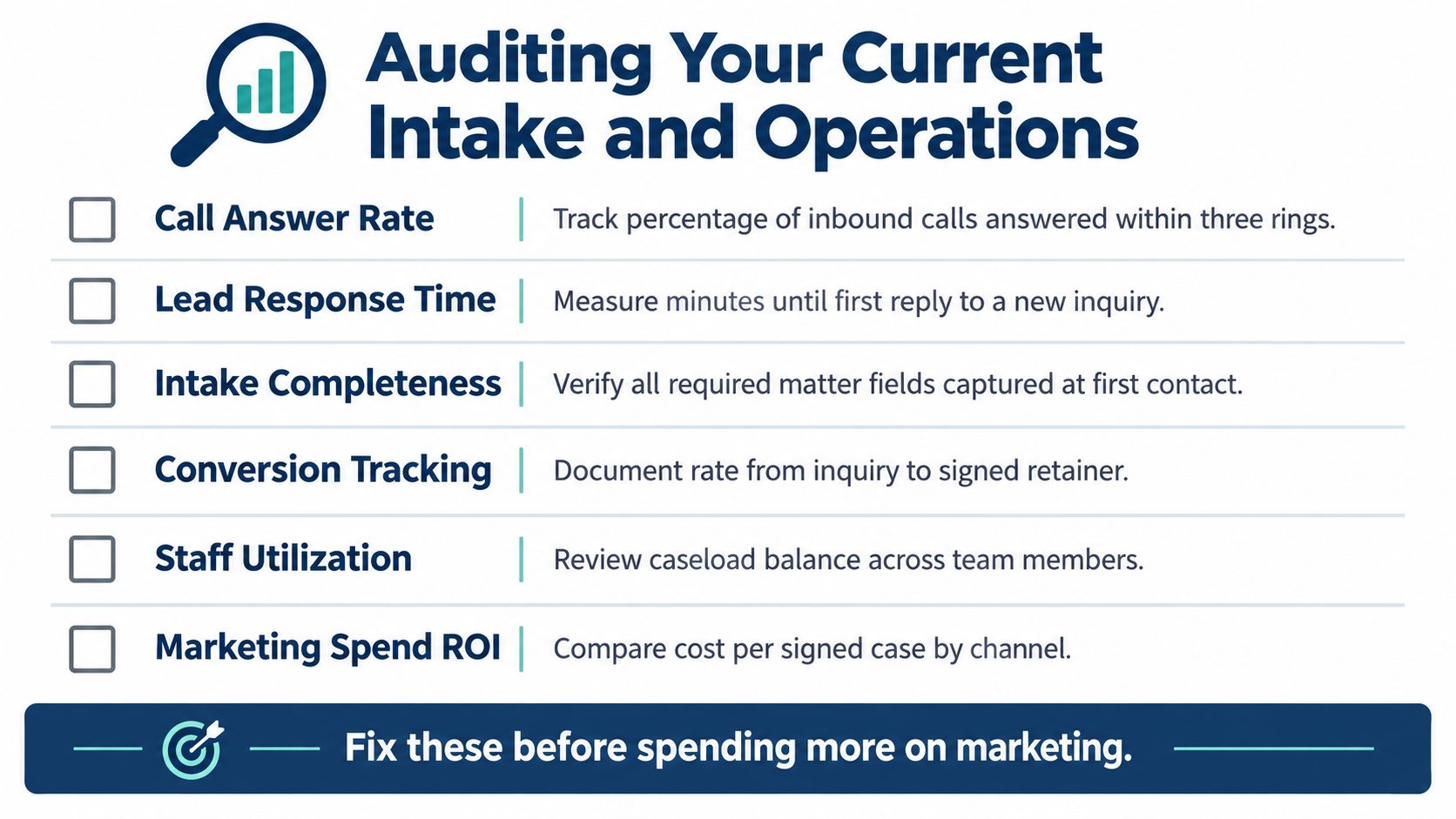
Before increasing marketing spend, audit the path between inquiry and signed engagement. The objective isn't to produce a prettier report. It's to identify the exact point where a viable matter stops moving.
Start with a sample of recent phone, form, chat, and referral inquiries. For each record, answer five questions: when did the inquiry arrive, when did a human respond, what facts were captured, who owned the next action, and what happened afterward? If the answers require searching three inboxes and asking two people what they remember, the firm has found an operational issue.
Use an evidence-based audit
Review these areas:
- Call answer rate: Separate calls answered live from calls returned later. The 2019 Clio secret-shopper study found that 27% of contacted law firms failed to answer or return phone calls, and 57% of calls reaching voicemail weren't returned within 72 hours, as reported in Clio's legal inquiry response findings.
- Email response quality: Don't count an automated acknowledgment as a meaningful response. The same Clio study found that 60% of contacted firms didn't respond to email inquiries at all, and defined an adequate response as one that answered at least one question, addressed rates or consultation booking, and communicated clearly.
- Current reachability: The 2024 Legal Trends Report found that only 33% of firms responded to test emails and 40% answered test phone calls. Including later callbacks, 48% remained effectively unreachable by phone in the test, according to Clio's 2024 report highlights.
- Intake completeness: Check whether matter type, jurisdiction, dates, parties, qualification status, consent or conflict flags, disposition, and next action are present.
- Attorney time allocation: Track which administrative tasks attorneys perform repeatedly, including record chasing, inbox management, intake callbacks, file opening, and status updates.
- Conversion visibility: Follow each source from inquiry to qualified contact, consultation, signed retainer, and decline reason. If the firm can't connect the stages, it can't make a sensible marketing decision.
The 2024 report also associated client-facing capabilities such as online communication and payment options with 51% more client leads and 52% higher revenues among firms using those capabilities, as reported by Clio in the linked findings above. Those figures don't mean every firm should buy every tool. They do show why contact capture, communication, qualification, and conversion should be managed as one workflow.
Fix the bottleneck before adding volume
If response is slow, establish channel-specific ownership and after-hours coverage. If qualification is inconsistent, build approved scripts and required fields. If follow-up fails, create automated task assignment with deadlines and escalation. If attorneys are buried in records and administration, move repeatable legal-support work into a dedicated role with quality review.
Attorney Assistant provides 24/7 live intake through Frontline, including answering, qualification, follow-up, warm transfers, appointment setting, and retainer-signing support. Its dedicated Staffline professionals work exclusively with one firm on ongoing legal-support roles, while the firm retains control of legal judgment and workflow requirements. Visit Attorney Assistant to review where your intake, follow-up, and case-support capacity is leaking, then decide which responsibilities should stay with attorneys and which can be owned by a trained, co-managed support team.
Related Articles

How to Call Answer Phone for Your Law Firm
Learn how to call answer phone professionally at your law firm. A practical guide to building 24/7 intake, scripting, and follow-up that signs cases.

Virtual Staffing Solutions for Law Firms
Discover how virtual staffing solutions build real operational capacity for law firms. Learn about co-managed models, dedicated legal support, and 24/7 intake.

5 Case for Support Examples for Law Firms
Review five case for support examples for law firms, with strategic breakdowns, reusable templates, and practical tactics for staffing, intake, and growth.