Why Leads Go Unconverted at Law Firms: Fix It Now

TL;DR:
- Most law firms lose revenue because of intake failures, slow response times, and poor digital presence. Improving response speed, assigning clear ownership, and building strong online proof can significantly increase conversion rates. Using a CRM and automating follow-up processes helps firms convert more leads into signed clients.
Lead conversion failure is the most expensive operational problem most law firms never measure. The average firm converts only 14–20% of leads into signed clients, while top-performing firms reach 35–50% by fixing intake, not by buying more leads. Why leads go unconverted rarely comes down to lead quality or volume. The root causes are slow response times, inconsistent follow-up, and a digital presence that fails to build trust before a prospect ever picks up the phone. Between 35–50% of law firm leads never receive any follow-up at all, costing firms an average of $200,000 per year in lost revenue.
Why leads go unconverted: the response time problem
Speed is the single most controllable factor in lead conversion. Firms that respond within 5 minutes are up to 21 times more likely to qualify a lead than firms that respond later. That gap is not a marginal advantage. It is the difference between a signed client and a prospect who hired someone else before lunch.

The probability of qualifying a lead decays sharply with every passing minute. Waiting just 30 minutes reduces qualification likelihood by 9 to 21 times compared to a 5-minute response. Waiting 24 hours makes a firm 7 times less likely to qualify that lead than a competitor who responded within the hour. Most firms do not track this decay at all.
The follow-up gap compounds the problem. A firm may respond to the first inquiry but then go silent after one voicemail or one email. Prospects who do not hear back within a predictable window move on. They do not wait. They call the next firm on the list.
Clear lead ownership is the operational fix most firms skip. When a lead sits in a shared inbox with no assigned owner, no one is accountable for the next step. The lead ages, gets buried, and eventually disappears from the pipeline entirely.
- Assign every lead to a named intake staff member at the moment it arrives.
- Set a maximum response window of 5 minutes for initial contact attempts.
- Log every outreach attempt with a timestamp in your CRM.
- Escalate leads with no response after two attempts within the first hour.
- Never rely on a shared inbox as a lead management system.
Pro Tip: Set a daily “aging leads” report in your CRM that flags any lead with no logged activity in the past 24 hours. Reviewing this list each morning takes five minutes and prevents thousands of dollars in lost cases.
Why does a weak digital presence cause leads to ghost your firm?
Prospects do not call a firm cold. They research first. Prospects spend 30–60 minutes reviewing Google listings, YouTube videos, client reviews, and LinkedIn profiles before deciding whether to call. By the time a prospect dials your number, they have already formed an opinion about your firm.
A generic website with stock photos, a handful of outdated reviews, and no video content signals that a firm is either too small to invest in its reputation or too disorganized to maintain it. Either interpretation kills conversion. The prospect moves to the next firm that looks credible.
The firms that convert referral leads at the highest rates share a common infrastructure: video case stories, a current YouTube presence, optimized directory profiles, and a steady stream of recent client reviews. Adding these elements has doubled signed clients for some firms without spending a dollar more on lead generation. That is the clearest proof that conversion failure is often an infrastructure problem, not a lead volume problem.
AI assistants like ChatGPT now influence early-stage referrals. Firms with strong digital content, particularly YouTube videos and detailed practice area pages, appear more frequently in AI-generated recommendations. Video case stories improve both direct conversion and AI-driven referrals, creating a compounding advantage over time.
- Audit your Google Business Profile and confirm all information is current and complete.
- Collect at least five new client reviews per month across Google and Avvo.
- Publish one video case story per quarter on YouTube, focused on a specific practice area outcome.
- Verify that your website loads in under three seconds on mobile devices.
- Check that your Martindale-Hubbell and Justia directory profiles are fully populated and match your website.
Pro Tip: Ask satisfied clients to record a 60-second video review on their phone. These informal testimonials outperform polished studio productions because they feel authentic to prospects who are evaluating trust.
What intake process failures cause the most lost leads?
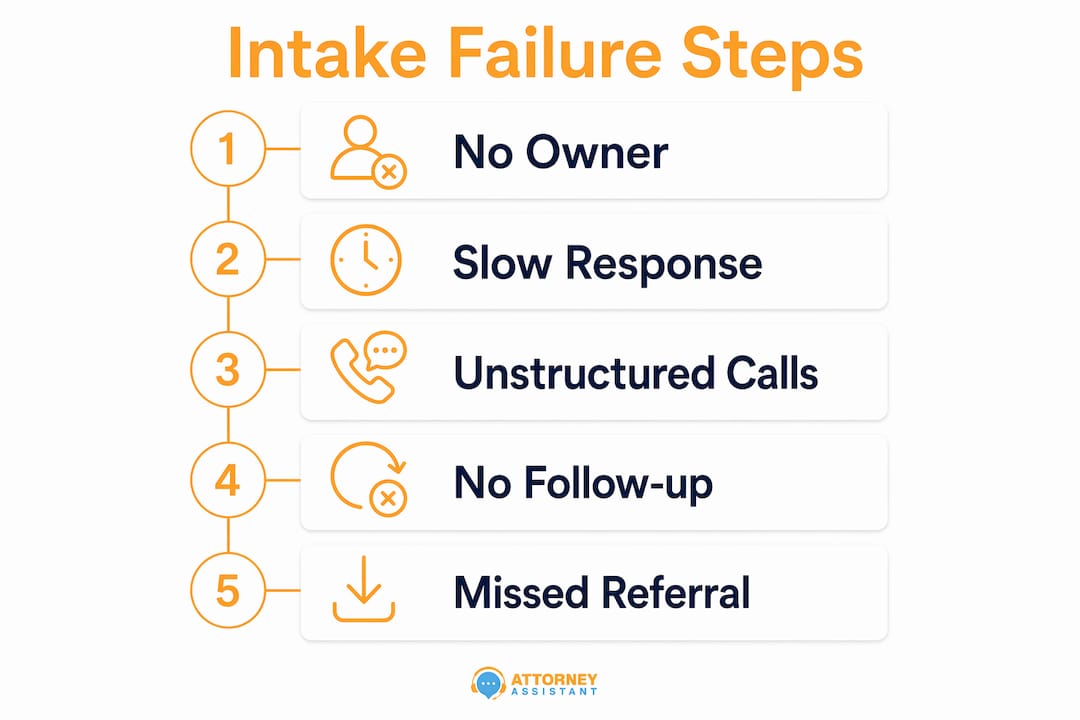
Operational breakdowns inside the intake process account for a large share of lost law firm leads. These failures are not dramatic. They are quiet and cumulative, and most firms do not notice them until they audit their pipeline.
Unstructured intake conversations are the most common failure point. When intake staff have no script and no qualification framework, every conversation goes differently. Some prospects get thorough information and a clear next step. Others get a vague promise to “have someone call you back.” That inconsistency produces inconsistent results.
The table below maps the most common intake failures to their direct impact on conversion.
| Intake failure | Impact on conversion |
|---|---|
| No assigned lead owner | Lead sits uncontacted and ages out of the pipeline |
| Missing SLA for first contact | Prospects hire competitors before the firm responds |
| Vague lead status in CRM | Staff cannot identify which leads need immediate action |
| Missed calls with no callback | Caller moves to the next firm within minutes |
| No documented next steps | Follow-up depends on memory, not process |
| Referral leads with no digital proof | Warm leads ghost after researching the firm online |
| No escalation rules for urgent cases | High-value leads wait in the same queue as low-priority ones |
Referral leads deserve special attention. Half of warm referral leads never make contact because the prospect researches the firm online and finds nothing compelling. A referral is not a guaranteed client. It is a warm prospect who still needs to trust what they see before they call.
Marketing surges create a separate risk. When a campaign drives a spike in inquiries, firms without scalable intake capacity lose a disproportionate share of those leads. The phones ring more, the inbox fills faster, and staff revert to informal handling. The leads that cost the most to generate get the least attention.
How to convert leads effectively with better intake and follow-up
Fixing lead conversion requires process changes, not just effort. The firms that reach 35–50% conversion rates operate with documented systems, not good intentions.
-
Set a 5-minute response SLA. Every inbound inquiry, whether by phone, form, or chat, requires a response attempt within 5 minutes during business hours. Document this as a firm policy and measure it weekly.
-
Assign a named lead owner immediately. No lead enters the pipeline without a specific staff member responsible for it. Shared ownership means no ownership.
-
Use CRM next-task timestamps. Tracking lead status via next-task timestamps prevents leads from becoming forgotten. Every lead in the pipeline must have a scheduled next action with a due date and an owner.
-
Protect same-day consult slots. Reserve at least two consultation slots per day for qualified leads who need immediate attention. Prospects who can schedule the same day show up at dramatically higher rates.
-
Structure your intake script. Capture name, contact information, case type, and urgency in the first two minutes. Give intake staff a framework so every conversation produces the same critical data points.
-
Build your digital proof assets. Publish video case stories, maintain fresh reviews, and keep directory profiles current. This work happens before the phone rings and determines whether a prospect calls at all.
-
Implement compliant automated acknowledgment. Automated responses that comply with ABA Model Rule 5.5 and TCPA regulations confirm receipt of an inquiry instantly. This keeps prospects engaged while a human prepares to follow up.
-
Audit aging and unowned leads weekly. Pull a report of every lead with no activity in the past 48 hours. Assign ownership and schedule contact before the end of that business day.
-
Train intake staff on objection handling. Prospects who say “I’m just gathering information” are not lost. Trained staff can move them toward a scheduled consultation without pressure.
-
Track lost and nurture reason codes. When a lead does not convert, record why. Over time, this data reveals the specific failure points costing the firm the most revenue.
CRM systems increase lead conversion by 47% compared to manual tracking. That figure reflects the compounding effect of consistent follow-up, clear ownership, and data-driven pipeline management. Understanding lead nurturing strategies that apply across industries can sharpen how firms think about multi-touch follow-up sequences.
Pro Tip: Review your intake follow-up process quarterly, not annually. Intake failures compound quickly, and a quarterly audit catches problems before they become expensive habits.
Key Takeaways
Law firms lose the majority of their revenue not from a shortage of leads, but from intake failures, slow response times, and a digital presence that fails to convert warm prospects into signed clients.
| Point | Details |
|---|---|
| Response speed is decisive | Firms responding within 5 minutes are up to 21x more likely to qualify a lead. |
| Follow-up gaps cost real money | Between 35–50% of leads receive no follow-up, costing firms $200,000+ per year. |
| Digital presence drives conversion | Video case stories and fresh reviews have doubled signed clients for firms without added lead spend. |
| CRM use closes the gap | CRM-managed intake converts 47% more leads than manual tracking by enforcing ownership and next steps. |
| Intake is a revenue function | Treating intake as a clerical task is the root cause of most lead conversion failure in law firms. |
What I’ve learned about why law firms keep losing leads they already paid for
Most law firms I have worked with share the same blind spot. They treat intake as an administrative function, something to handle after the real legal work is done. That framing is the root of the problem. Intake is where revenue is won or lost. Every inquiry that goes unanswered or poorly handled is a case that funded a competitor’s growth instead.
The firms that fix their conversion rates do not do it by buying more leads. They do it by taking their existing lead volume seriously enough to build a real process around it. That means documented scripts, named owners, response SLAs, and weekly pipeline reviews. It means treating a prospect’s first contact as a high-stakes moment, because for that prospect, it is.
The hardest mindset shift is accepting that speed and consistency are not nice-to-haves. They are the product. A prospect who calls three firms and hears back from one within five minutes will hire that firm. The other two firms will never know they lost.
Automation helps, but only when it is designed around compliance first. Rushing to automate intake without understanding ABA Model Rule 5.5 and TCPA constraints creates legal risk that outweighs any conversion gain. The goal is fast, compliant, and personal, in that order.
Measure response times, follow-up adherence, and stage conversion rates every week. The firms that improve are the ones that look at the numbers honestly and change what the numbers reveal.
— Nicole
How Attorney Assistant helps law firms stop losing signed cases
Law firms that fix their intake process sign more clients from the leads they already have.
Attorney Assistant handles the intake, follow-up, and administrative workflows that most firms struggle to maintain consistently. From lead follow-up services that contact prospects within minutes to virtual assistants who manage intake scripts and CRM updates, Attorney Assistant closes the gaps that cost firms revenue every week. Firms that work with Attorney Assistant respond faster, follow up consistently, and convert a higher share of their existing lead volume into signed cases. To see how this works in practice, book a call with the Attorney Assistant team.
FAQ
What is the average lead conversion rate for law firms?
The average law firm converts 14–20% of leads into clients. Firms with structured intake processes reach 35–50%.
How quickly should a law firm respond to a new lead?
Firms should respond within 5 minutes. Responding within 5 minutes makes a firm up to 21 times more likely to qualify a lead than responding later.
Why do warm referral leads stop responding?
Referral leads ghost firms when they research the firm online and find weak digital proof. Poor reviews, no video content, and outdated profiles cause warm prospects to choose a competitor instead.
What is the most common reason leads fall through in law firms?
The most common reason is no assigned lead owner combined with no documented next step. When no one is accountable for a specific lead, it ages out of the pipeline without contact.
Does a CRM actually improve law firm lead conversion?
CRM use increases lead conversion by 47% compared to manual tracking. The gain comes from enforced ownership, next-task timestamps, and consistent follow-up that manual systems cannot maintain at scale.
Recommended
- Convert more leads into signed cases for injury firms | Attorney Assistant
- How to Convert Leads into Cases for Law Firms | Attorney Assistant
- Law firm lead management: convert more clients in 2026 | Attorney Assistant
- Streamline your law firm follow-up process: convert more leads | Attorney Assistant
Related Articles

Lead Conversion Workflow for Law Firms: 2026 Guide
Discover effective lead conversion workflow strategies for law firms. Boost your client retention and increase revenue with our 2026 guide.

Call Flow Customer Service for Law Firms: A Practical Guide
Design a call flow customer service system for your law firm that captures leads, qualifies matters, and signs cases. Practical guide

Fear of Talking on Phone: 7 Practical Confidence Tips
Overcome fear of talking on phone with practical scripts, role-play, exposure exercises, and intake tools built for legal teams.