Client Communication Guide: Boost Law Firm Intake

TL;DR:
- Responding within five minutes across channels significantly increases client conversion rates.
- Consistent, empathetic communication and follow-up over two weeks boost signed client numbers.
- Regular audits and tracking KPIs help maintain and improve your firm’s intake effectiveness.
Every day, personal injury firms spend thousands on ads and SEO while quietly hemorrhaging the leads those efforts generate. A potential client calls after an accident, gets voicemail, and signs with a competitor before lunch. This isn’t rare. It’s the default for firms that treat intake as an afterthought rather than a revenue system. The good news: the fix isn’t expensive, and it doesn’t require more leads. It requires responding faster, communicating with empathy, and following up consistently. This guide walks you through the tools, scripts, follow-up protocols, and audit steps that turn your intake process into your firm’s most reliable growth engine.
Table of Contents
- Laying the foundation: Why client communication matters in personal injury intake
- Essential tools and preparation: Setting up your client intake system
- Step-by-step intake: From first contact to qualified client
- Follow-up and retention: Closing the loop for higher conversions
- Verification and improvement: Auditing your intake for continued success
- The uncomfortable truth about law firm client communication
- Take the next step: Automate, optimize, and win more cases
- Frequently asked questions
Key Takeaways
| Point | Details |
|---|---|
| Respond within 5 minutes | Quick multi-channel communication is crucial for converting law firm leads. |
| Use empathy-first scripts | Prioritize empathetic communication to build trust and boost intake retention. |
| Follow up consistently | A 7+ touchpoint follow-up process leads to higher client conversion rates. |
| Leverage technology | Portals, automated updates, and intake software streamline communication and case management. |
Laying the foundation: Why client communication matters in personal injury intake
When someone calls after a car accident or slip and fall, they’re scared, in pain, and often overwhelmed. That emotional state makes them hyper-sensitive to how your firm treats them in the first 60 seconds. A warm, quick response doesn’t just feel good. It signals competence, care, and trustworthiness.
The data backs this up. Firms focused on improving law firm response time consistently outperform competitors, and 80% more leads are captured when you respond within five minutes compared to firms that delay even by an hour.
| Communication factor | Impact on conversion |
|---|---|
| Response within 5 minutes | Up to 80% more leads captured |
| Empathy-first language | Higher trust, lower drop-off |
| Multi-channel follow-up | Sustained engagement, fewer ghosted leads |
| Generic or delayed reply | Significant lead loss to competitors |
Three common pitfalls kill conversion before a single case is signed:
- Generic responses that don’t acknowledge the caller’s specific situation
- Missed follow-ups after an initial contact that showed strong interest
- Skipping viability screening, which wastes time on unqualified leads and delays attention to strong ones
“For intake, respond within 5 minutes across multi-channels (phone, SMS, email); use empathy-first scripts, screen for viability (liability, injury severity), and follow up 7+ times over 2 weeks to boost conversions.”
Technology plays a bigger role here than most firms realize. Client portals and automated communications fuel retention more powerfully than competing on case outcomes alone. Clients who feel consistently informed are far less likely to leave or complain. Building intake communication strategies around speed and empathy is the single highest-leverage change most firms can make.
Now that the cost of ineffective communication is clear, let’s look at what you need to transform your intake practices.
Essential tools and preparation: Setting up your client intake system
Before you fix your scripts, you need the right infrastructure. Most small firms run intake with a phone, a legal pad, and good intentions. That’s not a system. That’s hope.
Here’s what a modern intake setup actually requires:
- Call tracking software to monitor which channels bring leads and how fast your team responds
- SMS and email platform for multi-channel outreach from a single dashboard
- Secure client portal where potential clients can submit details and documents safely
- CRM or intake software to log every lead, track status, and schedule follow-ups automatically
- Script library with empathy-first language tailored to personal injury scenarios
How does this compare to doing it manually?
| Feature | Manual intake | Tech-enabled intake |
|---|---|---|
| Response speed | Minutes to hours | Under 5 minutes (automated) |
| Follow-up consistency | Depends on staff memory | Automated scheduling |
| Lead tracking | Spreadsheet or paper | Real-time CRM dashboard |
| Conversion rate | Lower, variable | Higher, measurable |
| Staff workload | High, repetitive | Reduced through automation |
Following client intake best practices means more than just having the tools. It means training your team to use them with consistency. Your script library should include empathy-first intake scripts that guide staff through opening lines, case screening questions, and closing statements.
Prioritizing speed and empathy in intake drives retention more powerfully than case value alone. Clients don’t always know who has the best legal strategy. They do know who picked up the phone.

Pro Tip: Even solo practices see significant conversion jumps from one small change. Add SMS as a response channel. Most clients prefer texting and respond faster to it than calls or emails.
With the foundation set and necessary tools in mind, it’s time to walk through the details of effective, structured intake.
Step-by-step intake: From first contact to qualified client
Knowing you should respond fast is different from having a repeatable system that guarantees it. Here’s how to build one:
- Trigger immediate response. The moment a lead comes in via phone, web form, or SMS, your system or staff should respond within five minutes across every channel.
- Open with empathy. Your first words set the tone. “I’m so sorry you’re going through this. We’re here to help you understand your options.”
- Gather the facts. Ask about liability (who was at fault), injury severity, and treatment status. These determine case viability without making the caller feel interrogated.
- Assess case fit. Use a standardized checklist to determine if the case meets your firm’s criteria before investing more time.
- Enter everything in your CRM. Log the lead’s name, contact info, case summary, and disposition immediately after the call.
- Schedule follow-ups. Before hanging up, set the next contact point. Don’t leave it to memory.
| Intake stage | Primary objective |
|---|---|
| Greeting | Build rapport, reduce anxiety |
| Fact gathering | Identify liability and injury details |
| Case screening | Confirm viability for your firm |
| CRM entry | Ensure no lead is forgotten |
| Follow-up scheduling | Lock in next contact point |
The intake process walkthrough matters because execution is where firms lose leads they already had on the line. A warm tone during screening converts more callers than any marketing copy.
Empathy-first scripts, viability screening, and 7+ follow-ups over two weeks show a dramatic improvement in how many leads actually sign.
The right intake technology tips and CRM tools make every step of this process trackable and repeatable, not dependent on any one person’s memory or mood.
Establishing your workflow is only half the battle. Flawless execution in every intake step is where conversions are truly won.
Follow-up and retention: Closing the loop for higher conversions
Most firms quit too early. A lead doesn’t respond to the first call, so staff marks it cold and moves on. That’s the single most expensive mistake in personal injury intake.
Here’s a 7-touchpoint follow-up schedule that actually works:
- Day 1, within 5 minutes: Phone call immediately after inquiry
- Day 1, within 1 hour: SMS follow-up if no answer
- Day 1, end of day: Email summarizing how your firm can help
- Day 3: Second phone call with a personalized voicemail referencing case details
- Day 5: SMS check-in with a warm, no-pressure tone
- Day 10: Email with relevant information about their type of injury claim
- Day 14: Final call and handwritten note or direct mail for high-value leads
Firms that follow up 7+ times over two weeks consistently convert more leads than competitors who give up after one or two attempts. The data is clear. Persistence pays.
The lead follow-up steps that move the needle are the ones that feel personal. Reference the caller’s name, their accident type, and where they are in their recovery. That specificity builds trust faster than any generic message.
Pro Tip: Use your CRM to automate reminders for each touchpoint so nothing slips through. The follow-up system should run even when your best intake coordinator is out sick.
For intake tips that boost conversions, never let a successful follow-up call go unanswered. Responding slowly after a lead re-engages is just as damaging as missing the first call.
Up to this point, we’ve covered preparation, execution, and persistence.
Verification and improvement: Auditing your intake for continued success
Implementing a strong intake system is not a one-time event. It decays without oversight. Regular audits catch the small cracks before they become expensive gaps.
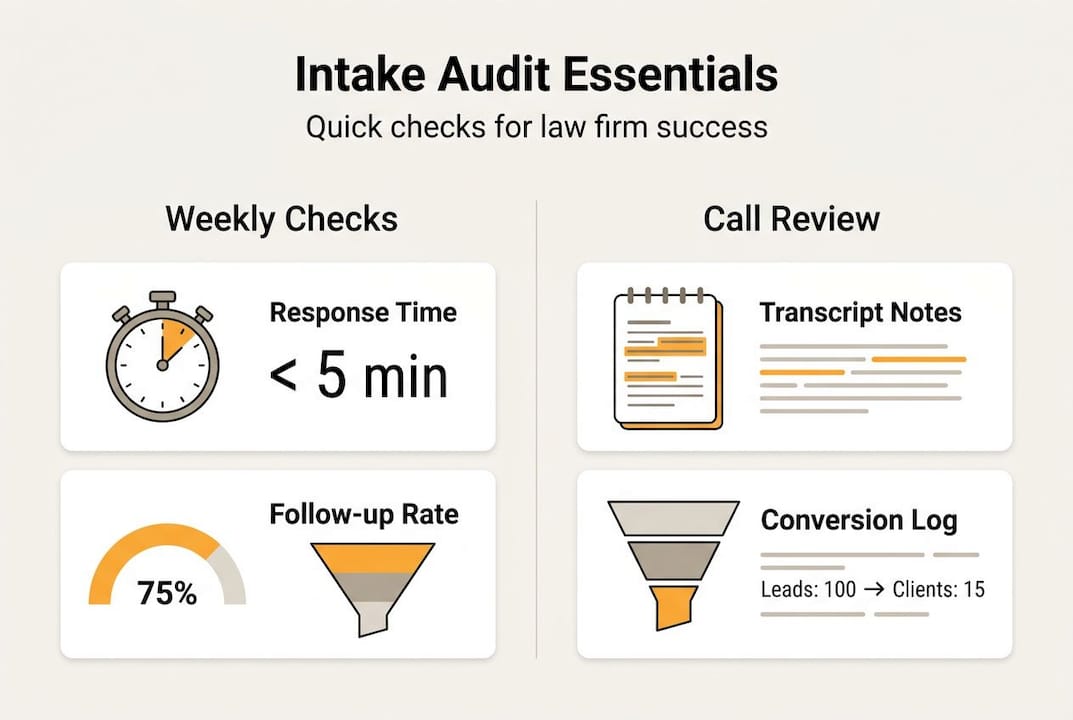
Track these four KPIs every week:
- First response time: Are calls and texts being answered within 5 minutes?
- Lead conversion rate: What percentage of inquiries become signed clients?
- Follow-up completion rate: Are all scheduled touchpoints actually happening?
- Client satisfaction score: Survey signed clients about their intake experience
Watch for these red flags that signal your system is slipping:
- Delayed first responses consistently exceeding 15 minutes
- Inconsistent tone across staff members or channels
- Leads marked “no contact” after only one or two attempts
- CRM entries with incomplete case details
| Audit item | Review frequency |
|---|---|
| Response time logs | Weekly |
| Follow-up completion rate | Weekly |
| Conversion rate by channel | Monthly |
| Script quality review | Monthly |
| Client satisfaction survey | Monthly |
Review intake call transcripts, not just outcomes. A signed client might have had a terrible intake experience and simply had nowhere else to go. Consistent, tech-enabled communication that drives retention is built through iterative improvement, not set-and-forget processes.
Understanding the value of an intake specialist becomes obvious once you start tracking these numbers. The ROI of a dedicated intake role or service is rarely abstract once you can see conversion gaps in real time.
The uncomfortable truth about law firm client communication
Here’s what we see over and over: firms investing heavily in attorney talent and aggressive marketing, but losing ground to smaller competitors with faster phones and warmer voices. That’s not a marketing problem. That’s a process problem.
Most attorneys believe their legal skill should close the deal. In a client-driven market, it usually doesn’t. Injured people are choosing between firms they found online within 30 minutes of an accident. They don’t have time to compare case outcomes. They respond to whoever made them feel heard first.
A single delayed or robotic first response can cost more revenue than a failed ad campaign. And unlike a bad ad, a cold intake experience also generates negative reviews and kills word-of-mouth referrals.
Firms that treat intake as their primary product, not a back-office function, consistently earn more referrals and better online reviews. We’ve seen this pattern repeatedly. The innovative client communication strategies that actually grow firms are deceptively simple: be fast, be kind, and follow up more than feels necessary.
The firms winning in personal injury right now aren’t always the most experienced. They’re the most responsive.
Take the next step: Automate, optimize, and win more cases
If you’re ready to put these strategies into action for your firm, here’s how to get started.
Putting all of this into practice is easier with the right support behind you. Attorney Assistant is built specifically for personal injury firms that want to stop losing signed cases to slow intake and missed follow-ups.
Our intake and reception services handle every inbound inquiry with empathy and speed, 24 hours a day. Our automated lead follow-up system ensures every touchpoint in your 7-step schedule happens without relying on staff memory. If you want to see exactly how this works for your firm, book a free consult and we’ll show you where leads are slipping through and how to stop it.
Frequently asked questions
What is the ideal response time for new client inquiries?
Respond within 5 minutes across all channels for the highest lead conversion rates. Even a 30-minute delay significantly reduces your chances of converting an inquiry into a signed client.
How many follow-ups should be done before closing a lead?
A minimum of 7 follow-ups over two weeks is recommended to maximize conversions. Most firms abandon leads after one or two attempts, which is where the majority of revenue leaks.
Which communication channels should law firms use for intake?
Use phone, SMS, and email together to match client preferences and ensure fast contact. Multi-channel outreach dramatically increases the likelihood of reaching a lead before a competitor does.
How does empathy-first communication impact client conversion?
Showing genuine empathy in the first contact builds trust and significantly increases the rate at which new inquiries become retained clients. Callers who feel heard are far less likely to shop around after that first conversation.
What is the most important intake metric to track?
First response time is the single metric with the greatest influence on overall conversion rates. Faster response increases conversion by up to 80%, making it the highest-priority number to monitor weekly.
Recommended
Related Articles

Benefits of Responsive Client Communication for Law Firms
Discover the benefits of responsive client communication for law firms. Boost trust, retention, and revenue with timely, quality interactions.

Macs for Lawyers: The Hardware and Compatibility Guide
A practical guide to Macs for lawyers covering hardware choices, software compatibility, security tradeoffs, and recommendations by firm size and workflow.
Business Telephone Answering Service for Law Firms
How a business telephone answering service works for law firms, including 24/7 intake, qualification, warm transfers, pricing models, and what