Conversion optimization for lawyers: Win more clients

TL;DR:
- Conversion optimization focuses on improving follow-up processes to turn inquiries into signed clients.
- Speed and consistency in response and follow-up significantly increase legal case conversion rates.
- Implementing automated systems and measuring key metrics enhances law firm intake success.
Most personal injury firms are convinced they need more leads. They spend thousands on Google Ads, SEO, and referral networks, then watch those same leads go cold before anyone follows up. The real problem isn’t traffic. It’s what happens after someone reaches out. Conversion optimization, which is the practice of turning more inquiries into signed cases, is one of the most underused growth levers in legal marketing. This article breaks down exactly what it means for law firms, where most intake processes break down, and what you can do right now to stop leaving cases on the table.
Table of Contents
- Understanding conversion optimization in the legal field
- Key elements of high-converting law firm intake
- Optimizing follow-up: Turning inquiries into clients
- Metrics and tools for conversion optimization success
- Our perspective: The reality of conversion optimization in law firms
- Take your law firm conversions to the next level
- Frequently asked questions
Key Takeaways
| Point | Details |
|---|---|
| Focus on intake process | Optimized client intake is the foundation for improved law firm conversion rates. |
| Automate follow-up steps | Using reminders and templates prevents lost leads and maximizes signed clients. |
| Track performance metrics | Monitoring response times and lead conversion data drives continuous improvement. |
| Personal touch remains vital | Human communication is still essential, even as automation tools support intake. |
Understanding conversion optimization in the legal field
Conversion optimization, at its core, means increasing the percentage of people who take a desired action. For e-commerce sites, that action might be adding a product to a cart. For personal injury law firms, the action is signing a retainer. But the path from inquiry to signed client is far more complex, emotional, and time-sensitive than buying a pair of shoes online.
Most firms treat conversion optimization as a website problem. They tweak button colors, rewrite headlines, and obsess over landing page load times. Those things can help, but they miss the bigger issue entirely. The majority of legal leads are lost not on the website but in the 24 to 72 hours after someone submits a contact form, calls the office, or sends an email. The gap between initial contact and a qualified response is where revenue disappears.
Law firm lead management is a discipline that recognizes this gap and builds systems around closing it. For personal injury practices specifically, the stakes are high. A potential client who just experienced a traumatic accident is emotionally primed to act. Delay the response, and they call the next firm on Google.
Here’s what a typical legal intake flow looks like in most firms:
- A prospect calls or fills out a web form
- A receptionist or intake staff logs the inquiry manually
- Someone follows up within a day or two (if at all)
- A screening call happens to assess case viability
- The prospect signs or doesn’t, often with no structured follow-up if they hesitate
Each step in that chain is a potential exit point. And without a deliberate system to move people from one stage to the next, attrition is constant.
“The firms that convert the most leads aren’t necessarily the ones with the best lawyers. They’re the ones with the most reliable, fastest, and most human intake processes.”
Conversion optimization improves lead conversion rates when firms stop treating intake as an administrative task and start treating it as a sales and service function. The mindset shift is significant. It means measuring response times, tracking qualification rates, and auditing follow-up consistency the same way you would audit your advertising spend.
The critical difference between generic conversion tactics and law firm-specific approaches is empathy. Injured people are not comparison shopping for office supplies. They’re scared, confused, and often dealing with insurance companies for the first time. A conversion-optimized intake process acknowledges that emotional reality and builds communication workflows that feel supportive rather than transactional.
Key elements of high-converting law firm intake
With the definition in place, let’s look at the intake stage, where conversion begins.
An effective intake process typically has four core stages: initial contact, case qualification, data collection, and follow-up scheduling. Most firms execute the first two adequately. It’s the third and fourth where performance collapses.
Here’s what a high-converting intake system includes:
- Immediate acknowledgment: An auto-response or live answer within minutes of initial contact
- Structured qualification scripts: Consistent questions to assess case viability without alienating the prospect
- Centralized data collection: A single system where all prospect information is logged and accessible
- Automated reminders: Triggered follow-up tasks so no lead sits idle
- Clear next steps communicated to the prospect: People who know what to expect are more likely to stay engaged
The comparison between manual and automated intake systems is stark. Manual systems rely on individual staff remembering to follow up, logging notes in different formats, and physically tracking where each lead stands. Automated systems assign tasks, send scheduled reminders, log all interactions, and flag stale leads before they go cold.
| Feature | Manual intake | Automated intake |
|---|---|---|
| Response time | Hours to days | Minutes |
| Follow-up consistency | Varies by staff | Standardized |
| Data accuracy | Prone to error | Logged automatically |
| Scalability | Limited by headcount | Scales with volume |
| Lead loss rate | High | Significantly reduced |
Efficient intake increases client conversion rates because it removes the friction that causes prospects to give up or go elsewhere. Every extra hour of delay, every phone tag loop, every unanswered question represents a case your firm won’t sign.

Clear communication is also a major driver of conversion. Prospects want to know: Will you take my case? What happens next? How long will this take? A well-designed intake process answers all three questions early and confidently. The client communication guide for law firms recommends setting response time expectations explicitly in your first contact, whether that’s a confirmation email or an intake call opener.
Pro Tip: Set up automated SMS reminders that go out within 5 minutes of a new inquiry. A simple message like “We received your request and will call you within the hour” dramatically reduces the chance of a prospect calling a competitor while waiting.
Optimizing follow-up: Turning inquiries into clients
After intake, follow-up determines whether potential clients actually sign up. Here’s how to optimize this crucial step.
The data on follow-up timing is unambiguous. Firms that respond within the first hour of an inquiry are exponentially more likely to convert that lead than firms that respond the next day. For personal injury cases, the window is even shorter because prospects are often under pressure to act, dealing with mounting medical bills or insurance deadlines.
Here are the key steps to convert an inquiry into a signed client:
- Respond immediately: Acknowledge the inquiry within minutes, not hours
- Assess the case quickly: Use a consistent qualification script to determine viability
- Qualify the prospect: Confirm liability, damages, and timeline in the initial call
- Schedule the next step: Never end a call without a firm next appointment or action item
- Send a follow-up summary: An email recapping what was discussed builds trust and keeps the prospect engaged
- Use a drip sequence: If the prospect hasn’t signed, trigger a follow-up sequence over several days
Automated follow-up processes reduce lead loss significantly. Without automation, follow-up depends on individual staff memory and motivation. With it, every prospect receives consistent communication regardless of how busy the office is.
Here’s a look at how response timing affects conversion rates:
| Response time | Estimated conversion rate |
|---|---|
| Within 5 minutes | Up to 80% higher conversion |
| Within 1 hour | 60% higher than same-day response |
| Same day | 30% higher than next-day response |
| Next day or later | Lowest conversion rate |
These numbers reflect a simple truth: personal injury prospects are often in a heightened emotional state, and the firm that responds first earns their trust first. Being second means competing against a firm that already started building a relationship.
For intake tips for better conversion, one of the most effective strategies is to use communication templates that feel personal but are standardized behind the scenes. A template for an initial follow-up email can be personalized with the prospect’s name and case type, but the structure, tone, and timing remain consistent across every lead. This is how firms scale without losing the human touch.
Pro Tip: Create a “stale lead” trigger in your CRM. If a lead hasn’t been contacted in 48 hours, generate an automatic alert to the intake manager. A five-minute check-in call to a cold lead can recover cases that would otherwise be permanently lost.
Metrics and tools for conversion optimization success
To sustain results, law firms must track their conversion performance and leverage the right tools.
You cannot improve what you don’t measure. Most personal injury firms know their advertising cost per lead. Very few know their cost per signed case or their intake-to-signature conversion rate. Those two numbers tell you far more about your firm’s actual performance than raw lead volume ever will.
The key metrics every firm should monitor include:
- Conversion rate: What percentage of inquiries become signed clients
- Qualified lead percentage: Of total inquiries, how many meet your case criteria
- Response time: How long it takes to make first contact after an inquiry
- Follow-up completion rate: What percentage of leads receive all planned follow-up touchpoints
- Case acquisition cost: Total marketing and intake cost divided by signed cases
Tracking these numbers weekly creates accountability. You’ll quickly see which staff members have the highest qualification rates, which lead sources produce the most signable cases, and where your biggest drop-off points are in the intake funnel.
The tools that support this kind of tracking include customer relationship management platforms, which are software systems that log every prospect interaction, intake automation software that triggers follow-up tasks, and dedicated lead follow-up platforms built specifically for legal practices.
The benefits of intake specialist support become clear when you see the data. Firms that invest in dedicated intake resources, whether internal staff or outsourced specialists, consistently outperform those where intake is handled by whoever picks up the phone.
Tracking metrics and using automation tools increases both efficiency and conversion rates because it shifts decision-making from gut instinct to evidence. When you know that 40% of your leads go cold after the first contact attempt, you can build a system to make a second and third attempt automatically.
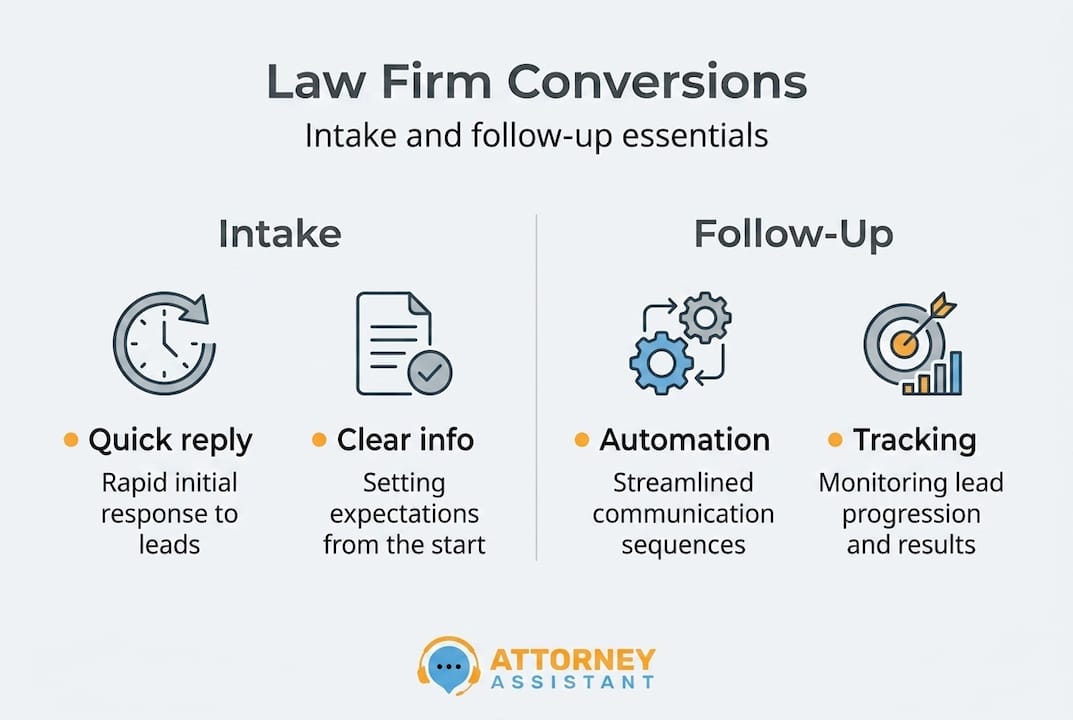
Stat callout: Law firms that optimize their intake processes convert up to 80% more leads than firms that rely on unstructured, manual processes. That’s not a marginal improvement. That’s the difference between a thriving practice and one that’s constantly scrambling for cases.
Continuous improvement is the goal. Every month, review your metrics, identify the stage in your intake funnel with the highest drop-off rate, and build one targeted fix. Over time, those incremental improvements compound into dramatically higher conversion rates without spending a single extra dollar on advertising.
Our perspective: The reality of conversion optimization in law firms
Having covered the nuts and bolts, here’s a candid perspective on what actually works in the legal industry.
Most law firms know they have an intake problem. They’ve seen leads go cold. They’ve had prospects say “I went with another firm” after weeks of silence. The issue isn’t awareness. It’s the assumption that fixing it means replacing staff with software.
That’s the wrong framing entirely. The firms that genuinely transform their conversion rates don’t swap people for bots. They build systems that make their people more effective. Automation handles the reminders and the data entry. Humans handle the empathy and the persuasion. The two work together, not against each other.
The deeper obstacle is cultural. Many firms fail to implement conversion best practices because adopting them requires admitting that the current process is broken, and that’s uncomfortable for any team that’s been doing things the same way for years. Data-driven optimization isn’t just a process upgrade. It’s a culture shift.
The firms we’ve seen transform their intake share one trait: a managing partner who treats conversion rate as a firm health metric, not an IT project. When leadership prioritizes it, the team follows. When it’s delegated and forgotten, nothing changes. Start there. Boosting intake effectiveness is ultimately a leadership decision before it’s a technology one.
Take your law firm conversions to the next level
Ready to apply these actionable strategies? Find the tools and support to drive your legal practice forward.
Attorney Assistant was built specifically for firms that are tired of watching leads disappear after the first contact. We handle the intake, follow-up, and administrative workflows that most firms leave to chance.
If you’re ready to stop losing cases you’ve already paid to attract, start by exploring our law firm tools designed for conversion tracking and intake management. For firms that want hands-on support, our lead follow-up support service ensures every inquiry gets a fast, consistent, and professional response. And if you want a complete intake overhaul, our intake services provide a structured, scalable system built around your practice’s case types and communication style.
Frequently asked questions
What is conversion optimization for lawyers?
Conversion optimization for lawyers is the process of improving intake workflows and follow-up systems so that a higher percentage of inquiries become paying clients. It focuses on speed, consistency, and communication quality rather than simply generating more leads, and firms that apply it convert significantly more leads than those that don’t.
How can law firms measure the success of conversion optimization?
Firms should track metrics like intake-to-signature conversion rate, average response time, follow-up completion rate, and cost per signed case on a weekly or monthly basis. Using the right automation and tracking tools makes this straightforward even for small teams without dedicated data analysts.
What are some common mistakes law firms make in intake and follow-up?
The most common mistakes are slow initial response times, inconsistent follow-up attempts, and relying on manual data entry that leads to lost information. These gaps are often the result of operational habits rather than bad intentions, but firms that address them see measurable gains in signed cases quickly.
Can automation replace human intake specialists?
Automation can handle reminders, data logging, and follow-up scheduling, but it cannot replace the judgment and empathy that human specialists bring to qualifying and converting emotional, stressed-out injury victims. The best outcomes come from combining both, where efficient intake processes use technology to support staff rather than replace them.
Recommended
- Optimize law firm intake and convert 80% more leads | Attorney Assistant
- 10 Lead Conversion Strategies Attorneys Need for Higher Revenue | Attorney Assistant
- Lead nurturing for lawyers: increase client conversion | Attorney Assistant
- How to enhance law firm response time for client conversion | Attorney Assistant
Related Articles

Medical Records Coordinator: What the Role Actually Does
A medical records coordinator manages records retrieval, summaries, billing, and liens for law firms. Learn duties, KPIs, and when to outsource vs hire.

Macs for Lawyers: The Hardware and Compatibility Guide
A practical guide to Macs for lawyers covering hardware choices, software compatibility, security tradeoffs, and recommendations by firm size and workflow.

Business Telephone Answering Service for Law Firms
How a business telephone answering service works for law firms, including 24/7 intake, qualification, warm transfers, pricing models, and what