Intake follow-up steps that boost law firm conversions

TL;DR:
- Most personal injury firms lose up to 30% of leads due to delayed and inconsistent follow-up. Implementing a structured process with the right tools and dedicated ownership increases client conversion rates. Continuous monitoring and staff accountability are essential for long-term success.
Every personal injury firm invests heavily in generating leads. But many practice owners watch promising prospects go cold while their staff juggles calls, paperwork, and competing priorities. The truth is brutally simple: if you are not following up fast, consistently, and with a clear process, you are handing cases to your competitors. Personal injury firms lose up to 30% of potential clients due to missed follow-ups. This guide walks through each stage of a reliable intake follow-up process so you can stop that leakage and start converting more of the leads you already have.
Table of Contents
- Understand why leads slip through the cracks
- Prepare your follow-up toolkit and workflow
- Execute the intake follow-up steps for every lead
- Monitor, measure, and optimize your process
- Why most intake follow-up fixes fail—and what actually works
- Take your intake follow-up to the next level
- Frequently asked questions
Key Takeaways
| Point | Details |
|---|---|
| Early follow-up matters | Responding to leads within 10 minutes can quadruple conversion rates. |
| Tools drive consistency | Use CRMs, scripts, and reminders to ensure no lead gets missed. |
| Monitor and optimize | Tracking key metrics helps you improve and retain more clients long term. |
| Define team roles | Assigning intake follow-up ownership is critical so leads don’t slip through the cracks. |
Understand why leads slip through the cracks
Most firms do not have a follow-up problem on paper. They have a follow-up problem in practice. Someone calls. It gets busy. A team member assumes another person followed up. Nobody did. That prospect signed with a competitor by 9 a.m. the next day.
The root causes of broken intake follow-up are predictable:
- Delayed first response: Calling back hours later instead of minutes
- No clear ownership: Staff assume someone else is handling it
- Poor lead tracking: Contacts noted on sticky notes or scattered spreadsheets
- Inconsistent scripts: Each staff member handles calls differently
- No escalation path: Unreturned calls simply go cold with no follow-up trigger
These are not technology failures. They are process failures, and they compound fast.
“The lead that gets contacted first wins the client. In personal injury, speed is not just a courtesy, it is a competitive advantage.”
The business impact is significant. Beyond the 30% of lost leads, each dropped intake represents not just a lost consultation but potentially tens of thousands of dollars in case value. Multiply that by 12 months and the financial cost of a broken intake system becomes impossible to ignore.
Clients shopping for a personal injury attorney are often in distress. They want someone responsive, organized, and clearly on their side from the very first call. Poor intake communication strategies do not just lose cases. They signal to potential clients that your firm may not be organized enough to fight for them.
Firms that have studied this problem find a consistent pattern: the issue is almost never a shortage of leads. It is a shortage of structure around those leads. Addressing that structure is how you boost PI case conversions without spending another dollar on marketing.
With the problem clear, let’s look at what you will need for a seamless follow-up process.
Prepare your follow-up toolkit and workflow
A reliable intake follow-up process does not run on good intentions. It runs on the right tools and clearly documented roles. Before anyone picks up a phone, your firm needs a foundation that makes consistency automatic rather than optional.
Here are the essentials every practice needs in place:
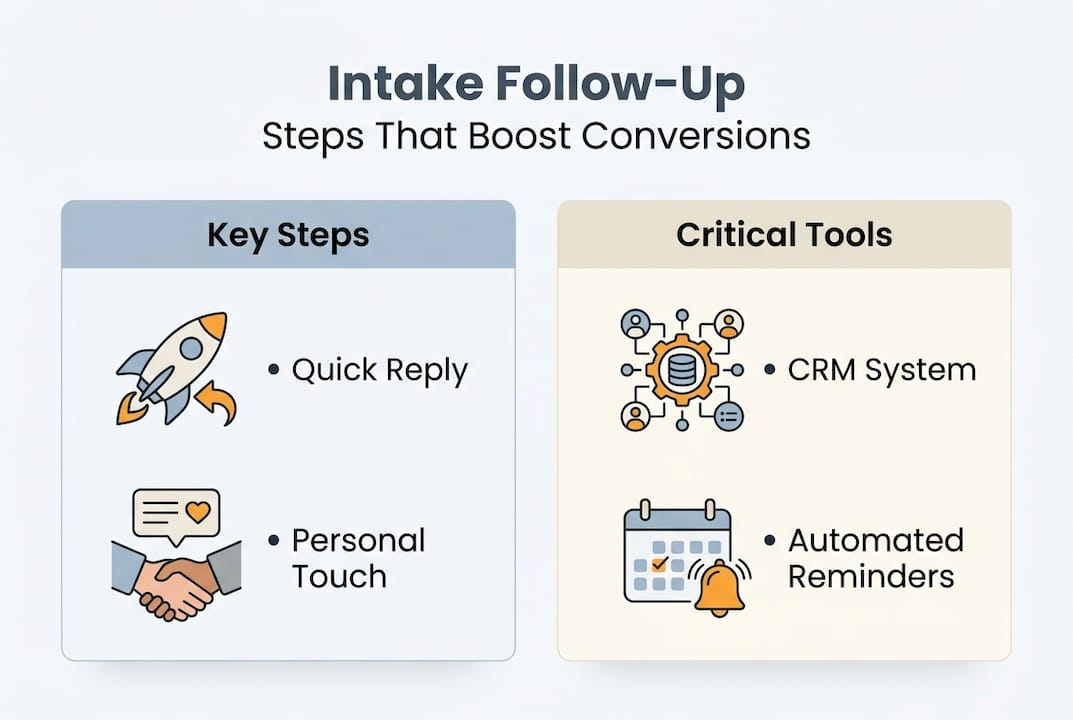
- CRM software: Tracks every lead, follow-up attempt, and outcome in one place
- Call scripts: Standardized language that guides staff through every type of intake call
- Email and text templates: Pre-written messages for each stage of follow-up
- Task reminders and alerts: Automated notifications so no lead sits idle
- Intake log: A written or digital record of every interaction with a prospect
Workflow software and scripted templates drive consistent follow-ups across your entire team, regardless of who happens to be on duty.
Here is how each tool maps to staff roles and firm outcomes:
| Tool | Staff Role | Primary Benefit |
|---|---|---|
| CRM software | Intake coordinator | Centralized lead tracking |
| Call scripts | All intake staff | Consistent client experience |
| Email/text templates | Admin support | Faster, uniform outreach |
| Task reminders | Team leads | Eliminates forgotten follow-ups |
| Intake log | All staff | Accountability and audit trail |
Documentation is not optional. Every interaction with a prospective client should be logged: date, time, method of contact, outcome, and next scheduled action. This creates accountability and gives you data to improve the process over time.

Assigning intake specialist roles formally rather than treating intake as a shared side task is one of the highest-leverage moves a firm can make. When one person owns the process, gaps close.
Pro Tip: Use automated reminders to ensure no lead waits more than 15 minutes for an initial response. Even a brief acknowledgment message keeps the prospect engaged while you prepare for a fuller follow-up call.
Once your toolkit is ready, it is time to implement the proven follow-up steps.
Execute the intake follow-up steps for every lead
Knowing what to do matters. Doing it in the right order matters more. A clear sequence removes decision fatigue from your staff and ensures every lead gets the same quality attention regardless of how busy the day gets.
Here is the step-by-step follow-up sequence every intake should follow:
- Immediate first contact: Call, email, or text within 5 to 10 minutes of receiving the lead
- Leave a voicemail if no answer: State your name, firm, and a clear reason to call back
- Send a follow-up email or text within 30 minutes: Provide a simple next step for the prospect
- Second call attempt within 2 to 4 hours: Try a different contact method if the first failed
- Day two follow-up: If still no response, reach out again via a different channel
- Day three to five escalation: Flag the lead for a senior intake contact or supervisor review
- Document the final outcome: Note whether the lead converted, went cold, or was referred elsewhere
The urgency of step one cannot be overstated. Responding within 5 to 10 minutes increases conversion rates by 400% compared to slower responses. That single data point should reshape how your team prioritizes the first minutes after a lead arrives.
Personalization also matters. A follow-up that references the prospect’s specific situation, “I understand you were in an accident on Route 9 last Tuesday,” feels attentive. Generic follow-ups feel like a conveyor belt. Prospects notice the difference and respond accordingly.
Strong improving intake communication habits also include confirming receipt of information and telling the client exactly what happens next. Uncertainty causes drop-off. Clarity builds trust.
Pro Tip: At the end of every intake call, confirm that the prospect received all materials and clearly state the next scheduled touchpoint. Something as simple as “You will hear from us by Thursday at noon” reduces no-shows and ghosting dramatically.
You can refine and scale these case conversion strategies over time once you have baseline data in place, which is exactly what the next section covers.
Even well-designed steps require careful monitoring to ensure they are followed consistently and can be improved.
Monitor, measure, and optimize your process
A follow-up process without measurement is just a checklist people forget to use. The firms that consistently outperform their competitors track specific numbers, review them regularly, and make adjustments based on what the data actually shows.
Start by monitoring these key metrics every month:
- Average follow-up time: How many minutes from lead arrival to first contact
- Conversion rate by channel: Which outreach method closes the most clients
- Missed lead rate: Percentage of leads that received no follow-up at all
- Attempt-to-contact ratio: How many attempts it takes to reach a prospect
- Drop-off stage: Where in the sequence leads are most likely to go cold
Here is how manual tracking compares to automated systems across the metrics that matter most:
| Metric | Manual tracking | Automated tracking |
|---|---|---|
| Follow-up time accuracy | Low, relies on memory | High, timestamped automatically |
| Missed lead visibility | Often invisible | Flagged in real time |
| Staff accountability | Hard to verify | Logged and auditable |
| Monthly reporting | Time-consuming | Generated automatically |
| Process improvement speed | Slow and reactive | Fast and data-driven |
Firms that track follow-up KPIs achieve 25% higher client retention compared to those operating without structured metrics. That is a meaningful advantage in a competitive personal injury market.
Schedule a brief team review every month to go over your numbers. Identify the stage where the most drop-off occurs and focus your next improvement cycle there. Effective intake process improvement is iterative, not a one-time fix.
Audit your workflow at least twice a year. Scripts go stale. Staff turnover changes how processes are executed. Market conditions shift client expectations. A quarterly check-in keeps your effective intake optimization process current and competitive.
By applying these steps, practice owners can take control of intake follow-up. Now here is an essential perspective you might not have heard.
Why most intake follow-up fixes fail—and what actually works
Here is the uncomfortable reality: most firms that try to fix their intake follow-up process fail not because the process is wrong, but because nobody actually owns it long enough for it to stick.
A new script gets written. A CRM gets purchased. There is a team meeting with genuine excitement. Then the day gets busy, old habits return, and six months later nothing has changed. This is the cycle we see repeatedly.
The problem is adoption, not design. Process changes fail when they are treated as administrative projects rather than cultural shifts. Staff need to understand why the follow-up matters to them personally, not just to the firm’s revenue. Incentivizing speed and conversion at the individual level changes behavior in ways that memos never will.
Top-performing firms do one thing differently: they make intake follow-up a defined, dedicated role. Not an extra task assigned to whoever is available. They invest in specialist-driven follow-up because specialists develop instincts, accountability, and expertise that generalists never can. When intake is someone’s primary job, it gets done right, every time.
Take your intake follow-up to the next level
You have built the framework. You know the steps, the tools, and the metrics. The next question is execution at scale without burning out your team.
Attorney Assistant is built specifically for this challenge. Our lead follow-up service ensures every inbound lead gets a rapid, professional response. Our lead recovery solutions re-engage prospects that slipped through before you had a process in place. And our intake reception support gives your firm a dedicated, trained presence that converts more callers into signed clients. Book a discovery call today and see exactly how much revenue your current process may be leaving on the table.
Frequently asked questions
How quickly should law firms follow up with new leads?
The best practice is to follow up within 5 to 10 minutes of receiving a lead. Responding within that window increases conversion rates by 400% compared to slower outreach.
What tools help law firms manage intake follow-up efficiently?
CRM software, call scripts, and automated reminders form the core toolkit for organized follow-up. Workflow software and scripted templates are proven to drive consistency across your entire intake team.
How can law firms measure if their follow-up process works?
Track follow-up response time, lead conversion rate, and missed lead percentage every month. Firms tracking follow-up KPIs consistently report 25% higher client retention than those without structured measurement.
What is the biggest mistake firms make with intake follow-up?
Failing to assign clear responsibility is the most common failure point, causing leads to fall between team members with no one accountable. Dedicated intake specialist roles solve this problem directly by creating defined ownership for every lead.
Recommended
Related Articles

Macs for Lawyers: The Hardware and Compatibility Guide
A practical guide to Macs for lawyers covering hardware choices, software compatibility, security tradeoffs, and recommendations by firm size and workflow.

Business Telephone Answering Service for Law Firms
How a business telephone answering service works for law firms, including 24/7 intake, qualification, warm transfers, pricing models, and what

Call Flow Customer Service for Law Firms: A Practical Guide
Design a call flow customer service system for your law firm that captures leads, qualifies matters, and signs cases. Practical guide