Legal client experience: How to boost intake and retention

TL;DR:
- Legal client experience (LCX) involves every interaction from the first call to case resolution, shaping client loyalty and referrals. Efficient intake and follow-up systems, blending automation with human empathy, are essential for converting leads and increasing profitability. Prioritizing timely responses and personal connection boosts retention, enhances reputation, and drives long-term firm growth.
Most personal injury attorneys assume client experience is just about being polite on the phone. It isn’t. Legal client experience (LCX) is a strategic system of touchpoints, from the first call to case resolution, that directly shapes whether leads sign with your firm, whether clients stay loyal, and whether they refer others. Firms that treat LCX as a side task lose cases not because their legal work is poor, but because their intake and follow-up processes push potential clients straight to competitors.
Table of Contents
- Defining legal client experience: More than customer service
- The intake experience: Your firm’s first impression
- Technology vs. human touch: Finding the right balance
- Optimizing the follow-up: From lead to loyal client
- Perspective: Why your firm’s intake and follow-up are the real engines of client experience
- Upgrade your client experience with dedicated support
- Frequently asked questions
Key Takeaways
| Point | Details |
|---|---|
| Legal client experience defined | It’s a holistic process covering every client interaction, not just courtesy. |
| First impressions matter | Effective, empathetic intake dramatically raises conversion and loyalty. |
| Balance tech and empathy | Combine automation for speed with human attention for connection and trust. |
| Optimize follow-up | Consistent, proactive engagement after intake turns leads into advocates. |
| Profitability impact | Even small improvements in experience can drive major long-term revenue gains. |
Defining legal client experience: More than customer service
Legal client experience is not customer service with a law degree. It is every single interaction a potential or current client has with your firm, the first inquiry email, the intake call, the status updates, the final resolution conversation, and everything in between. A client-centric legal approach recognizes this full lifecycle and designs each touchpoint to build trust, reduce anxiety, and move the relationship forward.
For personal injury clients specifically, the emotional stakes are high. Someone who just experienced a car accident or workplace injury is scared, confused, and sometimes in pain. They need a law firm that communicates clearly, responds quickly, and treats them like a person, not a case number.
What LCX actually includes:
- First contact responsiveness (how fast and how warmly your firm answers inquiries)
- Intake quality (whether clients feel heard during the information-gathering process)
- Ongoing communication (regular updates that keep clients informed without overwhelming them)
- Empathy at every stage (emotional attunement, especially during stressful legal events)
- Case resolution communication (how closure is communicated and how clients feel when they leave)
Every one of these elements affects not just satisfaction, but revenue. Client intake communication strategies are increasingly recognized as a direct driver of conversion rates, not just courtesy metrics.
Pro Tip: A 5% boost in retention can increase your firm’s profitability by anywhere from 25% to 95%. That is not a marginal gain. That is a business-transforming shift, and it starts with the client experience your firm delivers every single day.
Word of mouth also plays a massive role here. A client who felt genuinely cared for during a stressful personal injury case does not just stay loyal. They become an advocate. They talk to neighbors, family members, and coworkers. In a local market where personal injury firms compete heavily for attention, a reputation built on exceptional LCX is one of the most powerful competitive advantages you can develop.
The intake experience: Your firm’s first impression
Intake is where LCX either launches successfully or collapses before it starts. This is the moment a potential client decides, consciously or not, whether your firm feels trustworthy. It is your firm’s first impression, and in the legal world, first impressions are almost always final impressions.
Here is what a strong intake process looks like step by step:
- Respond within minutes, not hours. Speed signals respect. A lead who calls your firm and waits six hours for a callback has probably already signed with someone else.
- Lead with empathy, not process. Before you ask for facts, acknowledge the situation. “I’m sorry you’re going through this” is not just polite; it builds immediate trust.
- Use active listening. Let clients speak without interruption. Reflect back what they say. Personal injury clients often need to feel heard before they are ready to share case details.
- Gather information efficiently. Use structured intake forms and scripts that are thorough without feeling robotic. Every question should serve a purpose the client can understand.
- Set expectations clearly. Tell clients what happens next, when they’ll hear from you, and what the timeline looks like. Uncertainty creates anxiety. Clarity creates confidence.
- Follow up immediately after the call. A short email or text confirming next steps reinforces your responsiveness and keeps your firm top of mind.
The role of technology in intake has grown significantly. AI-powered intake benefits include 24/7 availability, instant response to after-hours inquiries, and consistent data collection. Research shows AI can drive 90% cost savings and near-perfect answer rates for routine intake questions, which is a meaningful operational gain for busy firms.
But automation has real limits. A chatbot cannot hear the tremor in a client’s voice when they describe a serious injury. It cannot recognize when someone needs emotional reassurance before they can answer factual questions. That is where relationship-based legal services make all the difference. The firms that win long-term are the ones that pair automation’s speed with human empathy.
“Tech gets you scale, real connection gets you loyalty.”
Improving intake response time is one of the highest-leverage changes a personal injury firm can make. Studies consistently show that leads contacted within five minutes of their inquiry are far more likely to convert than those contacted even 30 minutes later. That gap is enormous, and it is preventable with the right systems in place.

Technology vs. human touch: Finding the right balance
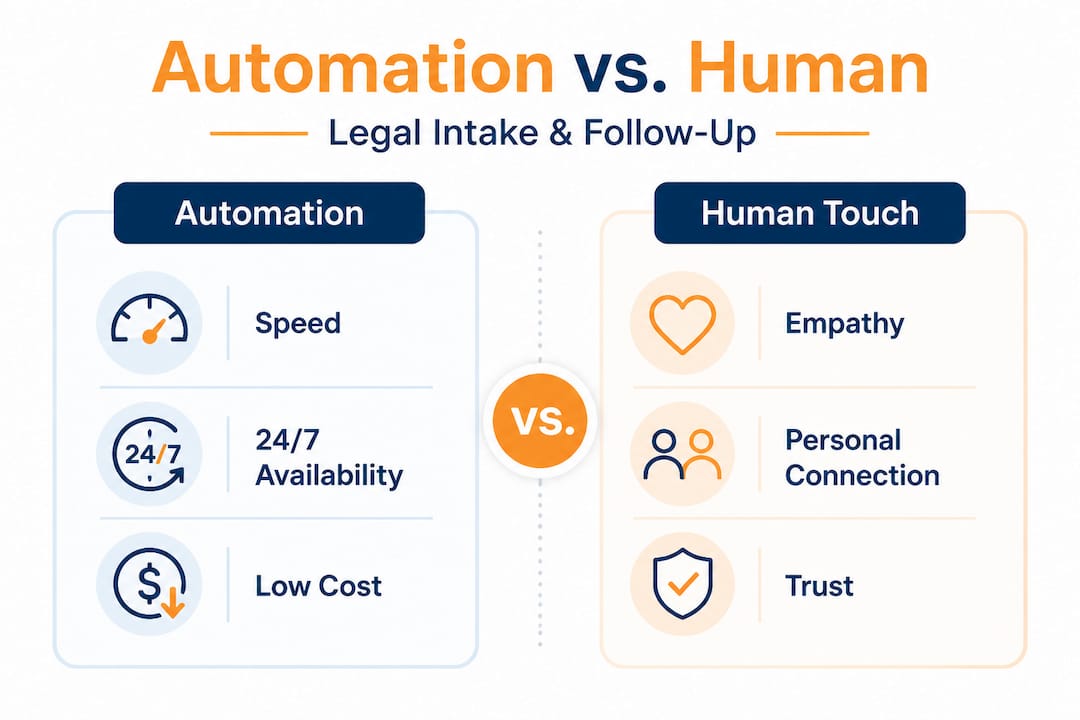
Speed and empathy are not opposites. The best firms understand that automation and human attention each have a place, and the key is knowing where each belongs. Research confirms that while tech optimists advocate AI for scale, human interaction remains essential for building the kind of loyalty that drives long-term firm growth.
Here is a direct comparison of what each approach delivers:
| Dimension | Automation | Human touch |
|---|---|---|
| Speed | Instant, 24/7 | Limited by availability |
| Cost | Low per interaction | Higher per interaction |
| Empathy | None | High |
| Accuracy (routine tasks) | Very high | Variable |
| Complex problem-solving | Poor | Excellent |
| Retention impact | Moderate | High |
| Trust-building | Low | Very high |
The ideal model is a hybrid. Consider AI in law firms as the infrastructure layer, handling the mechanical side of intake, reminder messages, appointment confirmations, and document requests, while your attorneys and intake staff handle emotional conversations, complex questions, and relationship-building moments.
Use technology when:
- Answering after-hours inquiries with an automated acknowledgment
- Sending appointment reminders and intake form links
- Routing leads to the correct department based on case type
- Collecting basic contact and case information before a live call
- Following up with unsigned leads via scheduled automated emails
Bring in human attention when:
- A client describes a traumatic event or is clearly distressed
- Questions involve nuanced legal strategy or sensitive details
- A client expresses doubt about whether to proceed
- You’re at a critical moment like a retainer signing or settlement discussion
- A client hasn’t responded to automated outreach and needs a personal call
The modern technology for client satisfaction discussion has evolved beyond “should we use AI?” to “how do we deploy it strategically?” Firms that answer that question well gain both efficiency and a better client experience. Those that automate everything without human checkpoints lose the connection that keeps clients loyal.
Personal injury law is an especially human practice area. Clients are dealing with physical pain, financial stress, and often uncertainty about their futures. Tailored legal solutions that account for this emotional context are not a luxury. They are a competitive necessity.
Optimizing the follow-up: From lead to loyal client
Most firms spend significant resources on getting leads. Far fewer invest equally in keeping them. Follow-up is where leads either become loyal, paying clients or quietly disappear to a competitor that responded faster or followed up more thoughtfully.
Hybrid approaches that combine AI and human input for follow-up deliver the best conversion and retention results. The key is building a systematic process that never lets a lead fall through the cracks, while still delivering moments of genuine personal connection.
Here is how touchpoint frequency, conversion rates, and retention impact relate:
| Follow-up touchpoint | Recommended timing | Conversion impact | Retention impact |
|---|---|---|---|
| Initial response | Within 5 minutes | Very high | High |
| Second outreach (if no response) | Within 24 hours | High | Moderate |
| Case status update | Every 1 to 2 weeks | Moderate | Very high |
| Milestone check-in | At each major case event | Moderate | Very high |
| Post-case follow-up | 30 days after closure | Low (direct) | High (referrals) |
Each row in this table represents a decision point. Miss the initial response window and your conversion rate drops sharply. Skip the milestone check-ins and clients start to feel forgotten, even when their case is progressing perfectly well. Add a post-case follow-up and you dramatically increase the likelihood of a referral.
Converting more leads is not just about faster response times. It is about consistency. Clients who receive a check-in call before a key deposition feel valued. Clients who get a settlement update email before they have to ask for it trust your firm more. These are small actions with outsized effects on loyalty.
Pro Tip: Build milestone check-ins into your case management system as required tasks, not optional ones. Assign them to specific team members with deadlines. A call that happens every time, without fail, is infinitely more powerful than a call that happens when someone remembers to make it.
Advocacy for client value in the legal context means representing not just the case, but the client’s full experience. A personal injury client whose firm follows up consistently, communicates clearly, and checks in at meaningful moments doesn’t just feel like a client. They feel like a priority. That distinction is worth more than any billboard.
Perspective: Why your firm’s intake and follow-up are the real engines of client experience
Here is the uncomfortable truth most legal marketing advice ignores: your firm’s biggest revenue leak is not a lack of leads. It is the leads you already have that are slipping away because intake is slow, follow-up is inconsistent, and nobody owns the client experience after the first call.
Most personal injury firms overinvest in advertising and underinvest in the systems that convert those advertising dollars into signed cases. They spend thousands per month on paid search and then fail to call back an inquiry for three hours. That is not a marketing problem. That is an operations problem.
The data backs this up clearly. A 5% retention boost delivers up to 95% more profit, and retention is built in the first few interactions. The intake call. The follow-up text. The case update email nobody sent. These are not administrative tasks. They are revenue-generating actions, and they deserve the same strategic attention you give to your courtroom preparation.
“Empathy and timely response are your most effective conversion tools.”
We have seen firms transform their conversion rates not by generating more leads, but by installing a consistent intake and follow-up process that treats every inquiry as a high-value opportunity. The law firm client satisfaction improvements that follow are not just about happier clients. They directly translate to more signed cases, higher revenue per client, and a stronger referral pipeline.
Attorneys are trained to think about client service in terms of case outcomes. That matters enormously. But in personal injury, clients often cannot evaluate the quality of your legal work until the case ends. What they can evaluate immediately is how fast you called them back, how clearly you explained the process, and whether they felt like a priority. Win on those dimensions and you win the relationship long before you win the case.
Upgrade your client experience with dedicated support
Many personal injury firms know they need better intake and follow-up systems but simply lack the bandwidth to build and manage them internally.
Attorney Assistant is built for exactly this situation. We handle intake optimization solutions and lead follow-up expertise so your attorneys can stay focused on advocacy instead of chasing leads or managing intake chaos. Our processes are designed to respond faster, convert more inquiries into signed cases, and deliver the consistent touchpoints that turn one-time clients into loyal advocates. If your firm is ready to stop leaking revenue from the leads it already has, we can help you build the system that captures every opportunity.
Frequently asked questions
How does legal client experience affect my firm’s profitability?
Improving client retention by just 5% can boost firm profitability by 25% to 95%, making LCX one of the highest-return investments a firm can make.
Can automation replace the human aspect of legal client intake?
Automation handles routine questions efficiently and at scale, but personal interaction remains essential for building the trust and emotional connection that drives long-term retention.
What’s a quick way to improve intake conversion at my firm?
Respond to new client inquiries within five minutes of receipt and follow up every inquiry with a personal confirmation that sets clear expectations for next steps.
Why is follow-up just as important as initial intake?
Consistent, timely follow-up signals to clients that they are a priority, which increases conversion from lead to signed client and dramatically improves the likelihood of referrals after the case closes.
Recommended
Related Articles

Appointment Setting Online: A Law Firm Guide
Master appointment setting online for law firms with proven strategies that turn leads into booked consultations and grow your practice.

Medical Records Request: A Practical Guide for Law Firms
Run a clean medical records request with HIPAA-compliant steps, sample language, timelines, fees, and follow-up tactics built for law firm operations.

Request for Discovery Template: A Practical Guide
Use our request for discovery template with annotated fields, jurisdictional notes, and filing instructions. Customize it for federal or state court cases.