What Is Digital Intake for Law Firms in 2026

TL;DR:
- Digital intake is a comprehensive online system that captures client data, consent, and case details before or during appointments, enabling faster response and higher conversion. It automates data flow into case management software, enhances compliance, and improves operational efficiency and client experience. Proper implementation involves workflow mapping, staff training, and seamless system integration to prevent bottlenecks and maximize benefits.
Most attorneys assume digital intake is just a paperless convenience upgrade. It is not. What is digital intake, at its core, is a system that captures client information, consent, and case details through structured online tools before or during the intake appointment. For law firms, the difference between a digital intake process and a paper one is not just efficiency. It is the difference between converting a lead and losing one to a competitor who responded faster.
Table of Contents
- Key takeaways
- What digital intake actually means for law firms
- How digital intake changes your firm’s operations
- Traditional intake vs. digital intake: a side-by-side look
- How to implement digital intake in your practice
- Key benefits of digital intake for law firms
- My honest take on why firms underestimate this
- How Attorneyassistant helps firms fix intake gaps
- FAQ
Key takeaways
| Point | Details |
|---|---|
| Digital intake is more than forms | It combines online questionnaires, e-signatures, and case management integration to create a complete intake workflow. |
| Speed directly affects conversion | Firms that capture and respond to client information faster sign more cases from the same lead volume. |
| Integration determines real ROI | Digital intake forms connected to case management software eliminate manual entry and prevent data loss. |
| Compliance is non-negotiable | Legal intake data requires encryption, audit trails, and vendor agreements to meet privacy and security obligations. |
| Implementation takes less than a week | Most practices can go live with basic digital intake setups in under seven days with proper training and fallback plans. |
What digital intake actually means for law firms
Digital intake replaces paper forms with online, structured questionnaires and e-signable documents that clients complete before or during their first appointment. For legal practices, this typically includes contact details, matter type, conflict checks, signed engagement letters, and initial case facts. The client never touches a pen. Your staff never transcribes handwriting.
This is different from simply emailing a PDF. True digital intake systems are built around structured data capture. Each field routes information directly into your case management or practice management software. That distinction matters because a fillable PDF that lands in someone’s inbox creates the same manual work on the back end. A real digital intake process eliminates that entirely.
Here is what a complete digital intake system typically includes:
- Online intake forms with conditional logic, meaning clients only see questions relevant to their matter type
- E-signature capability for retainer agreements and engagement letters signed before they walk in
- Secure data storage with access controls and audit trails built for legal compliance
- Automated delivery via SMS or email links sent 24 to 72 hours before appointments
- Multiple access points including portals, QR codes, and in-office tablets for clients who need assistance
Digital client onboarding that incorporates forms, e-signatures, and scheduling through one connected system increases speed and client experience quality simultaneously. It is not a single tool. It is a workflow.
Pro Tip: Do not confuse digital intake with digital marketing. The two work together, but they serve different functions. Intake is the operational system that captures and converts interest into a signed client.
How digital intake changes your firm’s operations
The operational impact of digital intake goes well beyond cutting paper costs. The real gains show up in three areas: staff time, data accuracy, and client conversion speed.
Reducing administrative load
Digital intake significantly reduces the administrative effort during client check-in by capturing all data before the appointment. Your staff is not printing packets, chasing down signatures, or manually entering information into your case management system. That time gets redirected toward calls, follow-up, and actual legal work.

For a busy personal injury or family law firm handling dozens of new inquiries per week, the cumulative time savings are significant. A front desk coordinator spending 20 minutes per new client on paper intake is losing over six hours per week on a workflow that digital intake eliminates.
Speed-to-lead and client engagement
Here is where the revenue impact becomes direct. Clients can complete forms at their own pace, reducing waiting room delays and improving engagement. More importantly, a firm that sends a digital intake link within minutes of a first inquiry signals responsiveness. That signal matters to clients choosing between attorneys.
Slow intake creates drop-off. A prospective client who fills out a web form at 9 PM and receives a digital intake packet at 9:02 PM is far more likely to complete it than one who waits for a Monday morning phone call.
Compliance and data security
Legal data carries serious obligations. Compliance requires security controls such as encryption, audit trails, and vendor agreements. Non-compliant intake processes expose your firm to fines and reputational damage. Digital intake platforms built for regulated industries include these controls by default. Paper forms stored in a filing cabinet do not.
Digital intake platforms integrated with case management software also reduce manual transcription errors, which is its own compliance risk. Incorrect case facts entered during transcription have downstream consequences. Digital intake captures the information once and routes it correctly.
Traditional intake vs. digital intake: a side-by-side look
Understanding the difference in workflow makes the operational gains concrete. Here is how the same client onboarding scenario plays out under each model:
| Step | Traditional intake | Digital intake |
|---|---|---|
| Initial inquiry | Phone call, manual notes | Web form auto-triggers intake link via SMS/email |
| Form delivery | Mailed or handed at office | Sent digitally 24 to 72 hours before appointment |
| Form completion | Client fills out paper forms in waiting room | Client completes forms at home on any device |
| Data entry | Staff manually types into case management system | Data flows directly into case management software |
| Signatures | Physical signature at appointment | E-signature captured before client arrives |
| Reminder and follow-up | Manual phone call from staff | Automated reminder with intake link resent if incomplete |
| Data security | Physical file, limited access controls | Encrypted, audit-trailed, access-controlled digital record |
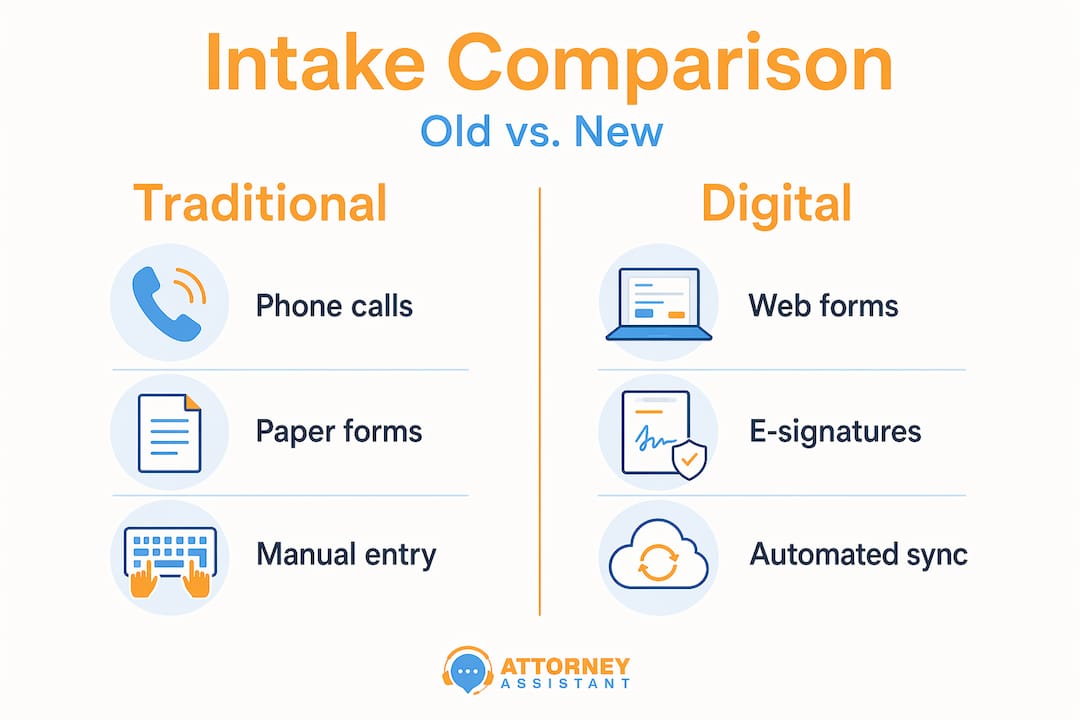
The bottlenecks in the traditional model compound each other. A client who forgets to bring their paper forms, or who arrives late because they had to fill them out in the waiting room, delays the attorney and disrupts the schedule. Digital intake eliminates most of those day-of disruptions before they start.
One important note: the comparison above assumes a well-functioning digital intake workflow. Poorly implemented digital intake, meaning systems that are not integrated with case management or that lack exception handling, can create new bottlenecks. That is why implementation matters as much as the technology itself.
How to implement digital intake in your practice
Getting digital intake operational does not require months of work. Most practices can implement basic digital intake setups in a week or less with the right preparation and training. Here is a practical sequence:
-
Map your current intake touchpoints. List every step in your existing intake process: initial call, paper forms, consent documents, retainer signing, conflict checks. You cannot digitize a workflow you have not documented. Audit current intake touchpoints including calls, paper forms, and consent processes before building your digital version.
-
Define your requirements. Identify which practice areas need different form logic. A family law intake looks different from a personal injury or estate planning intake. Your platform needs to support conditional logic so clients only answer questions relevant to their matter.
-
Select a compliant, integrated platform. Choose digital intake solutions that connect directly to your case management software. Platforms that support conditional logic questions adapted to client responses prevent irrelevant questions and keep data clean. Confirm vendor security agreements and encryption standards before signing.
-
Redesign your workflow around the digital process. Do not simply layer digital forms on top of your old paper process. Rebuild the sequence. Set up automated delivery triggers, reminder logic, and escalation paths for incomplete forms.
-
Train staff on exception workflows. This step is where most implementations fail. Training staff on exception workflows is critical to the success of digital intake. Not every client will complete forms digitally. Elderly clients, clients without smartphones, or no-shows need a fallback. In-office tablets, staff-assisted completion, and paper backups cover those gaps.
-
Test before going live. Run a pilot week with a subset of new inquiries. Identify friction points in the form logic, delivery timing, and staff handoff before rolling out firm-wide.
Pro Tip: Keep your intake form shorter than you think it needs to be. Collect only the information required to open the matter and prepare for the first appointment. You can gather additional details during the consultation. Long forms increase abandonment rates.
Key benefits of digital intake for law firms
When digital intake is implemented correctly and connected to your broader operations, the benefits are measurable:
- Faster lead response. Automated intake delivery means prospective clients receive their forms within minutes of first contact, not the next business day.
- Higher conversion rates. Firms that capture intake information quickly and completely before the first appointment improve client onboarding quality and reduce the drop-off that happens between inquiry and signed retainer.
- Fewer manual errors. Data captured once in a structured format and routed directly into your case management system eliminates transcription mistakes that create downstream problems.
- Professional client experience. A digital intake process signals that your firm is organized and respects the client’s time. That perception starts at the very first touchpoint.
- Reduced compliance exposure. Security and vendor governance are foundational. Encrypted digital records with audit trails are far more defensible than a filing cabinet of paper forms.
- Operational consistency. Every new client goes through the same structured process regardless of which staff member handles the inquiry. Consistency reduces the missed steps that lead to incomplete files.
My honest take on why firms underestimate this
I have worked with enough law firms to know that most practice owners treat intake as an administrative function rather than a revenue function. That is the core mistake.
When I see a firm spending thousands of dollars per month on pay-per-click advertising and losing 30% of those leads because intake is slow or inconsistent, the math is painful. You do not need more leads. You need to stop leaking the ones you already have.
The firms that get the most from digital intake are not the ones that bought the fanciest software. They are the ones that treated implementation seriously. They mapped their workflows, trained their staff, and built real exception handling for clients who cannot or will not complete forms digitally. The technology is secondary to the process design.
I also see firms go live with digital intake and declare victory after week one. Then the exceptions pile up, the staff reverts to old habits for edge cases, and the system slowly degrades. Ongoing oversight matters. Someone in your firm needs to own the intake process the way a partner owns a practice area.
The final thing I will say: integration is not optional. A digital intake form that does not connect to your case management system is just a prettier version of paper. The legal intake forms that actually drive conversion are the ones where data flows cleanly from first contact to open file without anyone touching a keyboard to move it.
— Nicole
How Attorneyassistant helps firms fix intake gaps
Digital intake is one piece of a larger operational picture. Attorneyassistant works with law firms that are losing revenue not from a lack of leads, but from gaps in how those leads are handled after first contact. Slow follow-up, missed calls, and incomplete intake workflows cost firms signed cases every week.
Attorneyassistant’s 24/7 intake services handle client capture and follow-up around the clock, so no inquiry goes cold because it came in after hours. The lead follow-up service targets the gap between first contact and signed retainer, which is where most revenue leaks occur. If you want to see where your firm currently stands, the free diagnostic tools at Attorneyassistant give you a clear picture of your intake gaps before you spend anything. Book a call to talk through what your firm needs.
FAQ
What is digital intake in a law firm context?
Digital intake is the process of collecting client information, case details, and signed agreements through online forms and e-signature tools before or during the first client appointment. It replaces paper-based intake and connects directly to case management software.
How long does it take to implement digital intake?
Most practices can implement a basic digital intake setup in a week or less with proper training and fallback plans for clients who cannot complete forms digitally.
What are digital intake systems and how do they differ from PDFs?
Digital intake systems are platforms that capture structured data, route it to case management software, and support conditional logic and e-signatures. Fillable PDFs require manual processing after submission and do not integrate with your case management system.
What are the main benefits of digital intake for law firms?
The main benefits include faster lead response, higher conversion rates, reduced manual data entry, improved compliance through encrypted records, and a more consistent client onboarding experience.
How do digital intake forms improve client conversion?
Digital intake forms sent immediately after first contact reduce the time between inquiry and completed intake, which keeps prospective clients engaged and reduces the drop-off that happens when follow-up is slow.
Recommended
Related Articles

Business Telephone Answering Service for Law Firms
How a business telephone answering service works for law firms, including 24/7 intake, qualification, warm transfers, pricing models, and what

Call Flow Customer Service for Law Firms: A Practical Guide
Design a call flow customer service system for your law firm that captures leads, qualifies matters, and signs cases. Practical guide

Fear of Talking on Phone: 7 Practical Confidence Tips
Overcome fear of talking on phone with practical scripts, role-play, exposure exercises, and intake tools built for legal teams.