Client retention for law firms: Boost loyalty and profits

TL;DR:
- Improving client retention significantly boosts profitability and referral rates for personal injury firms.
- Most firms focus more on client acquisition, neglecting cost-effective retention strategies.
- Implementing systematic follow-up and relationship-building post-settlement can retain clients and increase revenue.
Most personal injury law firms chase new leads while quietly hemorrhaging revenue from clients they already won. Increasing retention by just 5% can boost profits anywhere from 25% to 95%, yet most small and mid-sized PI practices spend the bulk of their marketing budget on acquisition. That math doesn’t add up. Client retention isn’t a soft, feel-good metric. It’s a direct driver of profitability, referrals, and long-term firm growth. This article breaks down what retention actually means for PI law firms, how to measure it, why you’re likely losing clients you could keep, and what a practical retention playbook looks like in 2026.
Table of Contents
- Understanding client retention in law firms
- Profitability impact: Why retention beats acquisition
- Challenges: Why law firms lose clients and how to prevent it
- Retention strategies for PI law firms: Practical playbook
- Most retention advice misses the mark: What PI firms must do differently
- Enhance your firm’s retention with Attorney Assistant
- Frequently asked questions
Key Takeaways
| Point | Details |
|---|---|
| Retention drives profits | Even modest retention gains can dramatically increase a firm’s profitability and client lifetime value. |
| Benchmark and track results | Law firms should regularly measure client retention rates and compare them against industry benchmarks for actionable insights. |
| PI firms face unique challenges | Client loyalty is harder in personal injury practices, but can be improved with targeted post-settlement strategies. |
| Proactive engagement wins | Year-round touchpoints and personalized outreach create lasting relationships and maximize referral potential. |
| Technology boosts retention | Integrating intake, CRM, and automated follow-up tools streamlines retention and reduces client loss. |
Understanding client retention in law firms
Client retention sounds simple, but it’s often misunderstood in the legal space. For law firms, it means the percentage of clients who return to your firm for additional legal needs over a given period. It’s not just about satisfaction scores or five-star Google reviews. It’s about whether a past client calls you first when a family member gets hurt in an accident, or whether they search for someone new.
The standard formula is straightforward: ((Clients at End of Period – New Clients Acquired) / Clients at Start of Period) × 100. Retention is measured year-over-year, stripping out new clients so you’re only counting the ones who came back. That distinction matters because confusing growth with retention is a common mistake that masks real churn.
Here’s how law firm retention benchmarks compare across professional services:
| Segment | Average retention rate |
|---|---|
| Professional services overall | 84% |
| Law firms (100+ attorneys) | 85.2% |
| Top-performing law firms | 92% |
| Median (professional services) | 73% |
These industry benchmarks tell a revealing story. Most law firms cluster around 85%, but top performers pull away at 92%. For small and mid-sized PI firms, even nudging your rate from 75% to 80% can translate into meaningful revenue gains without spending a dollar on ads.
Why does this matter specifically for PI practices? A few reasons:
- Referral volume is tied to retention. Clients who feel remembered and valued refer friends and family at much higher rates.
- Repeat cases do happen. Accidents, workplace injuries, and slip-and-falls affect the same families more than once.
- Word-of-mouth is your cheapest marketing channel. A retained client who refers two others costs you nothing in acquisition.
Strong lead management for law firms starts before the case even opens, and the intake specialist role is often where the retention relationship is first built or broken. If the first interaction is slow, cold, or disorganized, you’ve already started losing the client before the case begins.
Profitability impact: Why retention beats acquisition
Let’s talk numbers, because this is where most PI firm owners finally pay attention.
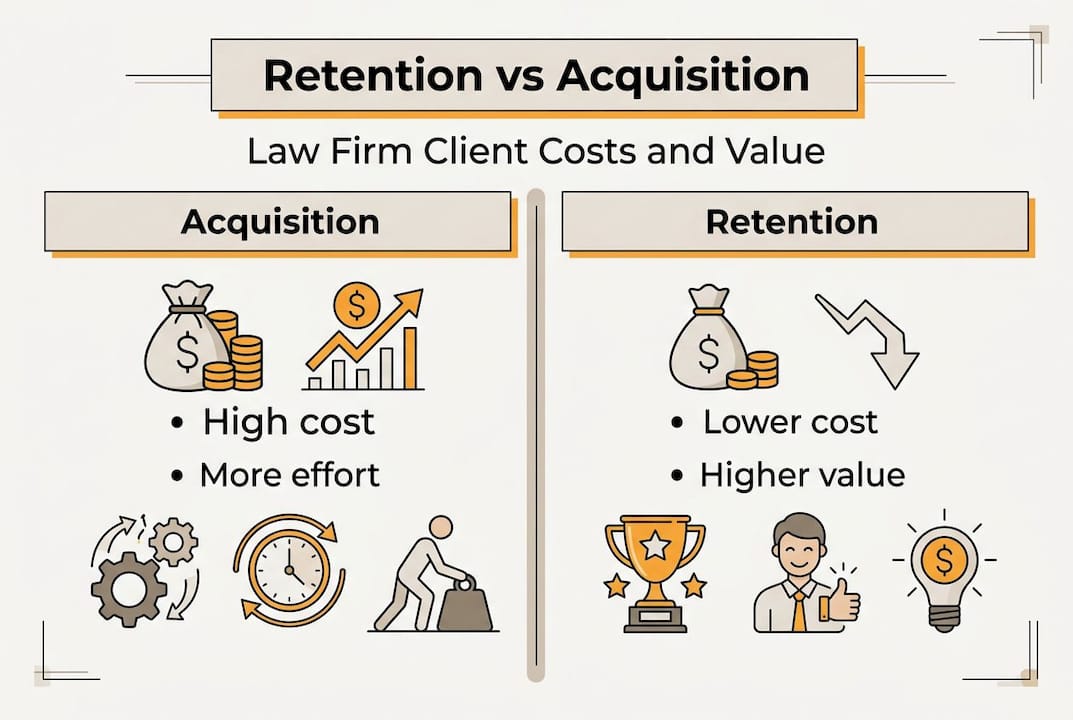
Acquiring new clients costs 6 to 12 times more than keeping existing ones, and retained clients in PI practices carry up to five times higher lifetime value. That’s not a marginal difference. That’s a structural advantage you’re either building or ignoring.
Here’s a side-by-side comparison that puts it in concrete terms:
| Factor | Acquisition | Retention |
|---|---|---|
| Cost per client | High (ads, referral fees, intake labor) | Low (communication, touchpoints) |
| Conversion effort | High (cold prospect) | Low (established trust) |
| Lifetime value | Baseline | Up to 5x higher |
| Referral likelihood | Low | High |
| Profit impact (5% improvement) | Minimal | 25% to 95% profit boost |
The financial case is overwhelming. Yet most small PI firms allocate 80% or more of their marketing budget to acquisition channels like Google Ads and lead generation services, while spending almost nothing on post-settlement communication or client nurturing.
Here’s a practical way to think about it. If your firm signs 100 new clients per year at an average case value of $8,000, and you improve retention so that 10 more past clients refer one case each, you’ve added $80,000 in revenue at near-zero acquisition cost. Improving response times is one of the fastest ways to signal to a client that they matter, which directly feeds retention.
Retention also opens the door to cross-selling clients across practice areas. A client you helped after a car accident may later need help with a workplace injury or a family member’s slip-and-fall. If you’ve stayed in touch, you’re the obvious call.
Here’s how to prioritize your retention investment:
- Identify your top 20% of clients by case value and referral history.
- Build a dedicated communication sequence for that segment post-settlement.
- Track referrals by source to measure which retained clients generate the most downstream revenue.
- Reinvest a portion of referral revenue into retention touchpoints.
Pro Tip: Not all clients are worth the same retention effort. Segment your client list by lifetime value and referral potential, then concentrate your highest-touch outreach on the top tier. A one-size-fits-all approach wastes resources and dilutes impact.
Challenges: Why law firms lose clients and how to prevent it
Here’s the uncomfortable reality: most PI clients don’t leave because they’re unhappy. They leave because you stopped showing up after the check cleared.

Law firms lose most clients after 2 to 5 years despite high satisfaction scores. The transactional nature of personal injury work makes this worse. Unlike corporate clients who return with ongoing legal needs, PI clients often resolve their matter and move on. If you don’t create a reason to stay connected, they simply forget you exist.
Employee turnover compounds the problem significantly. When the paralegal or intake coordinator who built a rapport with a client leaves, that relationship often leaves with them. Employee turnover directly impacts client continuity, and in small firms where one person handles most client communication, the disruption can be severe.
Common reasons PI clients don’t return or refer:
- No post-settlement follow-up. The case closes and communication stops entirely.
- Inconsistent updates during the case. Clients who felt ignored during the process won’t recommend you.
- Staff changes. A new face with no context makes clients feel like a number.
- No reminder of your services. Clients simply don’t think of you when a new need arises.
Prevention starts with systems, not intentions. Optimizing client intake sets the tone for the entire relationship. A smooth, responsive intake experience signals competence and care from day one. Following intake best practices means every client gets consistent communication regardless of which staff member is on duty.
Post-settlement touchpoints are non-negotiable. A simple check-in call 30 days after resolution, a holiday card, or an anniversary message on the date their case settled costs almost nothing. But it keeps your firm top of mind when a referral opportunity arises.
Pro Tip: Create a “case closed” workflow that automatically triggers a 30-day follow-up call, a 90-day check-in email, and a 12-month anniversary message. Most clients are genuinely surprised when their lawyer reaches out after the case ends. That surprise is your competitive advantage.
Retention strategies for PI law firms: Practical playbook
Knowing why you lose clients is step one. Building the systems to keep them is where firms actually win.
One of the most effective frameworks for PI retention is the Guard-Grow-Get model. Guard-Grow-Get prioritizes protecting existing clients first, then expanding their relationship with your firm, then pursuing new clients. Most firms do this in reverse, which is why they stay stuck on the acquisition treadmill.
Here’s how to apply it in a PI context:
- Guard: Set experience standards for every client touchpoint. Response time, update frequency, and post-settlement communication should be documented and followed consistently.
- Grow: Look for opportunities to expand the client relationship. Did a client’s spouse also sustain injuries? Is there a workers’ comp angle to explore? Are there family members who could benefit from a legal consultation?
- Get: Only after your existing clients are well-served should you focus energy on new acquisition campaigns.
For PI firms specifically, year-round nurture post-settlement is the highest-leverage retention activity. A client who settled 18 months ago and received three thoughtful touchpoints since then is far more likely to refer a family member than one who heard nothing after the case closed.
Practical retention tools worth implementing:
- A CRM that tracks case close dates and triggers follow-up sequences automatically.
- Templated but personalized outreach emails for 30, 90, and 365-day post-settlement milestones.
- A referral request script built into the post-settlement call.
- Quarterly newsletter or legal update emails to keep your firm visible.
Connecting these tools to a strong intake process strategy ensures that the retention loop closes properly. Every new client who comes in through a referral should experience the same high-quality intake that made the referring client trust you in the first place.
Most retention advice misses the mark: What PI firms must do differently
Most articles on client retention recommend satisfaction surveys and loyalty programs. That advice was designed for retail, not personal injury law. Sending a client a survey after their accident case settles isn’t relationship-building. It’s data collection dressed up as care.
The PI clients who refer the most business aren’t the ones who filled out a five-star survey. They’re the ones who felt remembered after the case ended. Loyalty in this space is built through anticipation, not reaction. Proactive outreach beats reactive surveys every single time.
High-performing PI firms we’ve observed don’t wait for clients to have a new legal need. They create touchpoints that keep the relationship warm year-round, even when there’s nothing to sell. A quick call to check how a client is recovering six months post-settlement costs five minutes. The referral it generates can be worth thousands.
Standard retention advice also ignores the role of intake communication in building long-term loyalty. The client’s experience in the first 48 hours sets the emotional tone for everything that follows. Firms that get intake right create clients who are predisposed to refer. Firms that fumble it spend years trying to recover trust they never fully built.
Enhance your firm’s retention with Attorney Assistant
Retention isn’t a marketing problem. It’s an operational one. Most PI firms lose clients not because they did bad work, but because their follow-up systems are inconsistent or nonexistent.
Attorney Assistant is built to close that gap. Our law firm intake solutions ensure every new client gets a fast, professional first response, setting the foundation for a retention-ready relationship from day one. Our lead follow-up services keep your firm engaged with prospects and past clients so no opportunity slips through the cracks. If your firm is ready to stop leaking revenue from clients you’ve already earned, let’s talk about building the systems that make retention automatic.
Frequently asked questions
How do personal injury law firms calculate their client retention rates?
Client retention is calculated as ((Clients at End – New Clients) / Clients at Start) × 100, measured year-over-year to focus only on clients who return rather than new ones acquired during the period.
What is considered a ‘good’ client retention rate for law firms?
A rate around 85% is typical for law firms, with top performers reaching 92%; PI firms should target 80% or higher as a realistic benchmark given the transactional nature of their cases.
Why do clients leave personal injury law firms even if they are satisfied?
Most PI clients disengage after their case resolves because firms lose clients post-settlement due to lack of follow-up, staff turnover, and no ongoing communication, regardless of how satisfied they were during the case.
How can PI law firms improve client retention after settlement?
Post-settlement follow-up sequences, personalized check-ins, and family referral outreach are the most effective tools; the Guard-Grow-Get framework gives PI firms a structured approach to protecting and expanding existing client relationships before chasing new ones.
Recommended
- Boost client intake: top communication strategies for law firms | Attorney Assistant
- Law firm engagement: convert more leads in 2026 | Attorney Assistant
- Cross-selling in law firms: boost revenue with smarter engagement | Attorney Assistant
- Optimize law firm intake and convert 80% more leads | Attorney Assistant
Related Articles

Client Follow-Up Strategy for Law Firms: 2026 Guide
Learn what is client follow-up strategy for law firms in 2026. Improve conversions and retention with effective communication techniques. Discover more!

Why Client Retention Is Important for Law Firm Growth
Discover why client retention is important for law firm growth. Learn how it boosts profits, lowers costs, and enhances stability today!
Macs for Lawyers: The Hardware and Compatibility Guide
A practical guide to Macs for lawyers covering hardware choices, software compatibility, security tradeoffs, and recommendations by firm size and workflow.