Automate Legal Intake: Boost Efficiency & Conversions

TL;DR:
- Automating legal intake increases lead response speed and improves conversion rates.
- It reduces administrative workload while enabling staff to build client relationships.
- Implementation involves mapping processes, selecting integrated tools, and involving staff early.
Many personal injury law firms hesitate to automate intake because they worry it will feel cold or robotic to potential clients. That fear is understandable, but it gets the logic backwards. The firms leaking the most revenue are not the ones with too few leads. They are the ones responding too slowly, following up inconsistently, and losing qualified prospects to competitors who pick up the phone faster. Automated legal intake does not strip out the human element. It protects it by clearing the low-value tasks off your team’s plate so they can focus where it matters most.
Table of Contents
- Understanding legal intake automation
- Top challenges automated intake solves for law firms
- Major benefits of automating legal intake
- How to successfully implement intake automation
- A perspective on automation: What most law firms overlook
- Discover automated intake solutions for your firm
- Frequently asked questions
Key Takeaways
| Point | Details |
|---|---|
| Faster lead conversion | Automating intake means you can respond to potential clients instantly for higher conversion rates. |
| Reduced admin workload | Automation takes care of repetitive tasks so your team focuses on valuable client interactions. |
| Improved client experience | Consistent, timely, and accurate intake gives clients a great first impression of your firm. |
| Error and lead loss prevention | Automated workflows greatly cut down on lost leads and intake mistakes common with manual processes. |
Understanding legal intake automation
Legal intake automation refers to using software and systems to capture, screen, qualify, and follow up with potential clients without requiring constant manual effort from your staff. Instead of a receptionist manually answering every inquiry and entering data into a spreadsheet, the process runs on its own, guided by rules and workflows your firm sets up once.
For small to mid-sized personal injury law firms, this typically means connecting several tools into one coordinated system. The core components include:
- Web forms that collect case details the moment a prospect visits your site
- Chatbots that answer questions and screen leads around the clock
- Document automation that generates retainers and intake forms without staff involvement
- CRM integration that routes leads, triggers follow-ups, and tracks every interaction in one place
This is a significant departure from traditional manual intake, where staff field calls one at a time, type information into disconnected systems, and rely on memory or sticky notes to follow up. Manual processes are slow, error-prone, and impossible to scale without hiring more people.
Here is a direct comparison between the two approaches:
| Factor | Manual intake | Automated intake |
|---|---|---|
| Response time | Hours or days | Seconds to minutes |
| Availability | Business hours only | 24/7 |
| Data accuracy | Human error risk | Consistent, structured |
| Staff workload | High, repetitive | Reduced, focused |
| Lead tracking | Fragmented | Centralized and searchable |
| Scalability | Limited by headcount | Grows with demand |
The efficiency and client experience gains from automation are well-documented, and intake specialist benefits become even greater when automation handles the repetitive tasks and your specialists handle qualified conversations.
For PI firms specifically, speed is often the deciding factor. Injured clients search for representation immediately after an accident. If your firm does not respond within minutes, another firm will. Understanding intake best practices is the foundation for building a system that never lets a qualified lead slip through.
Top challenges automated intake solves for law firms
Growing law firms face a predictable set of problems during intake. None of them are unique. All of them are solvable.
The most damaging issue is slow response time. A potential client calls, no one picks up, they leave a voicemail, and by the time someone calls back, the lead has already signed with a competitor. This is not a staffing problem. It is a systems problem. Automation addresses it directly by triggering an immediate text or email the moment a form is submitted or a call goes unanswered.
Here are the most common intake challenges automation resolves:
- Missed after-hours inquiries that never get returned in time
- Incomplete intake forms that delay case evaluation
- Manual data entry errors that create billing or case management problems
- Inconsistent follow-up where some leads get three calls and others get none
- Staff burnout from repetitive administrative tasks
Automation reduces lead leakage and missed opportunities by creating a structured path every lead follows, regardless of when they reach out or how busy your staff is at that moment.
“The firms that convert the most leads are not necessarily the ones with the best lawyers. They are the ones with the fastest, most consistent follow-up systems.”
Pro Tip: Map out every step a lead takes from first contact to signed retainer. Every gap or delay in that map is a place where automation can eliminate friction and reduce drop-off.
Automation also catches data errors before they become case problems. Structured forms with required fields and validation rules force leads to provide complete information, which means your attorneys start every case evaluation with accurate, usable data. Reviewing an effective intake process gives you a clearer picture of where those gaps most often appear.

Major benefits of automating legal intake
Once firms get past the setup phase, the results speak clearly. The benefits are not theoretical. They show up in signed cases, reduced overhead, and staff who are actually doing work that matters.
The most cited result is conversion. PI case conversions rise by up to 40% with proper intake automation in place. That number is not a minor efficiency gain. For a firm signing 20 cases a month, a 40% lift means 8 additional cases, all from leads you were already receiving.
Here is a summary of the measurable benefits firms typically report:
| Benefit | What it means for your firm |
|---|---|
| Up to 40% higher conversion rate | More signed cases from the same lead volume |
| 24/7 lead capture | No inquiries lost to after-hours or weekends |
| Faster follow-up speed | First contact in seconds, not hours |
| Lower admin cost | Staff reallocated to billable or high-value work |
| Better data quality | Accurate information from day one of every case |
The top benefits in order of impact for most PI firms are:
- Higher conversion rates from faster, more consistent response
- Reduced overhead by eliminating manual data entry and follow-up calls
- Improved first impressions through professional, instant communication
- Better case data that supports stronger evaluations and fewer surprises
- Scalability without proportional increases in headcount
Pro Tip: Track your current lead-to-signed-case conversion rate before implementing automation. That baseline number makes it easy to demonstrate the ROI of your new system within the first 60 days.
Beyond conversion, firms also report that staff morale improves. When your team is not fielding repetitive calls or chasing incomplete forms, they spend more time on meaningful work. Exploring legal intake tips helps firms identify which benefits to prioritize based on their current bottlenecks.
How to successfully implement intake automation
Knowing the benefits is one thing. Getting your firm from manual chaos to a working automated system is another. The good news is that a clear process makes implementation manageable, even for firms with no dedicated technology staff.
Follow these steps in order:
-
Audit your current intake process. Document every step from first contact to signed retainer. Note who is responsible for each step, how long it takes, and where leads tend to drop off. You cannot automate what you have not mapped.
-
Identify your biggest bottlenecks. Is it after-hours response? Slow follow-up? Incomplete forms? Focus your first automation investments on the pain points costing you the most signed cases.
-
Choose the right tools. Look for platforms that integrate with your existing case management software. Prioritize tools built for law firms, not generic CRM solutions. Reviewing top intake technology tips gives you a practical shortlist of what to evaluate.
-
Get staff buy-in before you launch. The firms that struggle with automation are usually the ones that surprise their teams with new tools. Involve staff in the selection process, explain how automation reduces their busiest frustrations, and train everyone before go-live.
-
Set measurable goals and track them. Define what success looks like before you start. Response time, conversion rate, lead volume, and admin hours saved are all useful metrics. Review them monthly and adjust your workflows based on what the data shows.
The intake automation overview at Attorney Assistant provides a practical framework for firms at different stages of readiness, whether you are building from scratch or upgrading an existing system.
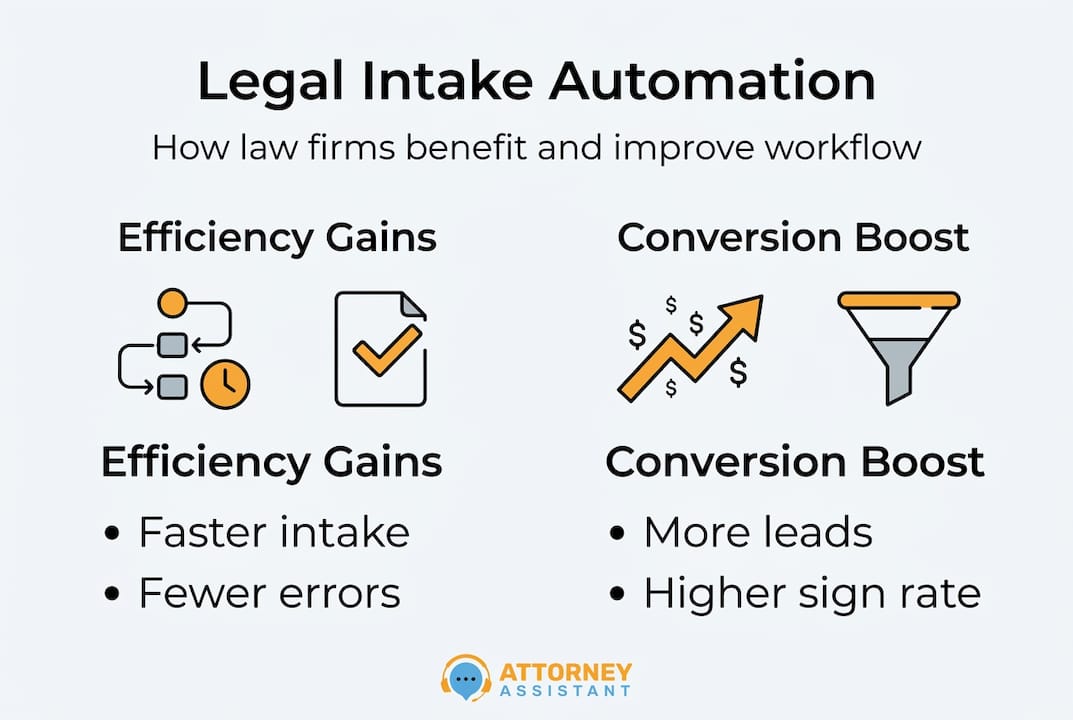
Implementation does not need to be an overnight overhaul. Most firms see better results when they automate one or two high-impact steps first, measure the results, and expand from there.
A perspective on automation: What most law firms overlook
Most conversations about intake automation center on efficiency and cost savings. Those benefits are real. But they miss the deeper opportunity.
The firms that gain the most from automation are not using it to cut staff. They are using it to redirect staff. When your team is no longer logging calls, chasing forms, and entering data manually, they are free to do something no software can replicate: build real relationships with qualified clients who need representation now.
Automation changes the nature of your team’s work. Instead of processing leads, they are advising clients. That shift matters more than any efficiency metric.
There is also a competitive angle most firms ignore. Automation is not yet standard across personal injury law. The firms that build consistent, fast, professional intake systems now are establishing a legal intake trend advantage that gets harder to close the longer competitors wait. Speed wins cases before the first consultation. The firms that respond in 90 seconds will always outconvert the firms that respond in 90 minutes, regardless of how skilled their attorneys are.
Discover automated intake solutions for your firm
At Attorney Assistant, we built our entire platform around one problem: law firms losing signed cases to leads they already had. Slow responses, missed follow-ups, and manual intake processes cost firms more than they realize until the numbers are in front of them.
Our intake and reception solutions handle first contact and qualification automatically, so no lead goes unanswered. Our lead follow-up service keeps every prospect engaged until they are ready to sign. If you want to see how it all works before committing, join our virtual webinar and walk through a live demo with our team. Your next signed case might already be waiting in your inbox.
Frequently asked questions
What is legal intake automation?
Legal intake automation uses software to collect, qualify, and follow up with leads, streamlining the process for both the law firm and potential clients. It replaces manual, error-prone steps with consistent, rules-based intake automation workflows that run around the clock.
How does automating intake improve law firm conversions?
Automation ensures instant responses, accurate data capture, and consistent follow-up, which greatly increase the chances of converting leads into clients. Firms using structured automation have seen conversion rates rise by as much as 40%.
Does automation mean a less personal client experience?
No. Automation frees staff to focus on high-touch interactions with qualified leads, which actually improves the overall client experience. The client experience improves when your team has more time for meaningful conversations instead of administrative tasks.
How soon can a law firm see results from automating intake?
Most firms see measurable improvements in efficiency and conversions within weeks of implementation. Rapid improvements follow when firms focus their first automation efforts on the highest-impact bottlenecks in their current intake process.
Recommended
Related Articles

Call Answering Service for Law Firms: What Actually Works
A call answering service for law firms should sign cases, not take messages. Learn pricing models, vendor criteria, and 24/7 intake that converts.

Case Management Notes: A Law Firm's How-To Guide
Learn how to write case management notes that hold up, with a defensible structure, privilege safeguards, handoff tips, and a smarter way to staff the work.

Medical Records Coordinator: What the Role Actually Does
A medical records coordinator manages records retrieval, summaries, billing, and liens for law firms. Learn duties, KPIs, and when to outsource vs hire.